Key Takeaways
- Forex is the deepest liquidity pool available to any trader: $9.5 trillion changes hands daily, up 27% on 2022 (BIS, 2025).
- There is no exchange. Price is made over the counter, 24 hours a day, five days a week, which is why quotes differ slightly between brokers and why the London-New York overlap carries the tightest spreads of the day.
- Every position is two currencies at once, measured in pips and sized in lots. Pip value multiplied by lot size fixes the monetary risk of a trade before it is opened.
- Leverage scales losses as fast as gains: capped at 1:30 in the UK and EU, up to 1:500 elsewhere, and the main reason 74-89% of retail CFD accounts lose money (ESMA, 2018; FCA, 2019).
- Margin level, not account balance, decides survival: a stop-out closes positions automatically once equity divided by used margin falls to the broker’s threshold (50% for retail accounts in the EU and UK).
- The controllable edge is process, not prediction: a regulated broker verified on its own regulator’s public register, a stop-loss on every trade, 1-2% of balance at risk per position, and a demo account before live capital.
What is Forex Trading
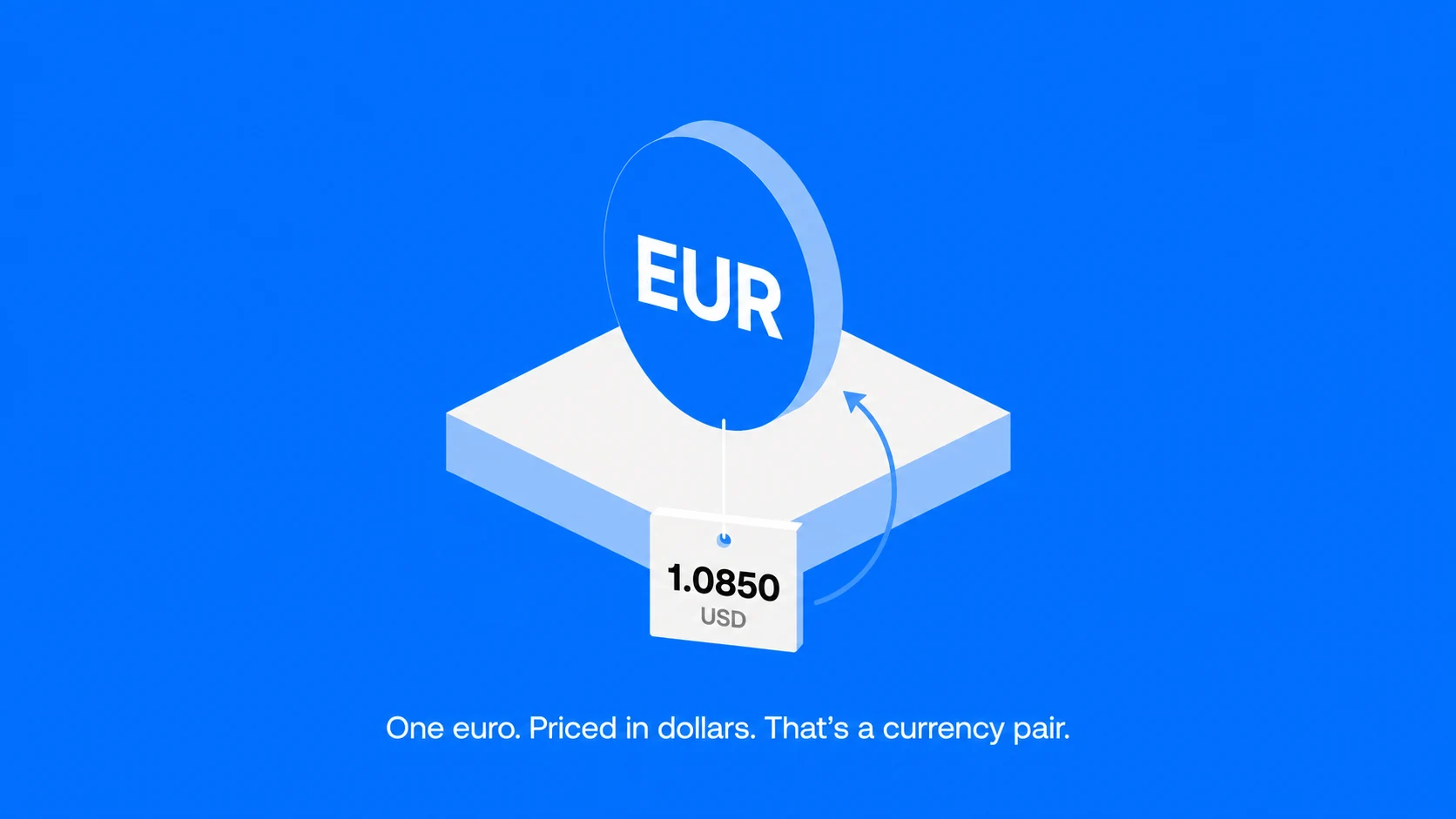
Forex trading is the exchange of one currency for another at an agreed price, executed to profit from exchange-rate movement or to hedge currency exposure. Every forex transaction involves a currency pair: the trader buys the base currency and sells the quote currency in a single action. A trader who buys EUR/USD at 1.0850 profits if the euro strengthens against the US dollar and loses if the euro weakens.
Forex trading serves two distinct purposes. Corporations, banks, and governments trade currencies to settle international trade and hedge currency risk. Speculative traders, institutional and retail, trade currencies purely to capture price movement, and speculation accounts for the majority of daily turnover per the BIS Triennial Survey, 2025.
How Does Forex Trading Work?
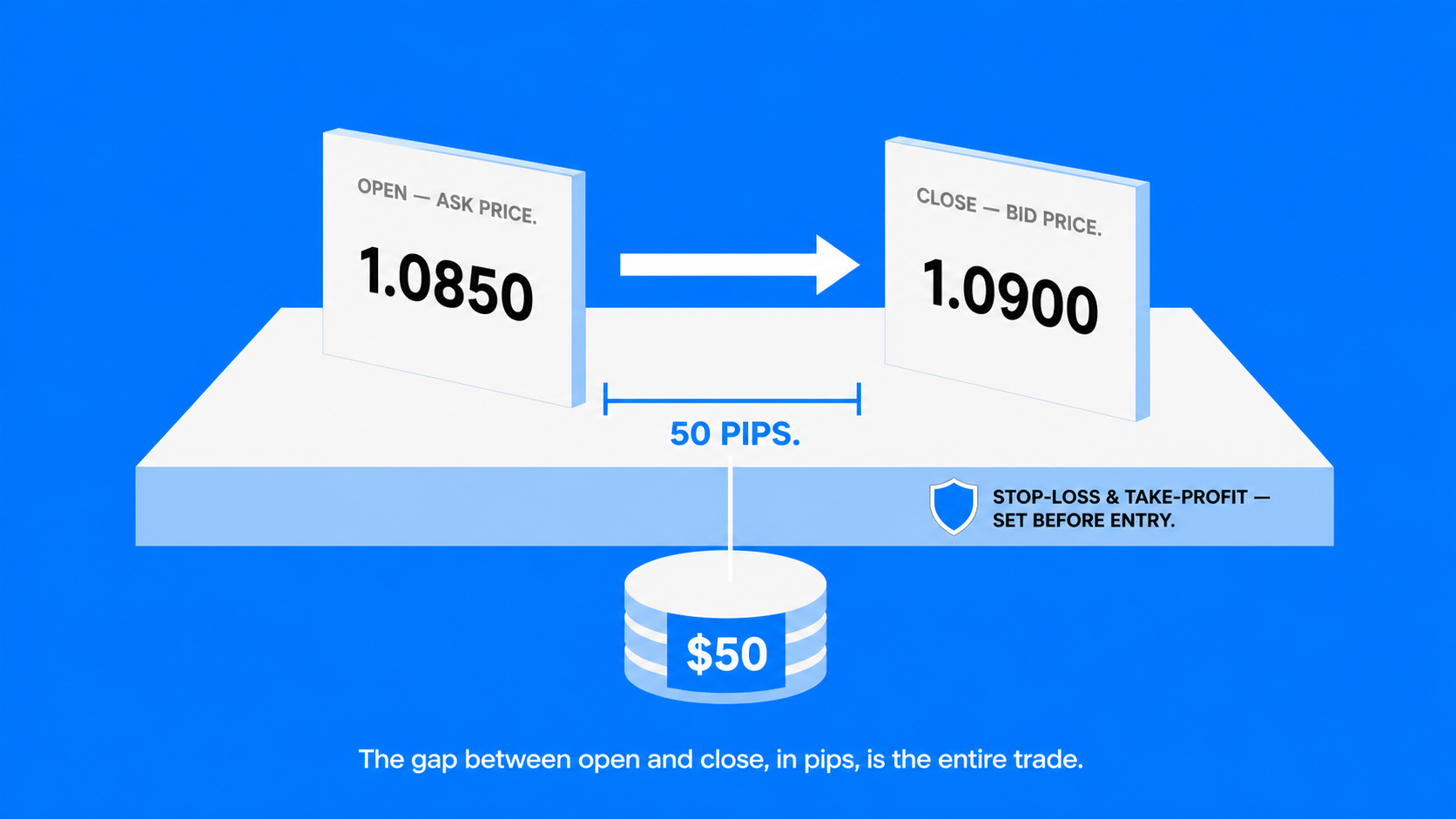
Forex trading works by opening a position on a currency pair, then closing that position once the exchange rate moves to a target level or a preset exit point. A trader who expects a currency to strengthen buys the pair (goes long); a trader who expects it to weaken sells the pair (goes short). Both directions are available from the same order ticket on a broker platform.
A position opens at the ask price and closes at the bid price for a long trade, with the reverse applying to a short trade. The difference between entry and exit, measured in pips, multiplied by the position’s lot size, determines profit or loss. A trader who buys one mini lot of EUR/USD at 1.0850 and closes at 1.0900 captures 50 pips at $1 per pip, a $50 gain before costs.
Most positions carry a stop-loss and take-profit order attached at entry, which close the trade automatically once price reaches a predefined loss or gain level. This attached-order mechanism is the primary control a trader retains over risk once a position is live, and it applies identically across every currency pair and account type described below.
Which Order Types Do Forex Traders Use
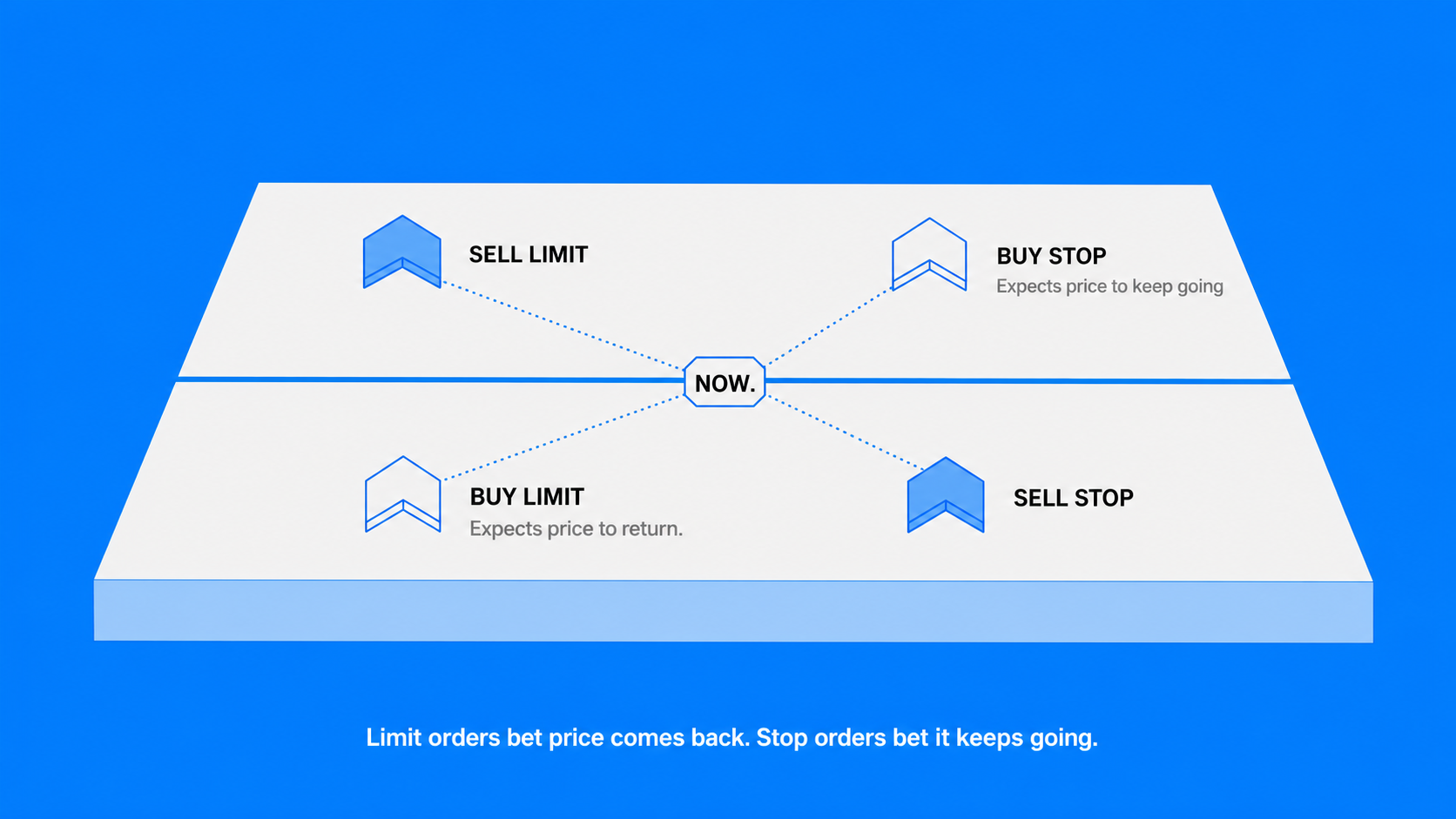
Forex orders fall into two categories: entry orders, which open a position, and exit orders, which close one. A market order is the simplest entry, executed immediately at the best available price, and it guarantees a fill but not a price, which is where slippage arises. Pending orders reverse that trade-off: they guarantee the price but not the fill, and they allow a trader to pre-place a strategy and step away from the screen.
Four pending entry orders cover every setup. A buy limit is placed below the current price to buy into a pullback, and a sell limit is placed above it to sell into a rally, which makes both the natural tools for range trading and mean-reversion entries. A buy stop is placed above the current price and a sell stop below it, so both trigger only once price moves in the anticipated direction, which makes them the standard instruments for breakout and news strategies. The distinction is direction of travel: limit orders expect price to come back, stop orders expect it to keep going.
Exit orders attach to a live or pending position. A stop-loss closes the trade at a defined maximum loss, a take-profit closes it at a defined target, and a trailing stop moves the stop-loss behind price by a fixed pip distance to lock in gains while a trend continues. Pending orders also carry an expiry setting, good-till-cancelled by default or limited to the trading day, and an order left open indefinitely can trigger days later into conditions the original analysis no longer covers. Selecting the correct order type is what allows the strategies described later in this guide to be executed as designed rather than approximated with market orders.
How is the Forex Market Structured
The forex market is a decentralized, over-the-counter (OTC) network with no central exchange. Prices form through direct dealing between banks, electronic communication networks, and broker platforms rather than on a single order book. This decentralized structure is why forex quotes differ slightly between brokers and why the market never closes during the trading week.
Turnover splits across instrument types. The BIS Triennial Survey, 2025 reports FX swaps as the largest instrument at roughly 42% of turnover ($4.0 trillion daily), spot transactions at 31%, outright forwards at 19%, and FX options near 7%. Retail traders participate almost entirely in the spot segment, typically through CFDs that mirror spot prices.
Geography concentrates the market further. Sales desks in the United Kingdom, United States, Singapore, and Hong Kong handled 75% of global FX trading in April 2025 (BIS, 2025), with London alone accounting for roughly 38%. This concentration explains why the London session produces the highest liquidity of the trading day.
What Are the Types of Currency Pairs
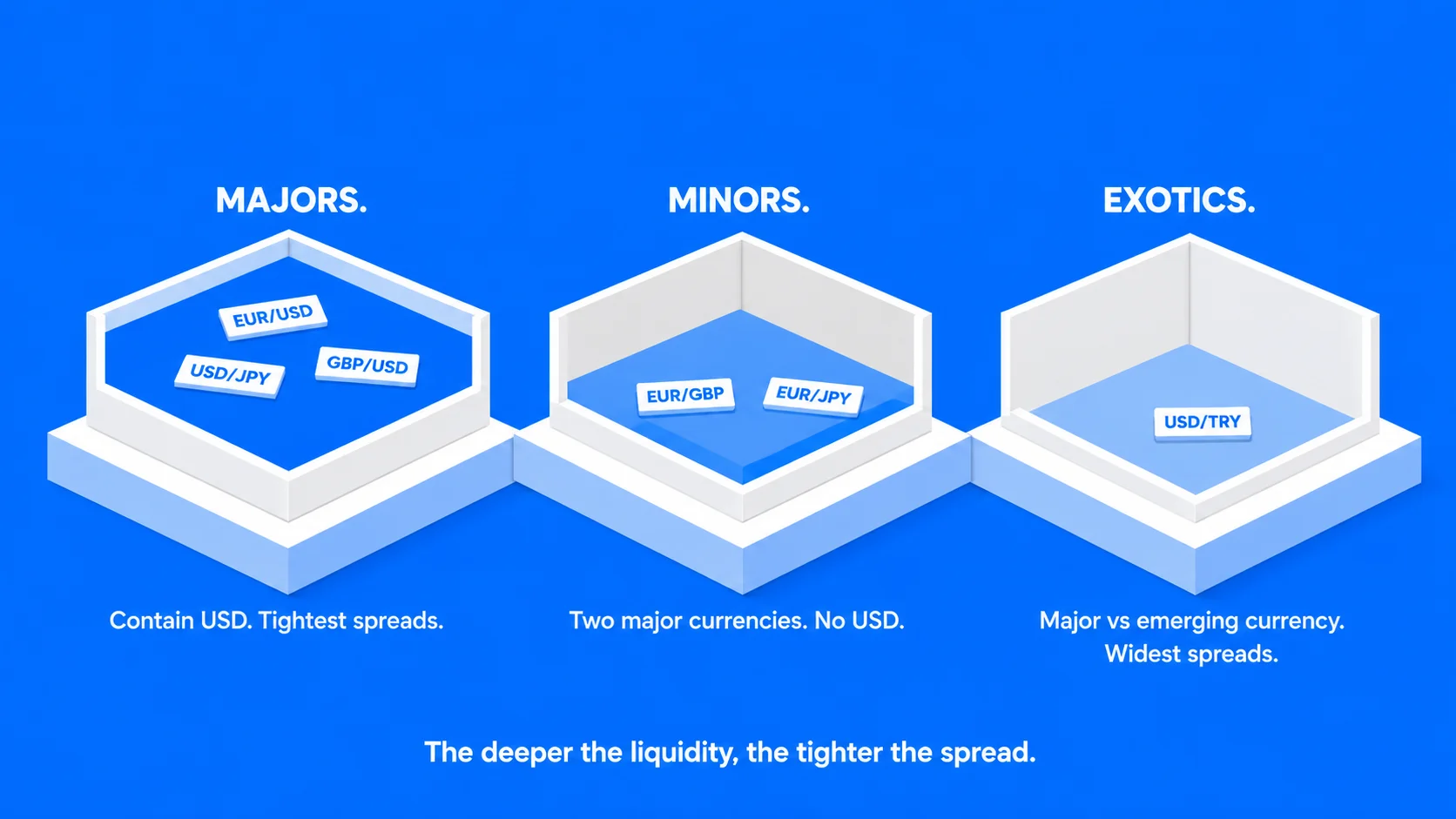
Currency pairs are divided into three groups: majors, minors, and exotics, ranked by liquidity. The grouping determines spread width, volatility profile, and suitability for each trading style.
| Group | Definition | Examples | Liquidity |
| Majors | Contain USD on one side | EUR/USD, USD/JPY, GBP/USD, USD/CHF, AUD/USD, USD/CAD, NZD/USD | Highest, tightest spreads |
| Minors (crosses) | Exclude USD, pair two major currencies | EUR/GBP, EUR/JPY, GBP/JPY | Moderate |
| Exotics | Major currency vs emerging-market currency | USD/TRY, USD/ZAR, USD/SGD | Lowest, widest spreads |
The US dollar appeared on one side of 89.2% of all FX trades in April 2025 (BIS, 2025), which makes the majors the practical core of retail forex trading. EUR/USD remains the single most traded pair, and major pairs collectively carry approximately 75% of forex volume.
How Does Currency Pair Correlation Affect Risk
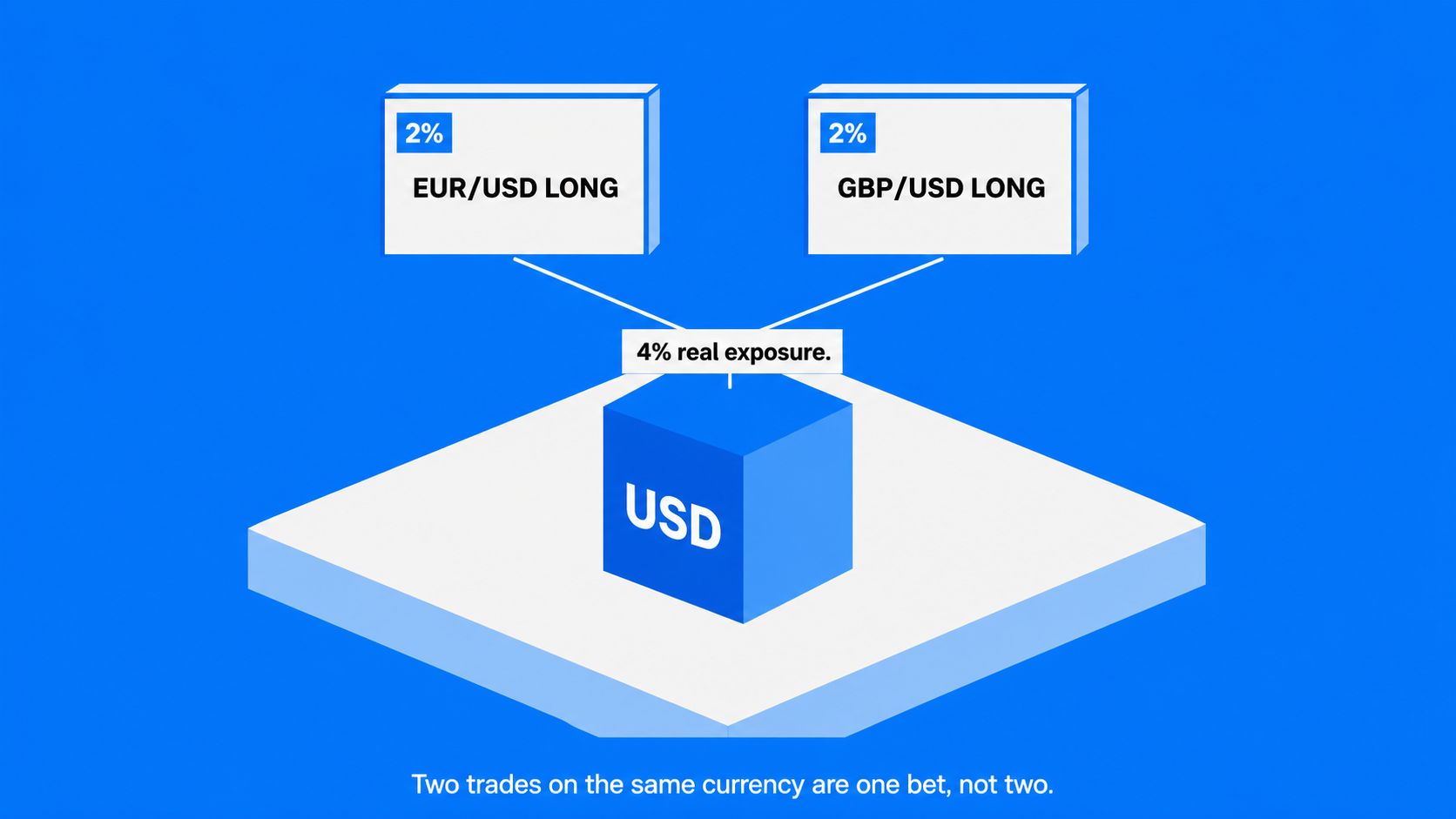
Currency pair correlation measures how closely two pairs move together, expressed as a coefficient from +1 (identical movement) to -1 (exactly opposite). Because every pair contains two currencies, pairs that share a currency inherit shared exposure. EUR/USD and GBP/USD typically correlate at +0.8 to +0.9, so a long position on both is not two independent trades but a single doubled bet against the US dollar. A trader risking 2% on each believes the exposure is 2% per position; in a dollar rally both lose together and the real risk taken was 4% on one idea.
Negative correlation creates the mirror problem. EUR/USD and USD/CHF have historically moved near -0.9, so a long EUR/USD alongside a long USD/CHF largely cancels the position while still paying two spreads and two sets of swap charges. Commodity-linked pairs behave as a bloc: AUD/USD and NZD/USD share exposure to Chinese demand and risk sentiment, and USD/CAD tracks crude oil, so simultaneous positions across those pairs concentrate rather than diversify.
The practical rule is to measure exposure by currency rather than by ticket. Before opening a second position, a trader lists the currencies already held long and short across the account and caps total exposure to any single currency at the same 1-2% used for individual trades. Correlations are not fixed, and they tighten during risk-off events precisely when diversification is expected to help, so coefficients should be rechecked on a rolling three to six month window rather than assumed from memory.
How are Currency Pairs Quoted
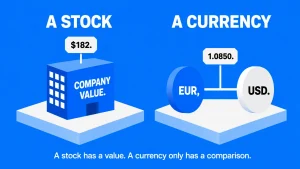
A forex quote states how many units of the quote currency buy one unit of the base currency. In EUR/USD 1.0850, the euro is the base currency and the US dollar is the quote currency: one euro costs 1.0850 dollars.
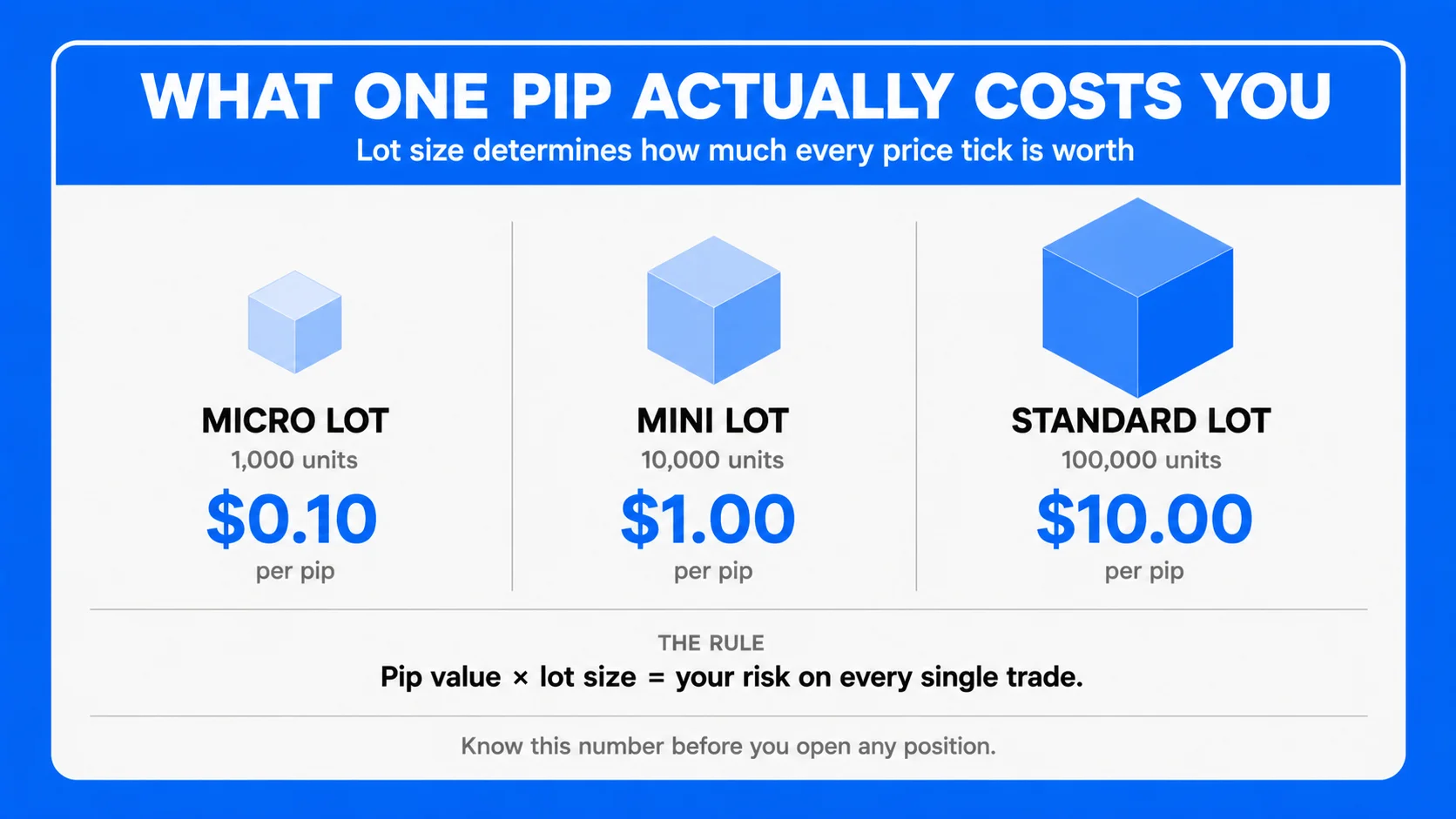
Price movement is measured in pips. A pip equals 0.0001 for most pairs and 0.01 for JPY pairs; a pipette is one-tenth of a pip. Position size is measured in lots: a standard lot is 100,000 units of the base currency (about $10 per pip on USD-quoted pairs), a mini lot 10,000 units ($1 per pip), and a micro lot 1,000 units ($0.10 per pip). Pip value multiplied by lot size defines the monetary risk of every trade before the trade opens.
What is a Pip in Forex Trading
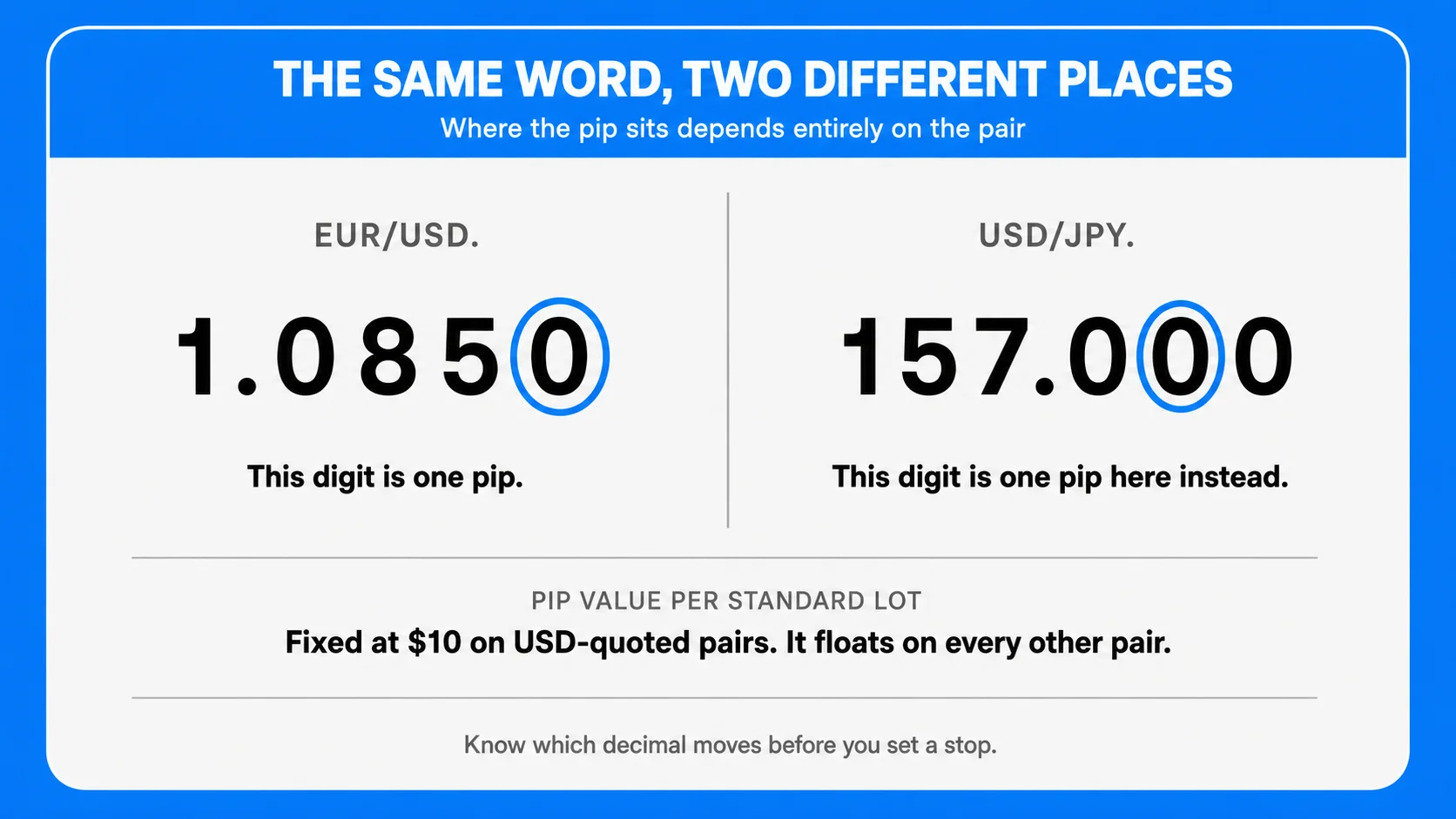
A pip, short for percentage in point, is the standard unit of price movement in forex and the common language of spreads, stop distances, and profit. For most pairs a pip is the fourth decimal place, 0.0001: EUR/USD moving from 1.0850 to 1.0851 is a one-pip move. For pairs quoted in Japanese yen a pip is the second decimal place, 0.01, so USD/JPY moving from 157.00 to 157.01 is one pip. Brokers quote a fifth decimal (third on JPY pairs) called a pipette or fractional pip, one-tenth of a pip, which is why a spread appears as 1.6 pips rather than a whole number.
Pip value converts a price move into money, and it depends on lot size and on which currency sits in the quote position. The calculation is one pip in decimal terms divided by the current exchange rate, multiplied by the position size. On USD-quoted pairs such as EUR/USD or GBP/USD the result is fixed and easy to memorise: $10 per pip on a standard lot of 100,000 units, $1 on a mini lot of 10,000, and $0.10 on a micro lot of 1,000. On other pairs it floats with price. One standard lot of USD/JPY at 157.00 gives 0.01 divided by 157.00, multiplied by 100,000, or roughly $6.37 per pip, and that figure changes as the rate moves.
Pip value is what makes risk a number rather than a feeling, because it turns a stop-loss distance into a currency amount before the trade is placed. On a $1,000 account risking 2%, the maximum acceptable loss is $20; with a 20-pip stop-loss that permits $1 of risk per pip, which is one mini lot. Widening the stop to 40 pips halves the permissible position to 0.5 mini lots for the same $20 of risk. Every cost in this guide is measured in the same unit, so a 1.6-pip spread on that mini-lot trade is $1.60 paid at entry, and the position needs 1.6 pips of favourable movement simply to reach break-even.
What is Leverage in Forex Trading
Leverage lets a trader control a position larger than the deposited margin, expressed as a ratio such as 1:30 or 1:500. A 1% margin requirement equals 1:100 leverage: $1,000 margin controls a $100,000 position. Leverage multiplies profit and loss by the same factor.
Regulators cap retail leverage to balance profit potential against loss potential. ESMA, 2018 and the FCA, 2019 limit retail CFD leverage to 1:30 on major pairs in the EU and UK, paired with mandatory negative balance protection and a 50% margin close-out rule. Brokers regulated in other jurisdictions may offer higher ratios, up to 1:500, which widens both the potential return and the potential loss on a position of the same size. Traders are advised to size positions according to their own risk tolerance and to use stop-loss orders as standard practice.
How Does Margin Work in Forex Trading
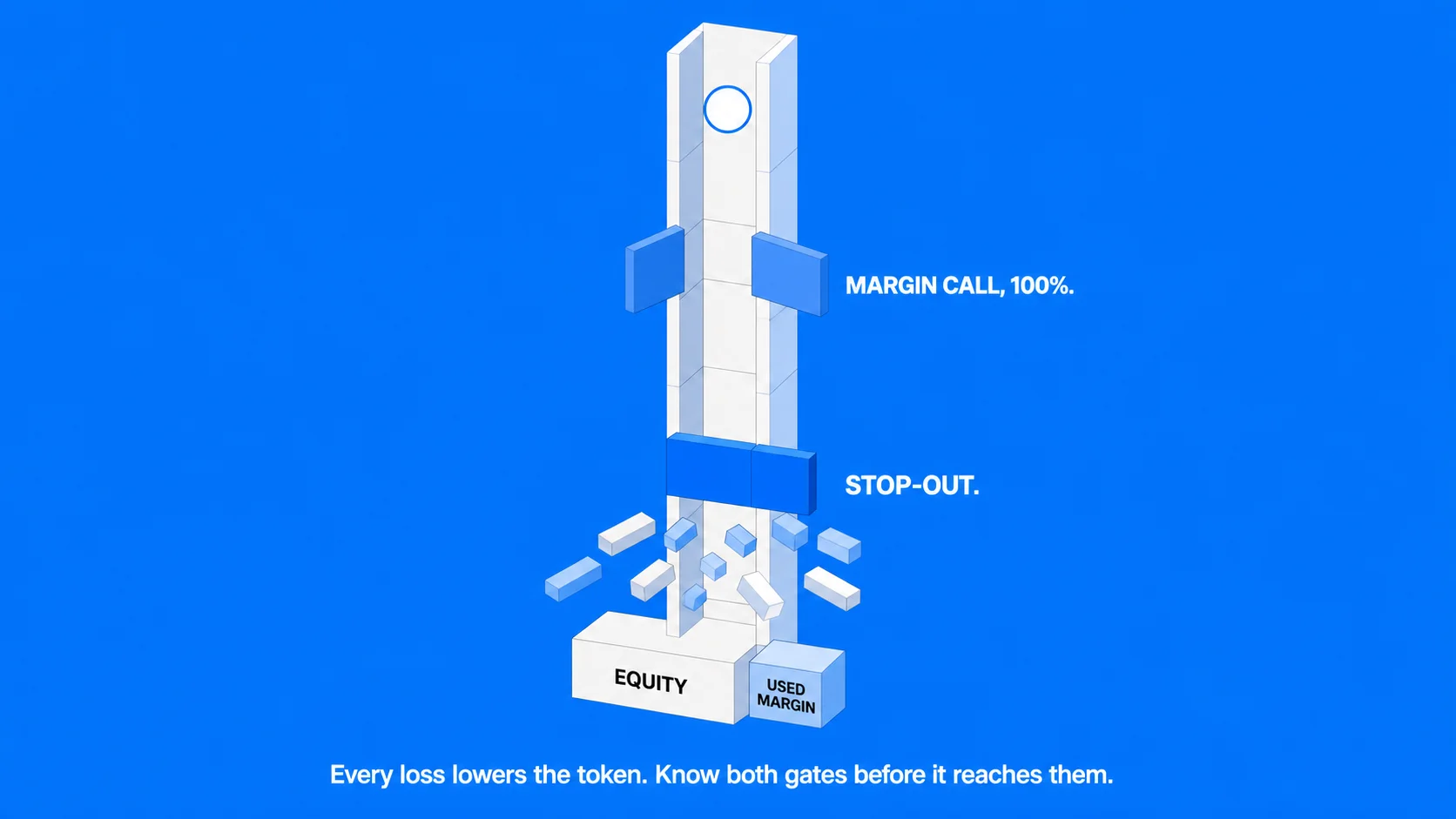
Margin is the deposit a broker holds against an open position, and four figures govern whether that position survives. Used margin is the capital locked by open trades, calculated as position notional divided by leverage. Equity is account balance plus or minus floating profit and loss. Free margin is equity minus used margin, the amount still available to open new positions or absorb losses. Margin level, the number that actually decides the outcome, is equity divided by used margin, expressed as a percentage.
A worked example: a $1,000 account trading at 1:100 opens one mini lot of EUR/USD at 1.0850, a notional value of $10,850. Used margin is $108.50, free margin is $891.50, and margin level is 921%. If the trade moves 50 pips against the position, equity falls to $950 and margin level drops to 876%. Losses reduce equity while used margin stays fixed, so margin level falls continuously as a position moves offside.
Margin call and stop-out are two separate events at two separate thresholds. A margin call is a warning, typically triggered when margin level falls to 100%, at which point no new positions can be opened. A stop-out is automatic liquidation: once margin level reaches the broker’s stop-out level, commonly 50% but as low as 20% at some brokers, the platform closes open positions without instruction, starting with the largest floating loss, until margin level recovers above the threshold. ESMA, 2018 and the FCA, 2019 made a 50% margin close-out rule mandatory for retail CFD accounts in the EU and UK, alongside negative balance protection that prevents an account from going below zero.
This is the mechanism behind most blown accounts. A trader using maximum leverage commits nearly all equity as used margin, which leaves almost no free margin to absorb an adverse move, so a routine 30-pip fluctuation reaches the stop-out level. The defence is structural rather than predictive: size positions so used margin stays a small fraction of equity, keep margin level well above 500%, and treat free margin, not account balance, as the true measure of how much room a position has.
Who Participates in the Forex Market
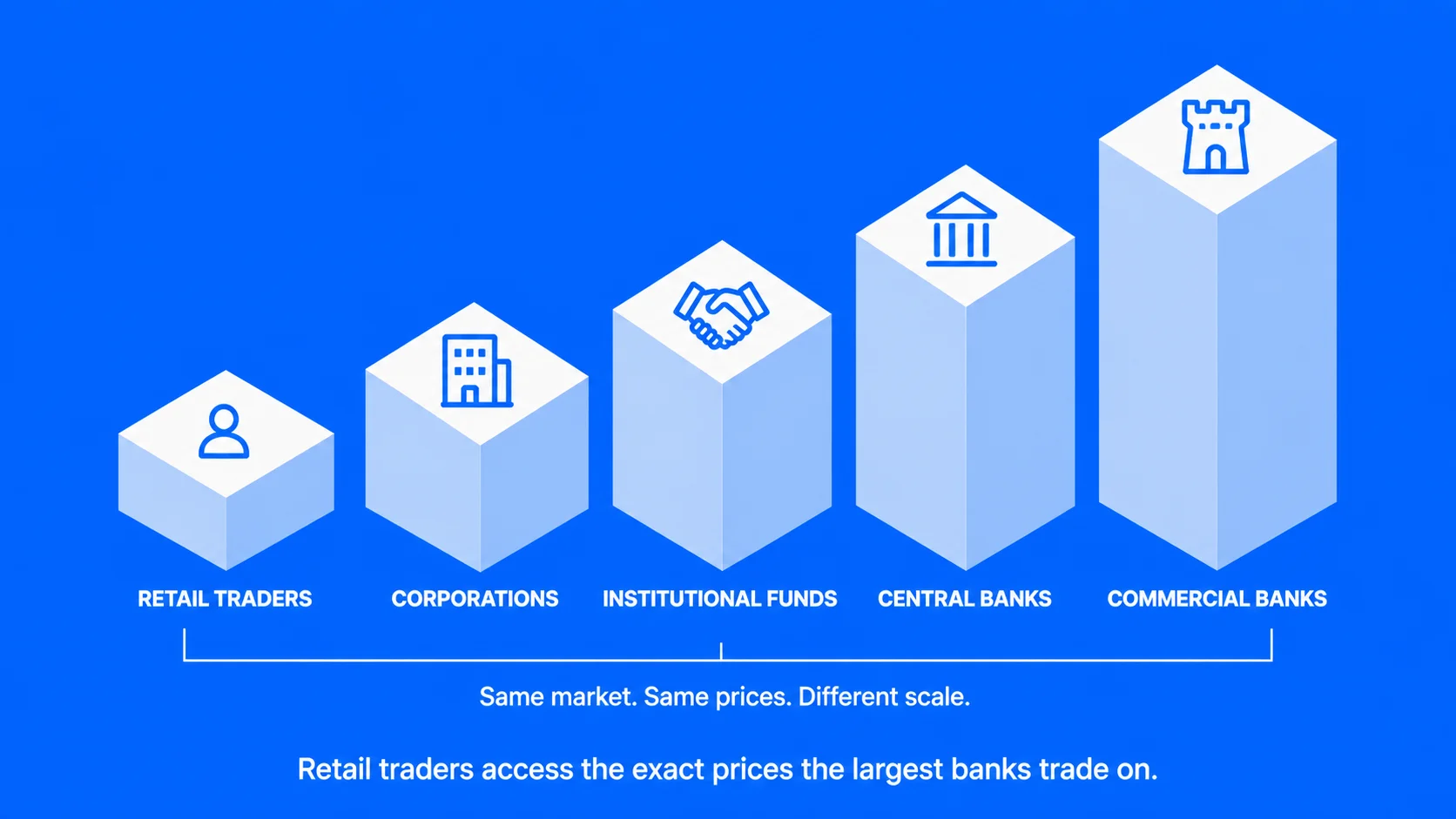
Forex market participants span five tiers: commercial and investment banks, central banks, institutional funds, corporations, and retail traders. Banks such as JP Morgan, UBS, Citi, and Deutsche Bank form the interbank core, and inter-dealer trading reached $4.4 trillion daily, 46% of turnover, in April 2025 (BIS, 2025).
Central banks intervene to manage currency values and set the interest rates that drive long-term exchange-rate trends. Hedge funds and proprietary firms trade currencies speculatively at scale while corporations hedge trade flows. Retail traders account for a low single-digit share of total turnover but access the same prices through broker platforms, which is the structural feature that makes retail forex trading possible.
When is the Forex Market Open
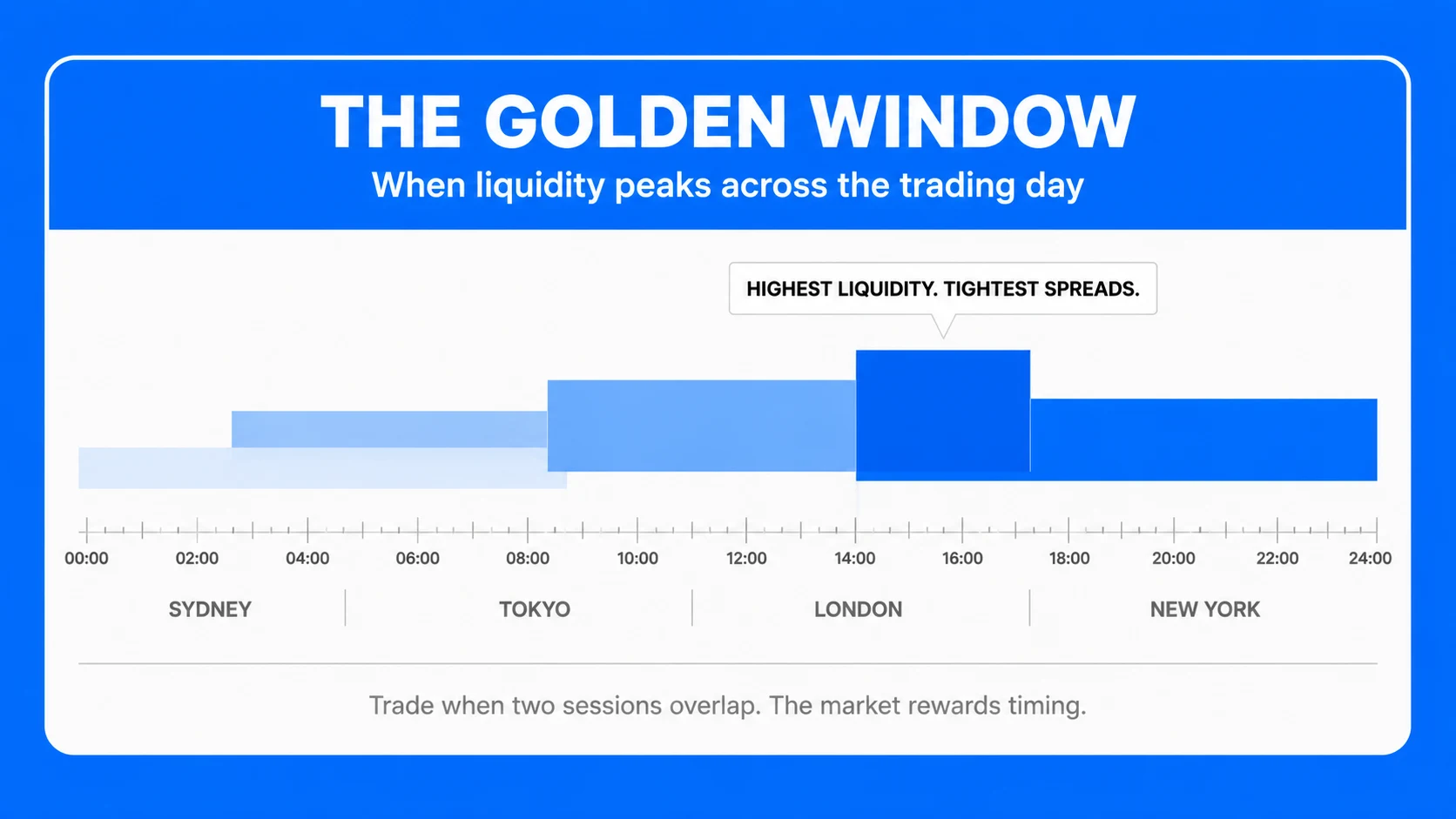
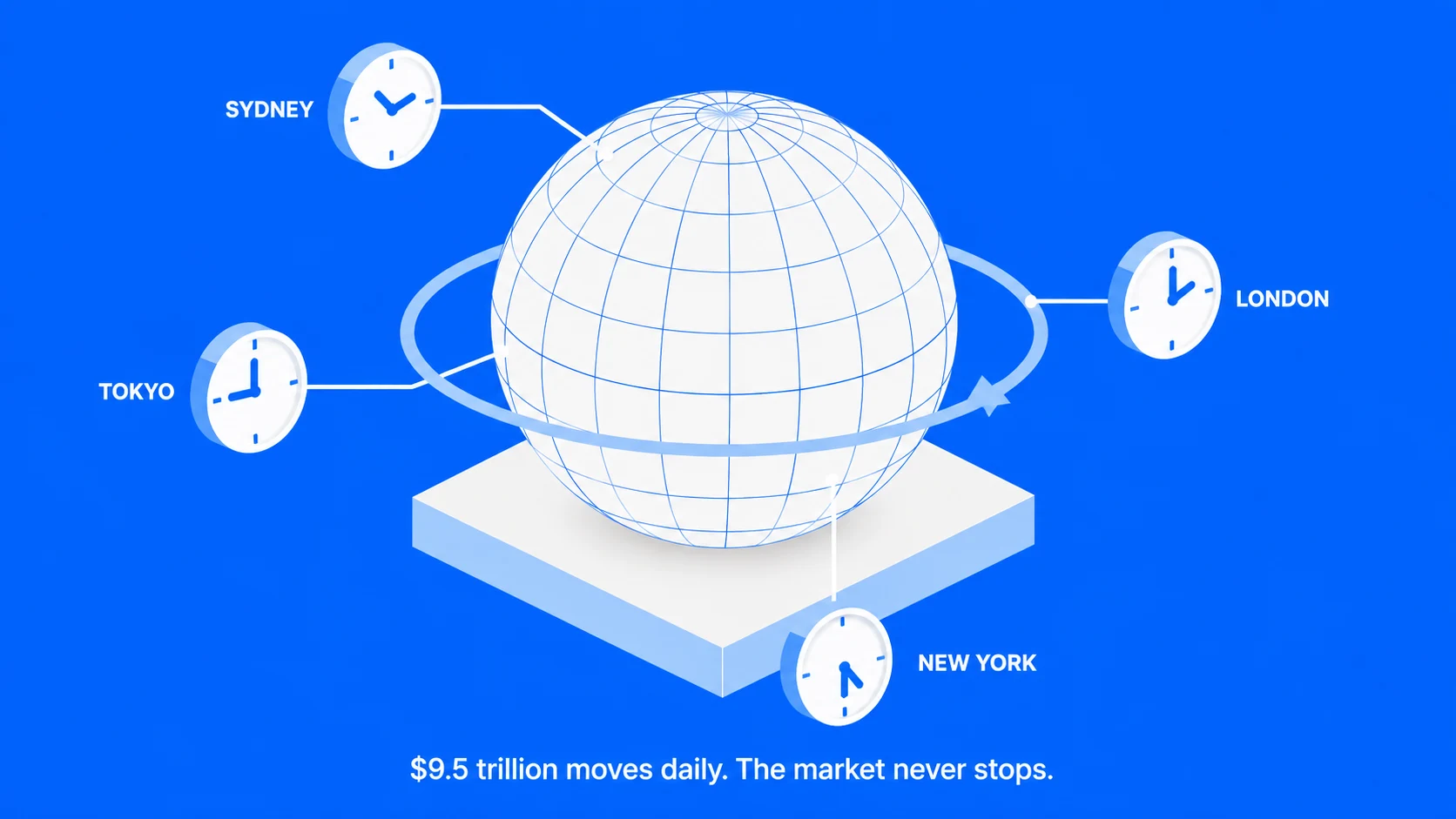
The forex market is open 24 hours a day from Sunday evening to Friday evening (ET), rotating across four sessions. The Sydney and Tokyo sessions run approximately 23:00-08:00 GMT, London 08:00-17:00 GMT, and New York 13:00-22:00 GMT, with times shifting one hour under daylight saving.
The London-New York overlap (13:00-17:00 GMT) concentrates the highest liquidity and tightest spreads of the day, since the two hubs jointly process more than half of global forex volume (BIS, 2025). Session selection directly affects execution cost and volatility exposure. The full session schedule and optimal windows per pair are covered in the forex trading hours guide.
How Much Does Forex Trading Cost
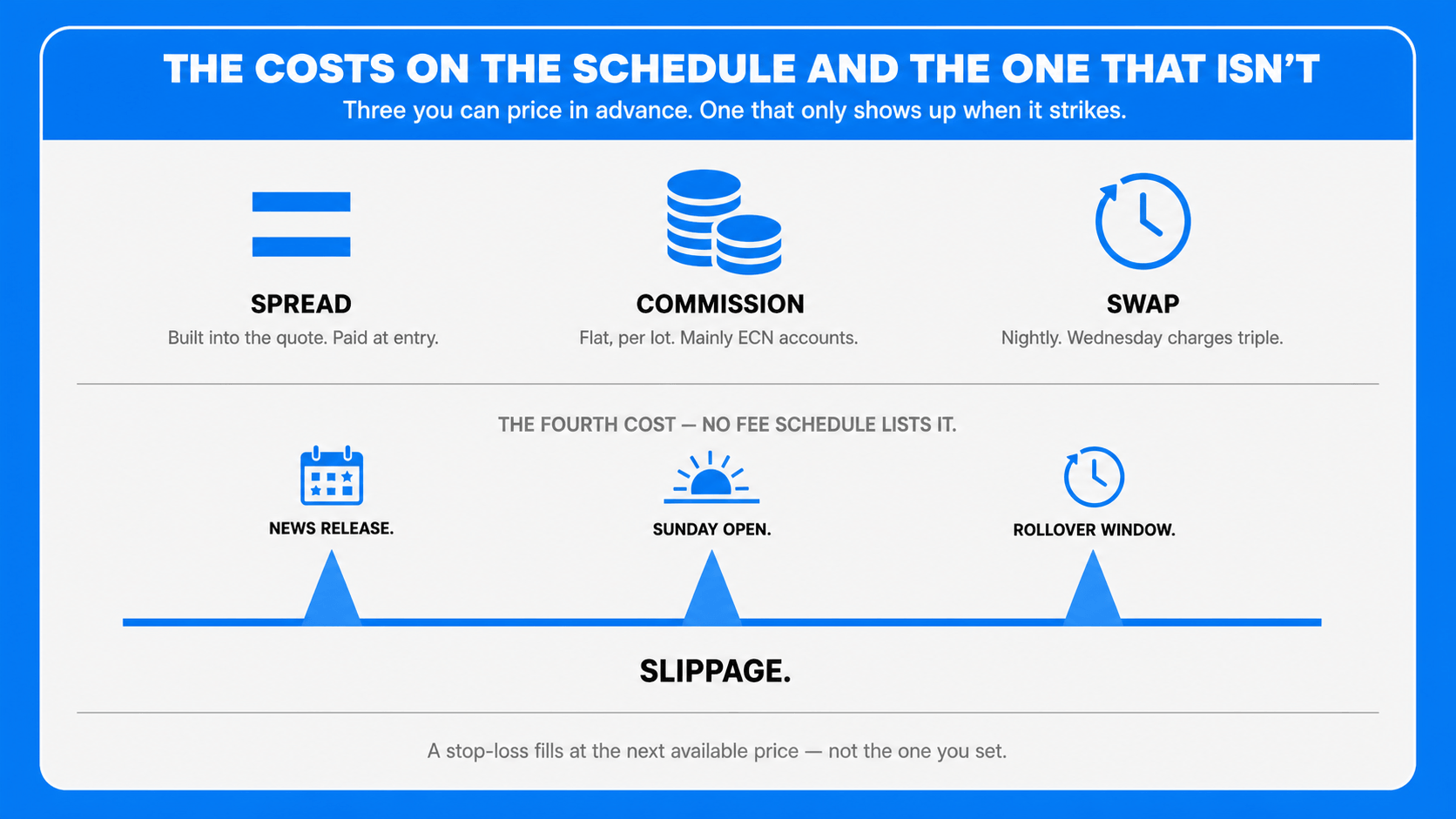
Forex trading costs consist of the spread, commission, swap fees, and non-trading fees. The spread, the gap between bid and ask price, is the primary cost on standard accounts. ECN-spread accounts replace the marked-up spread with a per-lot commission, typically $3.50-$7.00 per side.
Swap (rollover) fees apply to positions held overnight and reflect the interest-rate differential between the two currencies in the pair; the fee can be a debit or a credit, and Wednesday rollover charges three days of swap to account for weekend settlement. Brokers earn revenue through spread markups, commissions, and swap adjustments, and the full cost model per account type is broken down on the forex trading costs page.
Slippage, requotes, and spread widening form a fourth, variable cost that does not appear on any fee schedule. Slippage is the difference between the price requested and the price filled, and it occurs whenever the market moves between order submission and execution: a buy order sent at 1.0850 may fill at 1.0853, three pips of unbudgeted cost. Slippage runs in both directions on market orders, but stop-loss orders are filled at the next available price, so negative slippage on an exit can carry a position past its intended risk limit.
Execution conditions deteriorate predictably at three moments: high-impact economic releases (US Nonfarm Payrolls, CPI, central bank rate decisions), the Sunday market open, and the daily rollover window near 22:00 GMT when liquidity providers step back. Spreads on EUR/USD that sit near 1 pip in the London-New York overlap can widen to 10 pips or more for several seconds around a rate decision, and price can gap over a stop-loss entirely across the weekend. Practical controls are avoiding market orders in the seconds surrounding a scheduled release, using limit orders where entry price matters more than certainty of fill, and treating guaranteed stop-loss orders, where a broker offers them, as a paid insurance product rather than a default setting.
How does UEXO Give Access to the Forex Market
UEXO provides forex market access through CFD trading on major, minor, and exotic currency pairs, executed on MetaTrader 4 and MetaTrader 5. A forex CFD replicates the spot price of a currency pair without ownership of the underlying currencies, which allows long and short positions with identical mechanics.
UEXO’s forex offering maps to the market attributes defined above. Currency pairs are quoted with pip-precision pricing across the majors, minors, and exotics listed in the pair-grouping table. Leverage on forex CFDs is dynamic, scaling with account type, instrument, and jurisdiction, which demands the position-sizing discipline described in the leverage section, since the same multiplier applies to losses.
Account structure follows the execution models standard to the forex market. UEXO operates three live trading accounts: Standard (spread-based pricing from 1.6 pips, no commission), Pro (spreads from 0.8 pips plus $4 per round turn), and ECN (spreads from 0.0 pips plus $7 per round turn), alongside a swap-free option that replaces overnight interest with a fixed administration fee. Each account type connects to the cost components in the previous section: spread-based accounts concentrate cost in the bid-ask gap, while ECN-spread accounts shift cost to a transparent per-lot commission.
Execution runs 24/5 across all four global sessions, and platform-side tools (one-click trading, pending orders, stop-loss and take-profit attachment, and Expert Advisor support) implement the order mechanics referenced throughout this guide. Copy trading extends access to traders who allocate capital to third-party strategies rather than trading manually.
Risk disclosure applies to every UEXO forex product: CFDs are leveraged instruments, and the loss statistics in the next section apply to the retail CFD category as a whole.
Why do Most Retail Forex Traders Lose Money?
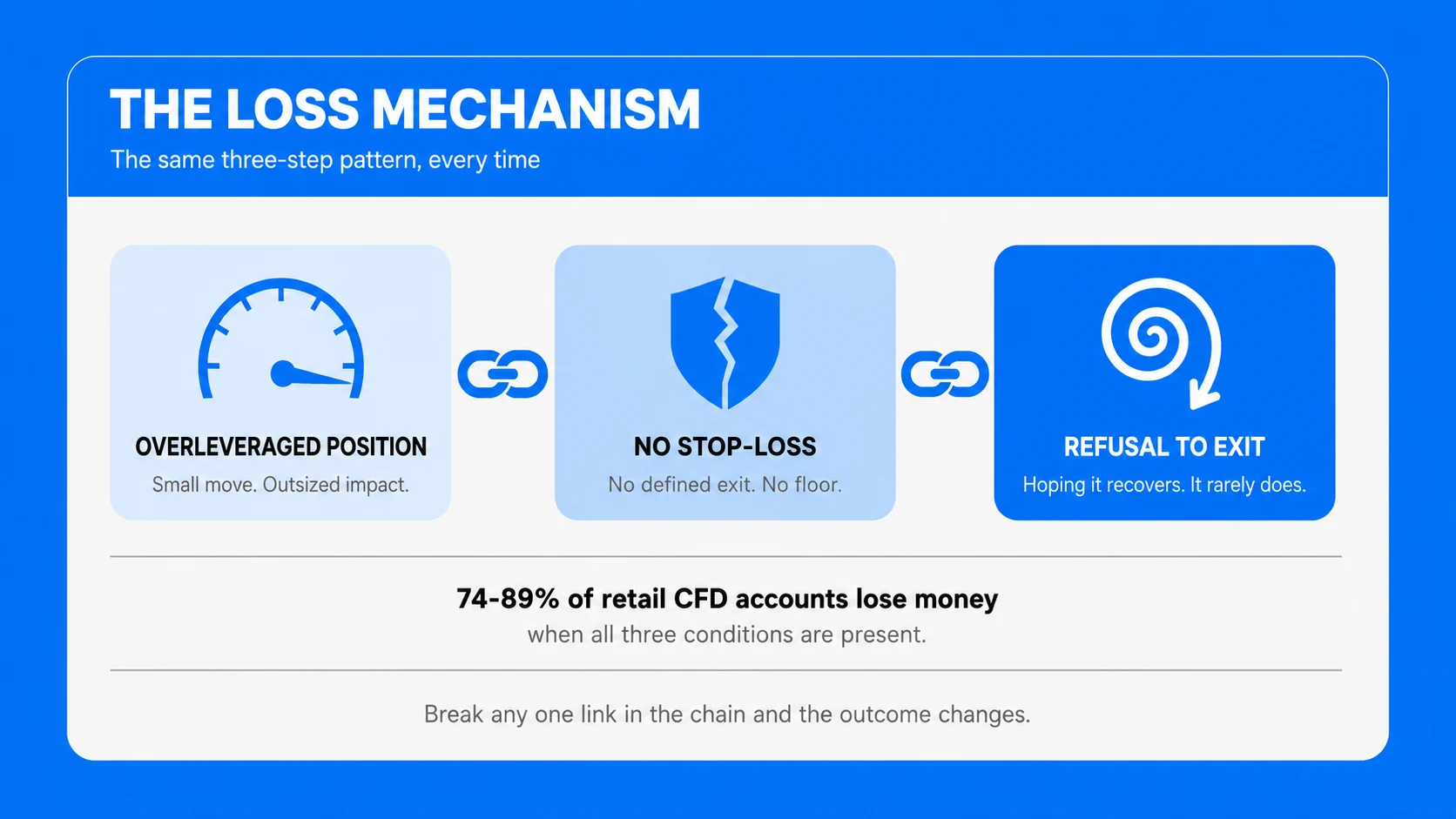
Retail forex traders lose money primarily through excessive leverage, absent risk management, and emotionally driven decisions, and the losses are documented at regulator level. ESMA, 2018 found that 74-89% of retail CFD accounts lose money, with average losses per client between €1,600 and €29,000. The FCA, 2019 reported that approximately 80% of CFD customers lose money. These figures are the reason EU and UK regulators capped leverage and mandated standardized risk warnings.
The loss mechanism is consistent: an overleveraged position, no stop-loss, and a refusal to exit a losing trade. Each corrective discipline belongs to a specific domain of forex trading knowledge: market analysis, strategy selection, platform proficiency, account configuration, structured onboarding, automation rules, indicator-based signals, psychological control, and scam avoidance. The following sections define each domain and link to its dedicated guide.
How Do Traders Analyse the Forex Market?
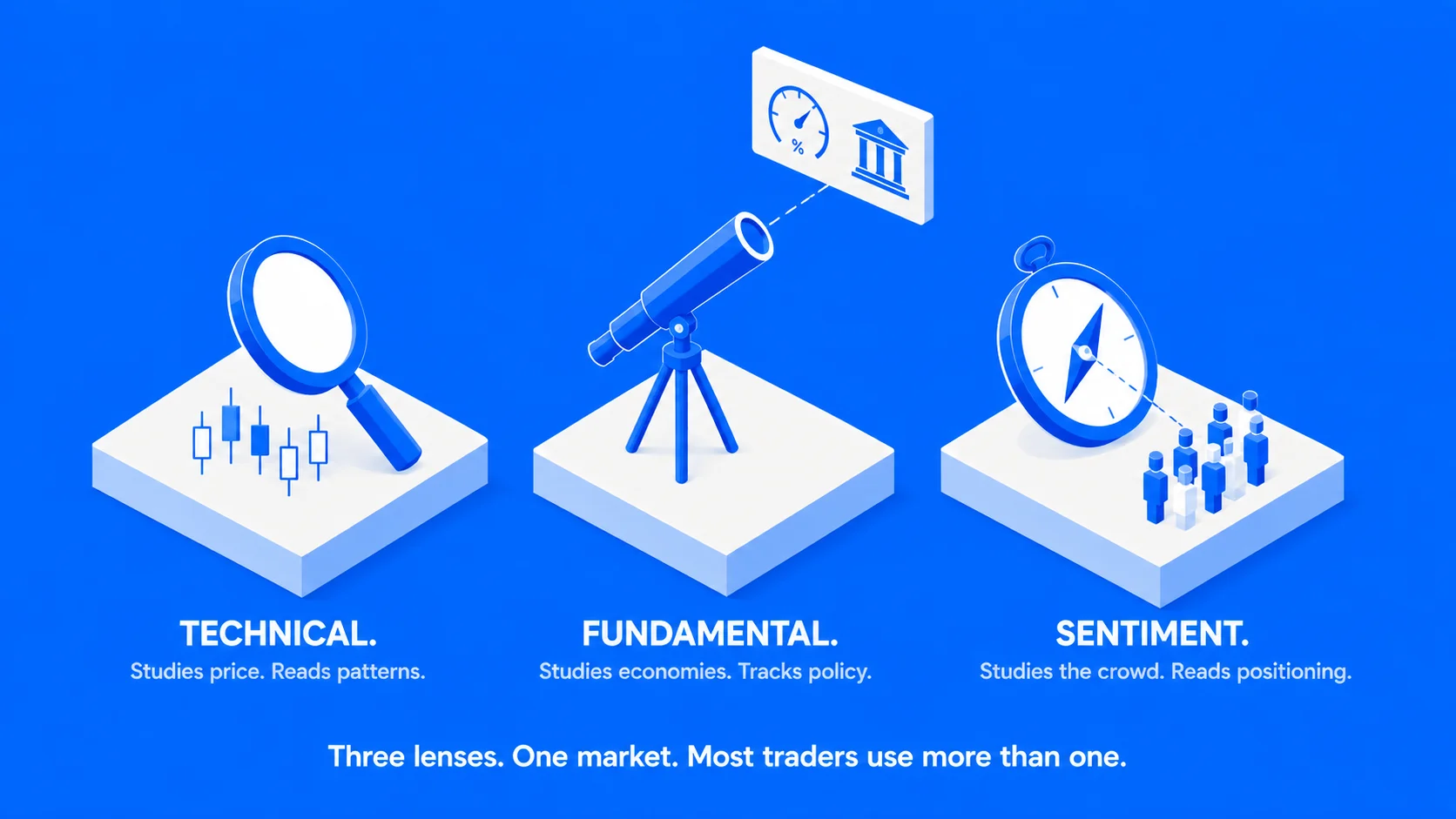
Forex traders analyse currency markets through three methods: technical analysis, fundamental analysis, and sentiment analysis. Most combine at least two, using fundamentals to establish direction and technicals to time entries.
Technical analysis studies past price and volume to forecast future movement, on the premise that price reflects all available information and that patterns repeat. Traders read candlestick charts, mark support and resistance levels, identify trends and chart patterns such as head and shoulders and triangles, and apply indicators to quantify momentum, trend, and volatility. It suits short-term trading, where fundamental drivers move too slowly to time an entry.
Fundamental analysis values a currency by the economic condition of its country, on the premise that exchange rates converge toward economic reality. Interest rate policy is the dominant driver, so decisions from the Federal Reserve, ECB, Bank of England, and Bank of Japan move markets more than any other scheduled event. Traders track inflation (CPI), employment data (US Nonfarm Payrolls), GDP, and trade balances through an economic calendar. It suits position traders holding for weeks or months.
Sentiment analysis measures how participants are positioned rather than what price or data says, read through the CFTC Commitments of Traders report, broker long/short ratios, and volatility measures. Crowded positioning is often treated as a contrarian signal.
Analysis produces the signal; risk management determines survival. Method selection, chart examples, and the release calendar that drives fundamental moves are covered in the forex market analysis guide.
Which Indicators do Forex Traders use often?
The four most used forex indicators are moving averages (trend direction), RSI (momentum, overbought above 70 / oversold below 30), MACD (trend-momentum crossover), and Bollinger Bands (volatility). Fibonacci retracement, ATR, ADX, and the stochastic oscillator extend the core set.
Effective indicator use combines two to three complementary tools, one trend indicator plus one momentum oscillator, rather than stacking redundant signals. Configuration values, chart examples, and signal rules per indicator are documented in the forex trading indicators guide.
Which Forex Trading Strategies Match Different Time Frames?
Forex trading strategies are divided into four styles by holding period: scalping (seconds to minutes), day trading (intraday), swing trading (days to weeks), and position trading (weeks to months). Scalping requires ECN spreads and low latency; day trading closes all positions before rollover; swing trading works from 4-hour and daily charts; position trading follows fundamentals.
Strategy overlays include trend following, range trading, breakout trading, news trading, and the carry trade, which earns the interest-rate differential on pairs such as AUD/JPY. Style selection depends on available screen time and risk tolerance. Full entry rules, examples, and pair selection per strategy are documented in the forex trading strategies guide.
Which Platforms Execute Forex Trades
Three platforms dominate retail forex execution: MetaTrader 4 (2005), MetaTrader 5 (2010), and cTrader (2011). MT4 remains the most widely used forex-specific platform with the largest Expert Advisor library; MT5 adds multi-asset support, 21 timeframes, and faster backtesting; cTrader provides native depth-of-market for ECN execution.
Platform choice determines charting capability, order types, automation language (MQL4, MQL5, C#), and mobile parity. UEXO runs both MT4 and MT5 on desktop, web, and mobile; a comparison of each platform’s execution model and feature set is available in the forex trading platforms overview.
Forex Account Types
Forex accounts differ by lot size (standard, mini, micro, cent), execution model (market maker, STP, ECN), and special conditions (swap-free, demo, managed). Ecn-spread accounts route orders to liquidity providers at interbank spreads plus commission; standard accounts price the cost into a wider spread; swap-free accounts remove overnight interest in exchange for a fixed administration fee.
Live account opening requires KYC verification, government photo ID plus proof of address, with minimum deposits ranging from $100 to several thousand dollars depending on tier. Account-by-account specifications and opening steps are detailed on the forex account types page.
How does a Beginner Start Forex Trading?
A beginner starts forex trading in six steps: learn the core mechanics, choose a broker, verify an account, practice on demo, define a risk plan, then fund and place a first trade. Demo trading on virtual funds tests the full order workflow (pair selection, position sizing, stop-loss, take-profit) at zero financial risk.
New traders reduce failure probability by using low leverage (1:10-1:20), trading only liquid major pairs, and risking 1-2% of account balance per trade. The complete step-by-step onboarding sequence is covered in the how to start forex trading guide.
Can Forex Trading Be Automated?
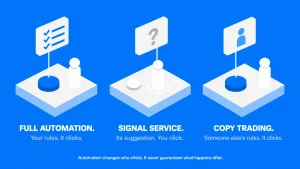
Yes. Forex trading is automated through Expert Advisors (EAs), algorithmic scripts, and copy trading. EAs execute coded rules on MetaTrader without manual intervention, typically hosted on a VPS for continuous 24/5 operation. Copy trading mirrors the live positions of a selected signal provider.
Automation removes emotional interference but introduces distinct risks: over-optimized backtests, connectivity failures, and fraudulent EAs sold on unrealistic return claims. The evaluation criteria for EAs and copy-trading providers are set out in the automated forex trading guide.
How does Psychology Affect Forex Trading Results?
Trading psychology determines whether a trader follows a plan under pressure, and psychological failure, not analytical failure, drives most retail losses. The recurring patterns are fear-driven premature exits, greed-driven overtrading, FOMO entries at price extremes, and revenge trading after a loss.
Discipline mechanisms counter each pattern: a written trading plan, fixed 1-2% risk per trade, mandatory stop-losses, daily trade limits, and a journal that records emotional state alongside every position. The full framework for building trading discipline is covered in the forex trading psychology guide.
How to Identify Forex Scams
Traders identify forex scams by verifying broker regulation on official registers and rejecting any offer of guaranteed returns. Tier-1 regulators, the FCA (UK), ASIC (Australia), CySEC (EU), and NFA/CFTC (US), publish searchable public registers where a licence number is confirmed in minutes. Regulated status brings segregated client funds, audits, negative balance protection, and compensation schemes such as the FSCS’s £85,000 investment cover (FSCS, 2019).
Common scam formats include clone brokers, signal-seller schemes, fraudulent EAs, Ponzi structures, and blocked withdrawals. Red flags, verification steps, and regulator register links are compiled in the forex scams and safety guide.
How does Forex Trading Compare to Other Markets?
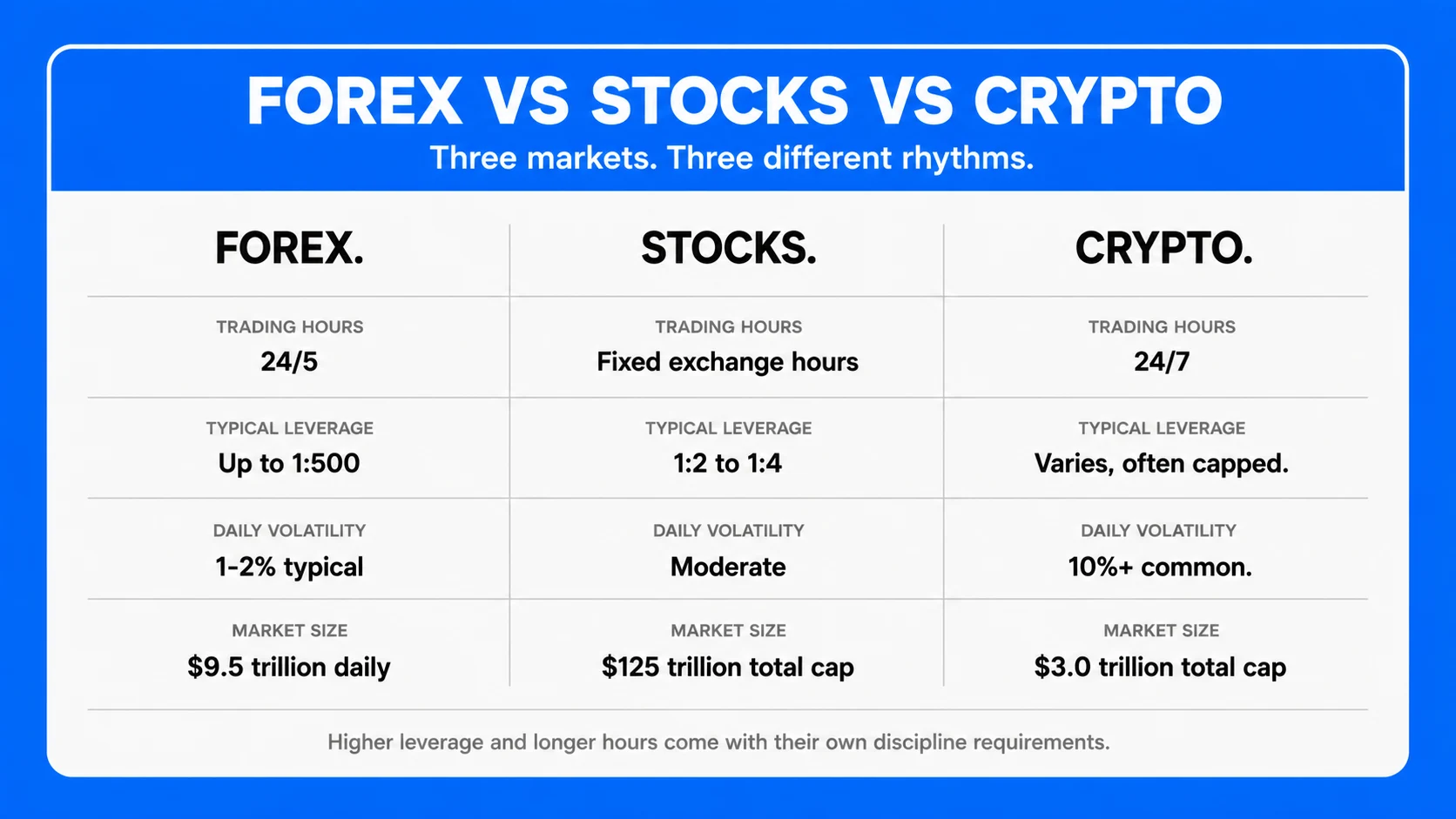
Forex trading offers higher liquidity, longer hours, and higher leverage than stock or crypto trading, with lower per-trade volatility. Daily forex turnover of $9.5 trillion (BIS, December 2025) exceeds every other market; global equity market capitalization stood near $125 trillion at end-2024, and total crypto market capitalization near $3.0 trillion at end-2025 (CoinGecko, 2025).
Stocks trade in fixed exchange hours with leverage near 1:2-1:4 and carry overnight gap risk; crypto trades 24/7 with routine 10%+ daily swings; forex majors rarely move more than 1-2% in a day. The full attribute-by-attribute comparison sits in the forex vs other markets analysis.
Is forex trading legal?
Yes. Forex trading is legal in most jurisdictions when conducted through a licensed broker; leverage limits and product restrictions vary by regulator (ESMA, 2018; FCA, 2019).
Is forex trading profitable?
Forex trading is profitable for a minority of participants. ESMA, 2018 data show 74-89% of retail CFD accounts lose money; profitability requires a tested strategy, controlled leverage, and consistent risk management.
Is $100 enough to start forex trading?
Yes. Micro-lot accounts allow positions of 1,000 units at roughly $0.10 per pip, which makes $100 a workable starting balance with 1-2% risk per trade.
Does the forex market open on weekends?
No. The forex market closes on Friday evening (ET) and reopens Sunday evening (ET); crypto CFDs remain the only 24/7 retail instruments.
What is the difference between technical and fundamental analysis?
Technical analysis forecasts price from historical chart data and indicators, suiting short-term entries. Fundamental analysis values a currency from interest rates, inflation, and growth data, suiting positions held for weeks or months. Most traders use both.
Conclusion
The fastest path from reading about the forex market to operating in it is a demo account: every mechanic in this guide (pair quotation, pip value, lot sizing, leverage, stop-loss placement) is testable on virtual funds before capital is exposed. Open a free demo account to run the full trade workflow on live market prices, then progress to the starting-forex guide when the process is consistent.