What is a forex trading strategy?
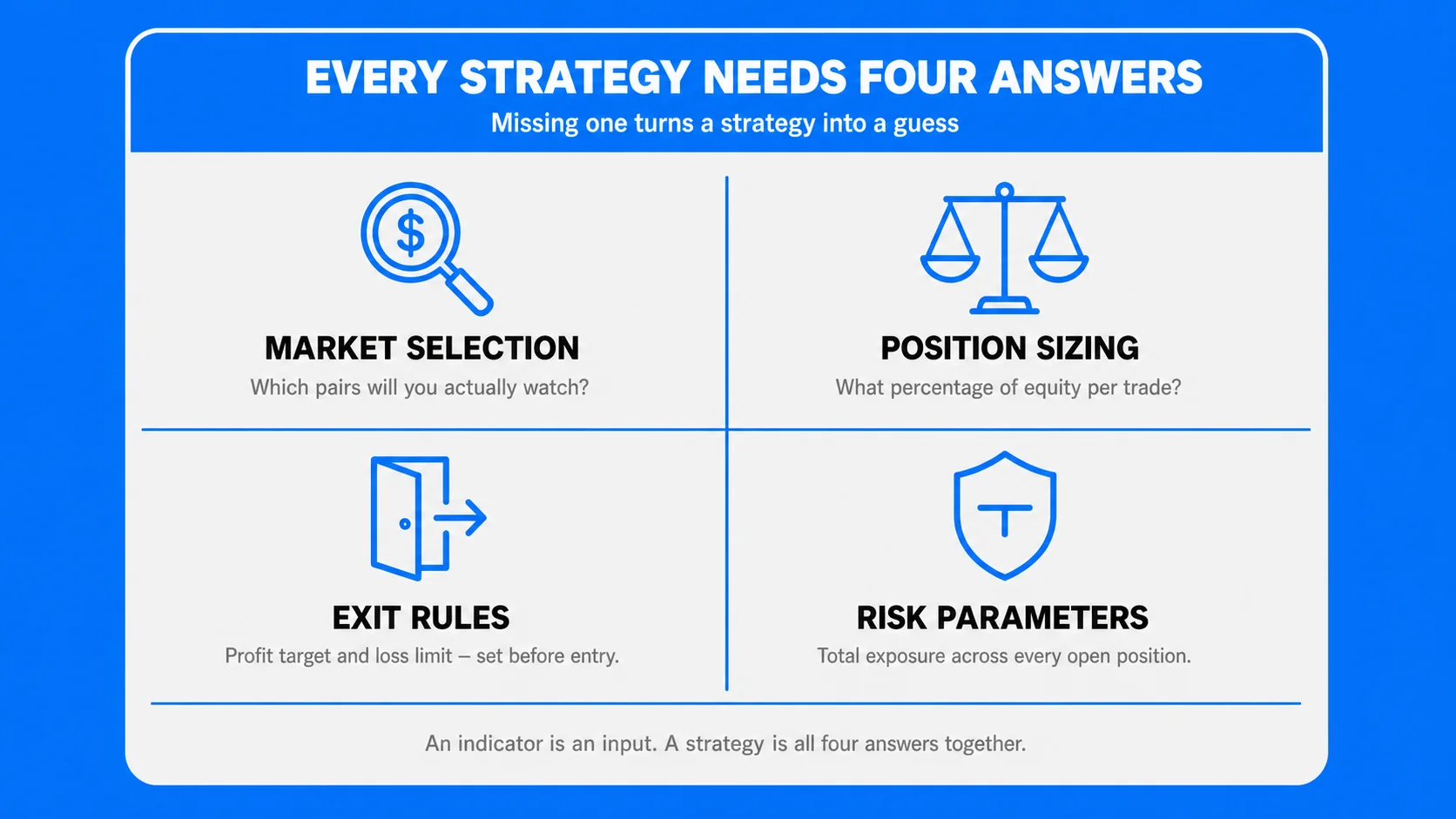
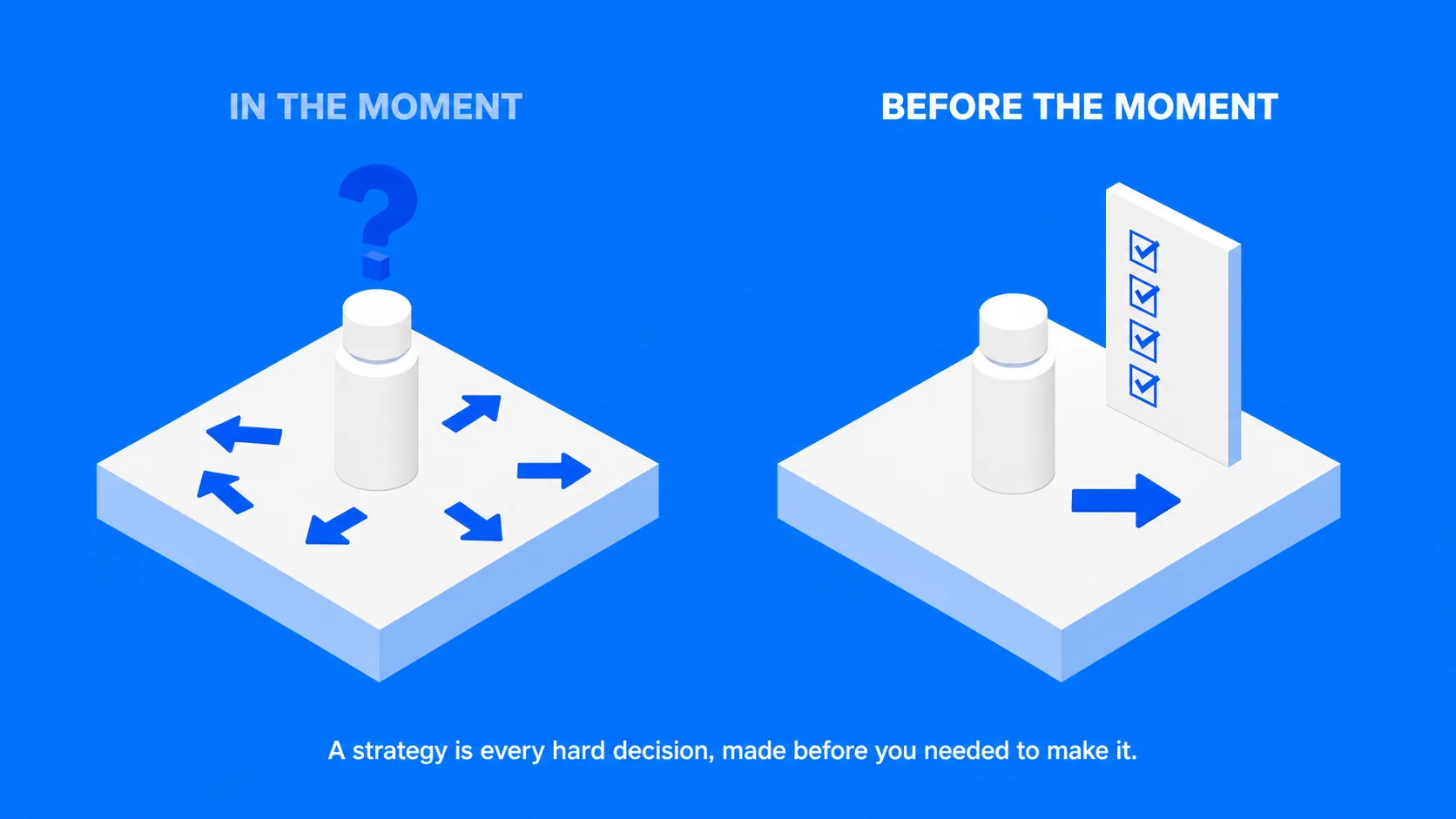
A forex trading strategy is a rules-based decision framework that governs four things: which currency pairs to trade, when to enter and exit, how large each position is, and how much capital is at risk at any moment, applied to the foreign exchange market whose scale is documented every three years by the Bank for International Settlements. The word “strategy” is often used loosely to mean a chart pattern or an indicator setting, but an indicator is only an input; a strategy is the complete set of instructions built around inputs.
Every functional strategy addresses four essential components. Market selection defines which pairs the trader watches, since price behavior on EUR/USD differs from behavior on an exotic pair with wider spreads. Position sizing defines the amount committed per trade, usually as a fixed percentage of account equity rather than a fixed lot size. Exit rules define both the profit target and the loss threshold before the trade opens. Risk parameters cap total exposure, including how many positions can run simultaneously and how much of the account can be at risk across all of them.
How do manual and automated strategies differ in practice?
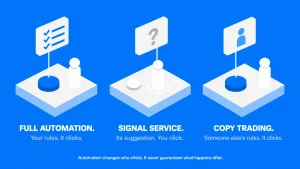
A manual strategy requires the trader to observe conditions and execute each order personally, which allows judgement in unusual conditions but invites inconsistency and hesitation. An automated strategy encodes the same rules into an algorithm that executes without interpretation, which guarantees consistency but cannot adapt when market conditions change beyond what the code anticipates. Most beginners start manually, because writing rules by hand forces them to understand every rule.
One point competitor guides rarely state directly: a strategy is not a standalone tool that works for anyone who picks it up. A strategy must fit the specific person using it, and that fit begins with choosing the right type.
What are the main types of forex trading strategies?
Forex trading strategies are grouped primarily by time horizon: the expected holding period of a trade and the chart timeframe used to find it, which together determine how the strategy is managed day to day. Strategies also differ by market approach, since some are built for trending conditions and others for ranging markets, but the holding period is the axis that most affects a trader’s life. The four main categories, ordered from shortest to longest horizon, are scalping, day trading, swing trading and position trading, each carrying its own pace, screen-time demand and margin for error.
Which strategy suits a beginner with limited time?
Time availability is the primary filter, before any question of skill or capital. Scalping demands near-constant attention to the screen during active sessions, while swing and position trading can be managed with one or two chart reviews per day. A beginner with a full-time job is structurally mismatched with scalping regardless of talent, and often better served by the longer-horizon families described below.
Scalping strategy
Scalping is an ultra-short-term approach that targets very small, frequent profits from trades held for seconds to a few minutes, usually on 1-minute or 5-minute charts. A scalper may execute dozens of trades in a session, so each trade’s cost matters: tight spreads and deep liquidity are prerequisites, not preferences. Success depends on execution speed, strict discipline in cutting losers instantly, and trading only the most liquid pairs during peak session overlap, making scalping the most demanding strategy family in both attention and temperament.
Day trading strategy
Day trading involves opening and closing positions within a single session, with no trade held overnight, typically on 15-minute to 1-hour charts. Closing everything before the session ends removes overnight risk, including gaps caused by news released while the trader sleeps. The typical day trader is time-intensive and news-aware, tracking economic calendars because scheduled releases such as rate decisions move intraday prices sharply. Day trading suits people who can dedicate defined hours each day to the market.
Swing trading strategy
Swing trading holds positions for several days to a few weeks to capture individual price swings, usually identified on 4-hour or daily charts. The key advantage is reduced screen time: analysis is done once or twice a day, which makes swing trading compatible with a full-time job. Risk sits in the intermediate range, since overnight exposure exists but stop-loss distances are wider and less vulnerable to short-term noise. Swing trading is a common starting family for beginners.
Position trading strategy
Position trading is long-term trend following, with trades held for weeks, months or in some cases years, guided heavily by fundamentals such as interest-rate differentials and macroeconomic trends. Chart timeframes are weekly and monthly, and entries are infrequent. Position trading requires patience and sufficient capital to withstand wide interim price fluctuations without breaching risk limits, since a multi-month trend rarely moves in a straight line. Whatever the holding period, every one of these strategy families survives only when paired with deliberate control of risk.
How do traders manage risk within a forex strategy?
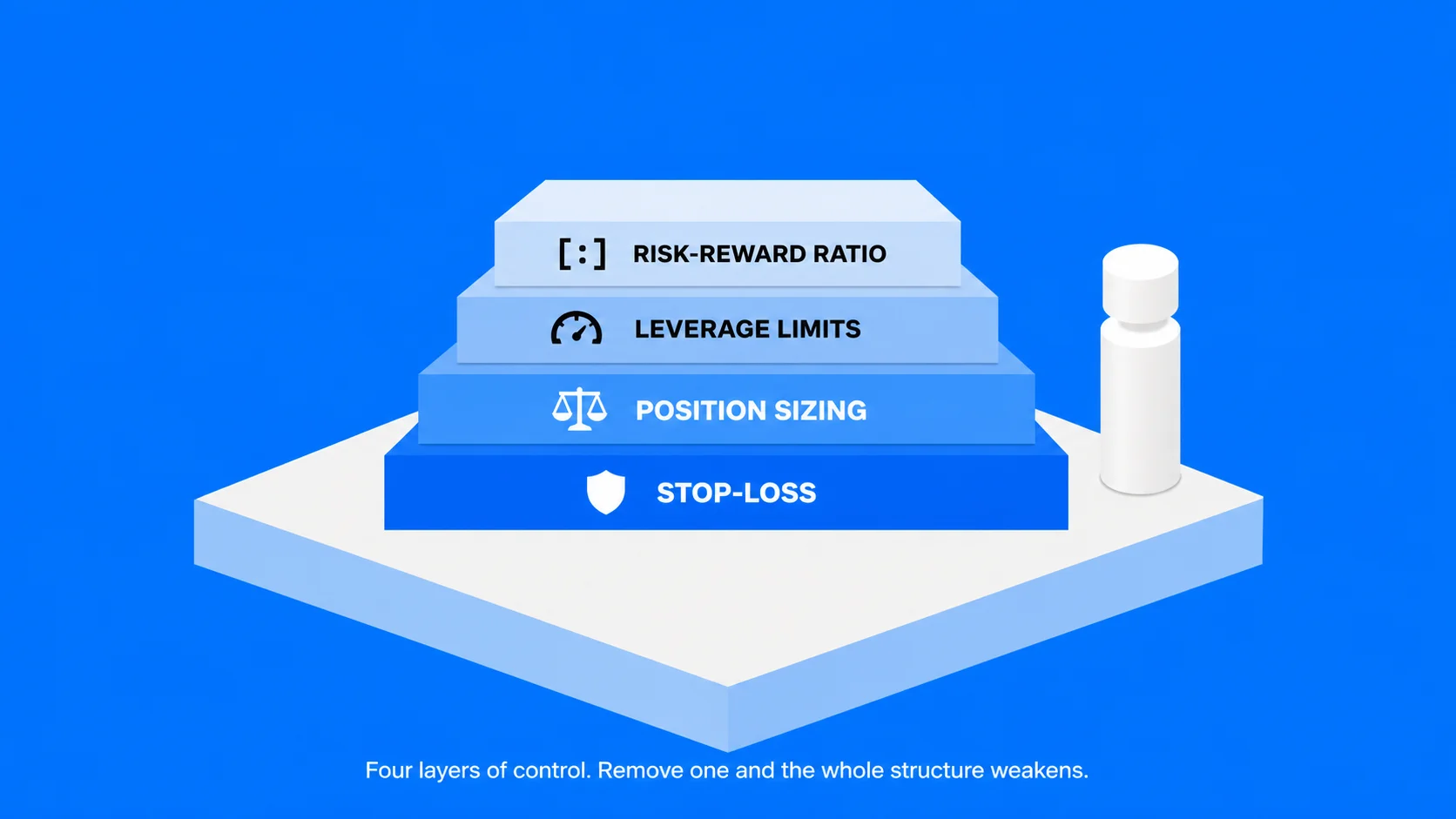
Risk management is the set of pre-defined controls inside a strategy that limits how much capital any single trade, or any sequence of losing trades, can remove from the account. Every strategy includes these parameters before the first live trade; a strategy without them is a directional opinion, not a system.
Regulatory data underlines why these matters: disclosures required by the European Securities and Markets Authority (ESMA) since 2018 show that most retail CFD and forex accounts lose money, a pattern the UK Financial Conduct Authority links closely to the absence of disciplined risk controls rather than to the market itself. For a strategy builder, that connection is encouraging means the risk section of the rulebook, which is fully within the trader’s control, does more to shape outcomes than the entry signal does.
The primary risk controls used across all strategy types are:
- Stop-loss orders: a predefined exit price that closes a losing trade automatically, capping the loss on that position.
- Position sizing: rules that set trade size from account equity, so the amount risked stays proportional.
- Leverage limits: self-imposed caps below the maximum a broker offers, since leverage magnifies losses as much as gains.
- Risk-reward ratio: a minimum ratio of potential gain to potential loss required before a trade qualifies.
A stop-loss functions as capital protection, not prediction: the trader is not claiming to know where price will go, only defining where the trade idea is proven wrong. Position sizing then controls how much that wrong idea costs, either through fixed lot rules or, more effectively, a percentage-of-account rule that also adjusts for the pair’s volatility, so a wide stop on a volatile pair automatically means a smaller position. Leverage sits above both: maximum permitted leverage varies by jurisdiction, capped at 30:1 on major pairs for retail traders under ESMA (2018) and 50:1 under the US CFTC, so traders are responsible for verifying the rules that apply where they live.
How much of an account should be risked on a single trade?
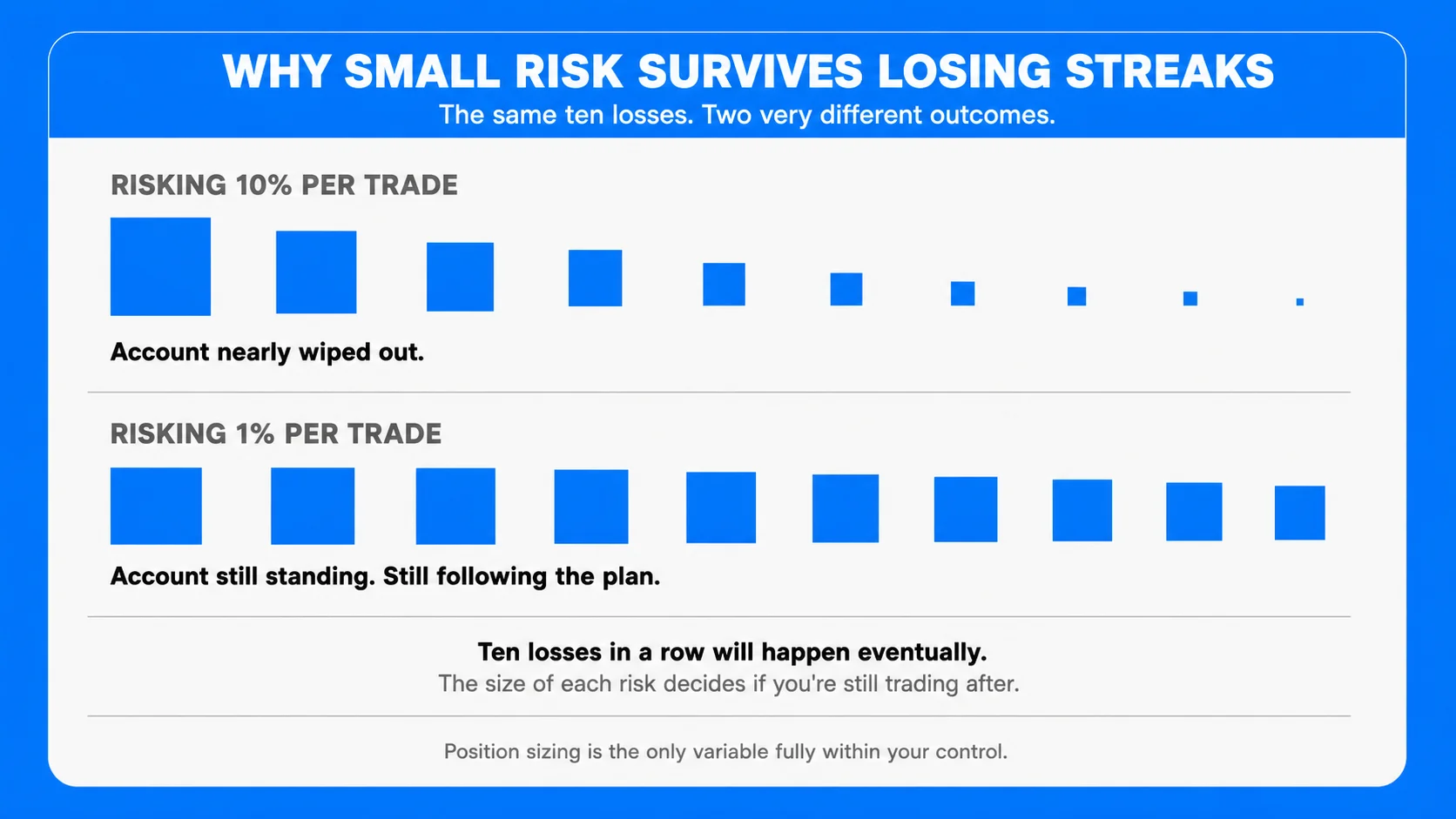
The widely cited convention in trading literature is 1 to 2 percent of equity per trade, described in Van Tharp’s “Trade Your Way to Financial Freedom” (1999) as the foundation of ruin avoidance: at 1 percent risk, ten consecutive losses remove roughly 10 percent of the account, a drawdown a trader can recover from and, more importantly, keep following their rules through. With risk parameters defined, the trader is ready to create the strategy itself.
How to create and select a forex trading strategy
No single universal strategy exists, because the correct strategy depends on personal factors: available time, starting capital, risk tolerance and genuine interest in the markets being traded. The selection process therefore starts with the trader, not with the market. Any guide that names one approach as “best” is answering the wrong question; the practical question is which rules-based system a specific person can execute consistently for months. The following sequence builds that fit deliberately.
- Assess personal availability and risk of comfort first. Count the hours per week realistically available for analysis and execution and define the maximum drawdown that would not cause panic. These two numbers eliminate more strategy options than any technical consideration.
- Select a time-horizon family. Match the hours from step 1 against the four families above: continuous availability opens scalping and day trading; one review per day points to swing or position trading.
- Define entry, exit and risk rules explicitly. Write the exact conditions that trigger an entry, the stop-loss and target logic, and the percentage risked per trade. Vague rules cannot be followed or tested; backtesting, covered later, verifies these written rules against historical data.
- Choose one currency pair to focus on initially. A major pair such as EUR/USD offers tight spreads and abundant information, and depth of familiarity with one pair beats shallow attention across ten.
- Commit to a trading journal. Record every trade’s setup, size, outcome and the trader’s adherence to the rules, since the journal becomes the raw data for later review.
Can a trader change strategies later?
Yes, and most eventually do, but changes must be deliberate and data-driven: a documented pattern across dozens of journaled trades, not a reaction to a single loss. Abandoning rules after one losing trade is the most common way a working system gets discarded before its edge appears. Once a strategy is written and running, the next discipline is knowing how to evaluate whether the system is actually performing.
How do you evaluate a forex trading strategy?
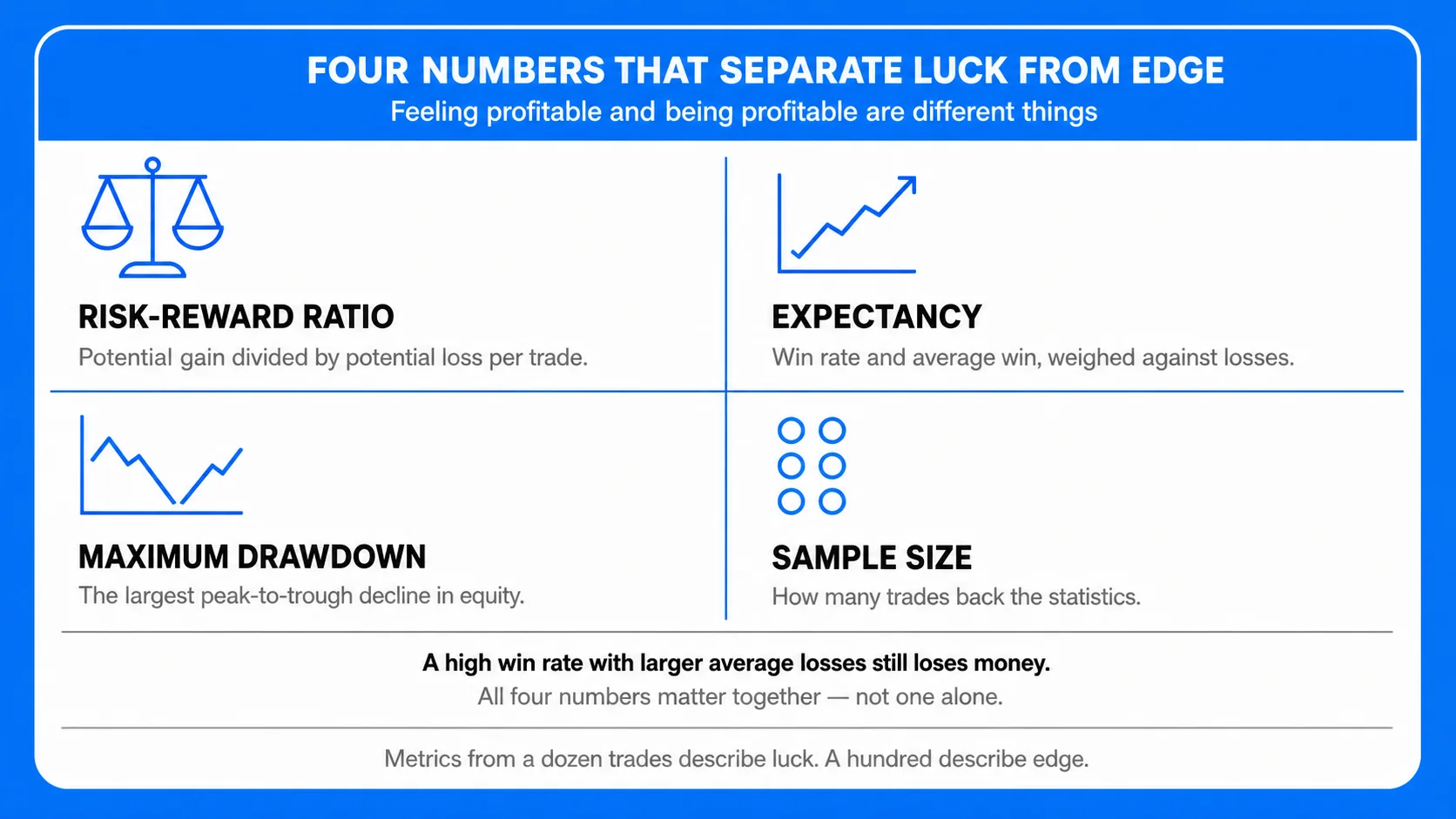
Evaluating a forex trading strategy is as important as creating one, because a strategy that feels profitable and a strategy that is statistically profitable are frequently different things. Past performance does not guarantee future results, so evaluation is about establishing whether an edge existed over a meaningful sample, not about predicting the next trade. Four metrics, used together, give a realistic picture:
- Risk-reward ratio: average potential gain divided by potential loss per trade; a 2:1 ratio risks 1 unit to target 2.
- Expectancy: (win rate x average win) minus (loss rate x average loss); positive expectancy means profit over many trades.
- Maximum drawdown: the largest peak-to-trough decline in account equity across the tested period.
- Sample size: the number of trades behind the statistics; small samples produce unreliable metrics.
The risk-reward ratio alone proves nothing, because a favorable ratio paired with a low win rate still loses money. Expectancy resolves this by combining both sides: Van Tharp (1999) defined the “R” concept, where each trade’s result is expressed as a multiple of the initial risk, and a system earning a positive average R across a large sample is viable. The reverse trap is worth understanding early: a 2023 study of 25,000 retail traders found that most held win rates above 50 percent, yet the majority still finished behind because their average loss was larger than their average win. The lesson is constructive, not discouraging, since sizing losses smaller than wins is a rule any trader can set in advance. Drawdown then measures the psychological cost of the equity curve, since a deep decline breaks most traders’ discipline long before the account is empty.
What is the minimum number of trades needed to trust a strategy’s performance?
Basic statistical reasoning in trading literature treats 30 trades as an absolute floor and 100 or more as a credible sample, with the required number rising for lower-frequency strategies whose results vary more per trade. Metrics from a dozen trades describe luck, not edge. Evaluation only becomes possible, though, when the strategy is embedded in something that generates consistent data in the first place: a written trading plan.
How do I turn a strategy into a consistent trading plan?
A trading plan is the bridge between strategy theory and daily execution: a written document that specifies not only the rules-based strategy itself but the routine surrounding those rules. The distinction matters because impulsive decisions rarely come from ignorance; they come from facing choices in real time without a pre-committed answer. Research on sequential decision-making supports this, with Danziger, Levav and Avnaim-Pesso (2011, PNAS) showing that decision quality degrades measurably across repeated judgements, which is precisely the condition a trader without a plan operates under every session.
A complete plan contains a small set of essential sections: the market overview and chosen pair, the strategy’s entry, exit and risk rules, hard risk limits for the day and week, the sessions during which trading is permitted, and a fixed review cadence tied to the evaluation metrics above. The plan converts the strategy families, risk controls, selection steps and performance measures covered so far into one operating document a trader follows the same way every day.
A plan on paper still proves nothing until confronted with data. Once the plan exists, structured forex strategy testing against historical and simulated conditions is the natural next step, and testing is where a written strategy earns or loses its place.
How do backtesting and forward testing help validate a forex strategy?
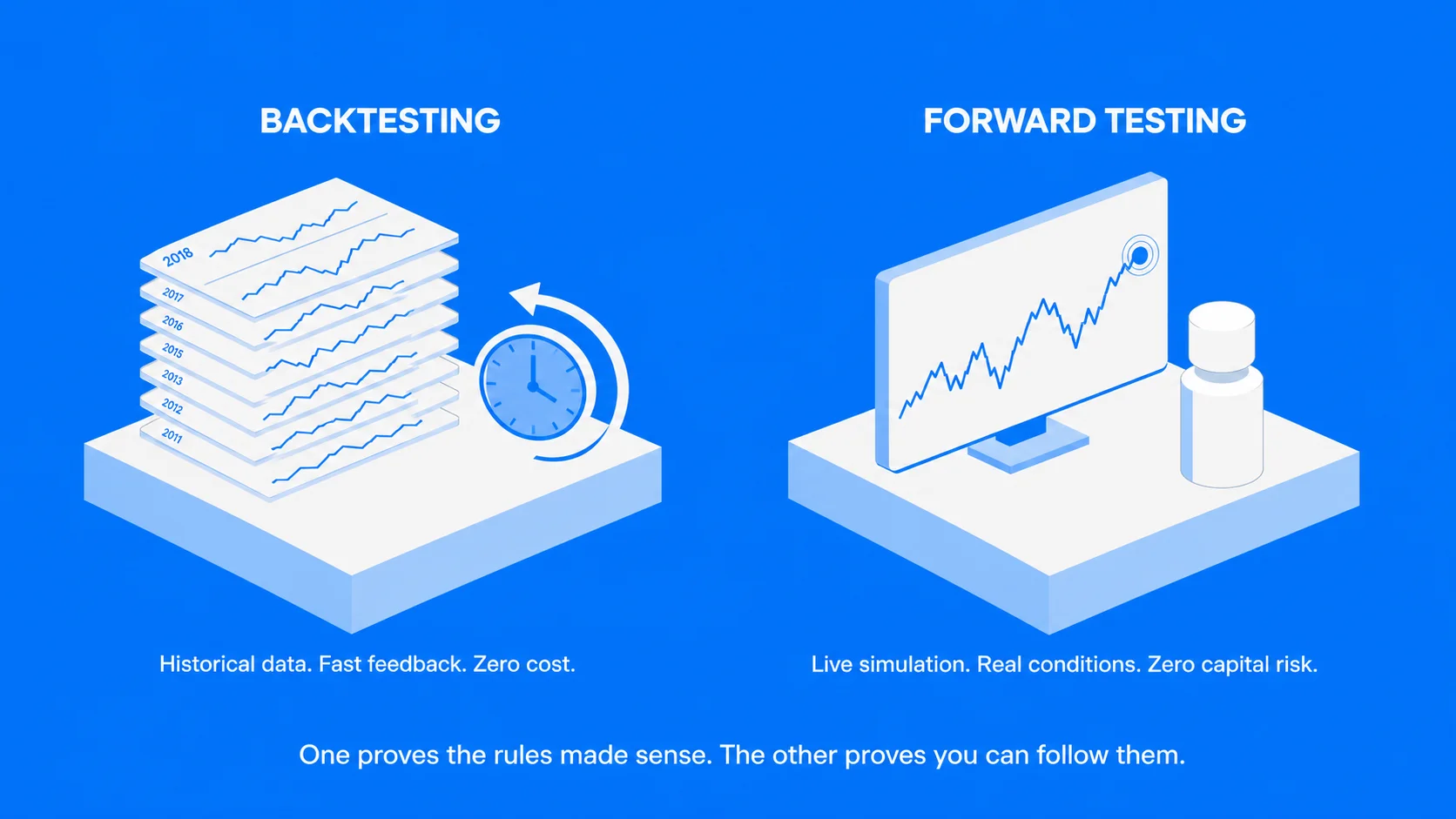
Backtesting applies a strategy’s written rules to historical price data to measure how the rules would have performed, while forward testing runs the same rules in a live or simulated market in real time; the two methods complement each other and neither guarantees future profits. Past performance is not indicative of future results, so testing establishes plausibility, not certainty.
Backtesting comes first because the cost is zero and the feedback is fast: years of data can be reviewed in days, producing the expectancy, drawdown and sample-size figures described earlier. The limitation is realism, since historical replay cannot fully reproduce live spreads, slippage on fast markets, or the emotional pressure of watching real positions move.
Forward testing fills exactly that gap. Running the strategy in a simulated demo environment with virtual funds, then optionally with small live positions, exposes execution speed, order handling and the trader’s own discipline under real-time conditions. The full methodology, including data selection and common testing errors, is covered in UEXO’s dedicated guide to forex strategy testing. A strategy that survives both stages has earned cautious live deployment.
What technical analysis tools are commonly used in forex strategies?
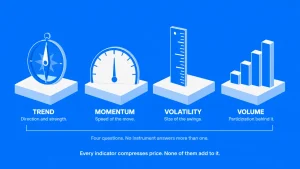
Many forex strategies use technical analysis tools to time entries and exits, the same tools a trader draws on when writing the entry and exit rules in Step 3 of strategy creation, but the tools are not the strategy: they generate information, and the strategy’s rules decide what to do with it. The commonly used tools fall into three groups:
- Trend-following tools: moving averages and trend lines, which identify the prevailing direction and its slope.
- Support and resistance tools: horizontal price levels and pivot points, which mark zones where price has repeatedly reversed.
- Oscillators: the Relative Strength Index (RSI) and stochastic oscillator, which flag overbought and oversold conditions in ranging markets.
Trend tools suit swing and position strategies, support and resistance levels anchor stop-loss placement across all families, and oscillators serve shorter-term mean-reversion approaches. Each group answers a different question, which is why strategies typically combine one tool from two groups rather than stacking five indicators that repeat the same signal. Full explanations of each tool, with usage rules for each strategy family, are available in UEXO’s learning hub for technical analysis for forex.
How does fundamental analysis fit into a forex strategy?
Fundamental analysis reads the economic causes of price movement rather than the price chart itself, using interest-rate differentials, inflation data, central-bank policy and scheduled economic releases to judge a currency’s direction. Fundamental analysis drives longer-horizon strategies most heavily: position trading depends on it, and day traders track the economic calendar because releases such as rate decisions move intraday prices sharply. Technical and fundamental analysis are complementary inputs, not rival strategies, one timing the entry and the other explaining the trend behind it. A full treatment of the key drivers is covered in UEXO’s guide to forex fundamental analysis.
What are the most common mistakes traders make when using forex strategies?
Even a well-designed strategy fails when its rules are ignored or applied in conditions the rules were never built for, so awareness of the typical errors is itself a performance improvement. The recurring mistakes among strategy users are:
- Changing rules after a losing streak, which discards the sample before the edge can appear.
- Failing to keep a journal, leaving no data for the evaluation metrics that reveal what actually works.
- Using inconsistent position sizes, which lets one oversized loss undo many disciplined wins.
- Trading without a written plan, returning every decision to real-time impulse.
- Applying trend strategies in ranging markets, a mismatch between the tool and the current condition.
Each of these errors is correctable through the plan, journal and review cadence already described. A fuller breakdown, with correction steps, is available in UEXO’s resource on forex trading mistakes.
How can UEXO help you apply and test a forex trading strategy?
A strategy is only as good as the environment where its rules are executed, and moving from paper to live markets works best in stages. UEXO supports both stages in one platform: the charting timeframes, order types (including stop-loss and limit orders) and educational content a rules-based trader needs, alongside the account types that carry a strategy from testing to deployment.
Start by validating the strategy in a UEXO demo trading account, where entries, sizing and exits are practiced with virtual funds and no capital exposure. Once the strategy shows a positive edge across a sample of journaled trades, moving to a UEXO live trading account applies the same tested rules in real market conditions, on the platform where the strategy was built. Validate first, deploy second, and let the evaluation metrics, not emotion, guide the strategy’s path toward profitability.
Can forex trading strategies guarantee profits?
No. No trading strategy can guarantee profits; forex trading involves substantial risk, and past performance is not indicative of future results. Profitability claims attached to any strategy are marketing, not statistics.
Is there a single best forex trading strategy?
No. The best strategy depends on a trader’s time availability, risk tolerance, market focus and goals; a strategy that works for one person can fail for another. Fit determines outcome more than the strategy’s popularity does.
Can I combine multiple forex strategies?
Yes. Many traders combine strategies, for example a trend-following approach with a mean-reversion overlay for ranging conditions, but each strategy must be tested separately before being combined. Combining untested systems combines unknown risks.
Conclusion
A well-defined forex trading strategy, tested against data and applied through a written plan, transforms trading decisions from guesswork into a disciplined, measurable process; ongoing education and strict risk management remain the conditions that keep that process intact. These concepts become skills only through practice, and practice does not require capital exposure. The most useful next step is to take the strategy built through the five selection steps into a UEXO demo trading account, where entries, sizing and exits can be tested with virtual funds and no financial exposure. When the results justify it, the same account environment carries the strategy into a live trading account without relearning the platform.