Key Takeaways
- Structure: a base currency priced in a quote currency, written as ISO 4217 codes.
- Cost: the spread is the entry cost; one pip on 100,000 EUR/USD units is about $10.
- Majors: seven USD pairs, deepest liquidity and tightest spreads.
- Minors: crosses without a dollar leg: thinner volume, wider spreads.
- Exotics: emerging market currencies, widest and least stable spreads.
What Is a Currency Pair?
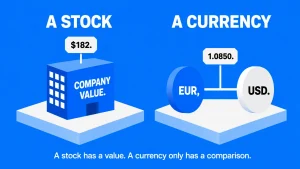
A currency pair prices one currency, the base currency, in terms of a second one, the quote currency, using the three-letter codes defined by ISO 4217. In EUR/USD the euro is the base and the US dollar is the quote, so 1.0850 means one euro buys 1.0850 US dollars. The base is always a single unit, so the number moves only when the relative value of the two currencies changes.
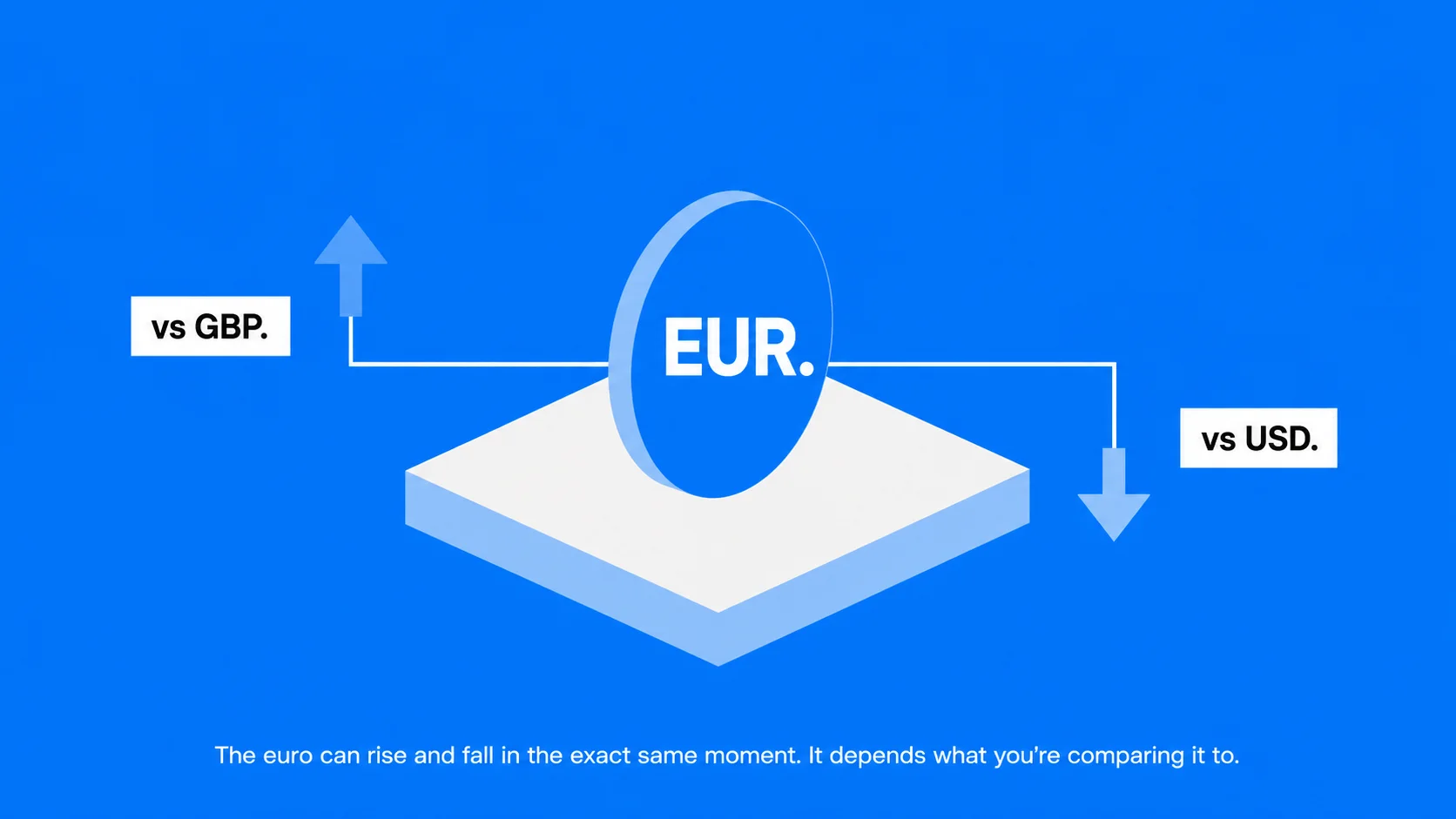
Because both currencies sit in the same transaction, you never simply buy dollars: you buy one and sell the other at once. Buying EUR/USD is a position in favour of the euro against the dollar, and selling it is the reverse. That makes a beginner’s first decision comparative rather than directional. The question is not whether the euro will strengthen, but whether it will strengthen against the dollar specifically, and a euro that rises against sterling while slipping against the dollar still loses money on a long EUR/USD position. Acting on that distinction starts with reading the quote itself.
How Do You Read a Currency Pair Quote?
| Quote component | What it means | What it tells you |
|---|---|---|
| Base currency | First code in the pair | The unit being priced and traded |
| Quote currency | Second code in the pair | How much is paid per unit |
| Bid | Price your broker buys at | Where you can sell the pair |
| Ask | Price your broker sells at | Where you can buy the pair |
| Spread | Gap between bid and ask | Immediate cost of opening a position |
The spread is measured in pips: the fourth decimal for most pairs, the second for yen pairs. At 1.0850 bid and 1.0851 ask, the spread is one pip. On a standard 100,000-unit EUR/USD position one pip is worth about $10, so that spread costs roughly $10 to enter and a five-pip spread costs $50, before the price moves at all.
Why does the spread widen on less liquid currency pairs? A market maker quoting a pair with fewer buyers and sellers carries more risk and prices it into the gap. The US dollar sits on one side of 89% of all FX trades, BIS data shows, so dollar pairs draw the deepest flow and the tightest quotes. Liquidity is the variable behind nearly every cost difference between pairs.
What Are the Major Currency Pairs?
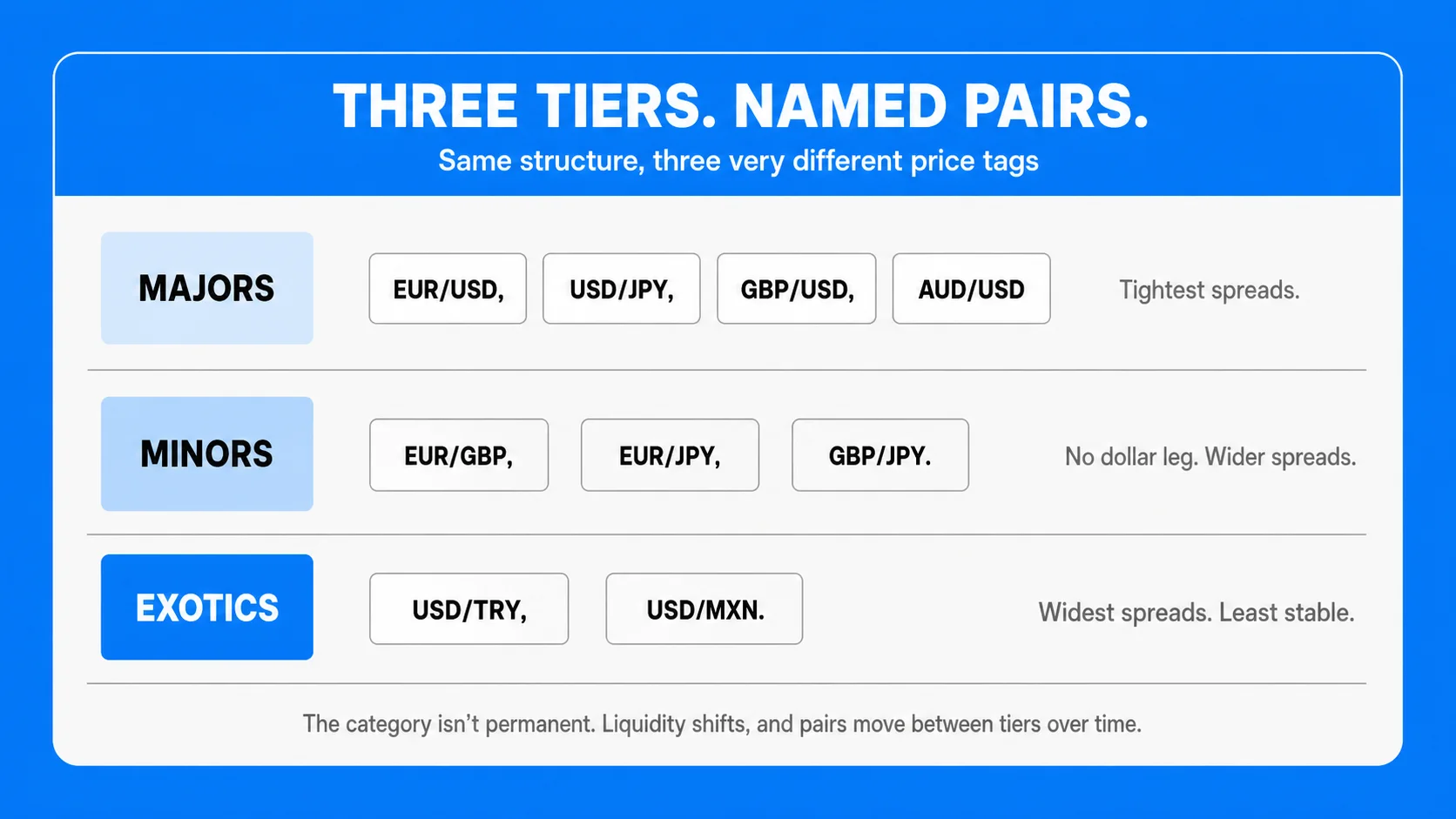
Liquidity defines the major currency pairs: seven pairs that combine the US dollar with another heavily traded currency. The BIS reports that the ten most traded pairs all involve the US dollar, which appears on one side of 89.2% of trades, ahead of the euro at 28.9% and the yen at 16.8%. Those shares total 200% rather than 100%, because every trade counts two currencies.
- EUR/USD: the euro against the dollar, the most heavily traded pair worldwide.
- USD/JPY: the dollar against the yen, driven by interest rate differences.
- GBP/USD: sterling against the dollar, reactive around UK data releases.
- USD/CHF: the dollar against the franc, often bought in risk-off periods.
- AUD/USD: a commodity currency pair tracking Australian resource exports.
- USD/CAD: a commodity currency pair tied closely to crude oil prices.
- NZD/USD: the New Zealand dollar, driven by agricultural exports and rate policy.
AUD/USD and USD/CAD are worth separating out: Australia and Canada are large commodity exporters, so both track metal and oil prices alongside rate expectations, a driver the other majors lack. All seven share USD on one side of the quote.
What Are Minor Currency Pairs?
A minor currency pair, or cross, excludes USD and sets two other actively traded currencies against each other. Minor refers to turnover, not to the economies involved: the euro, yen, pound, and franc are among the world’s most traded currencies. A cross is priced through two major relationships, so EUR/GBP reflects what EUR/USD and GBP/USD imply about the euro against the pound.
- EUR/GBP: euro against sterling, driven by relative eurozone and UK policy.
- EUR/JPY: euro against yen, often used as a risk appetite gauge.
- GBP/JPY: sterling against yen, known for larger intraday ranges.
- EUR/CHF: euro against the franc, typically one of the calmer crosses.
A cross inherits the liquidity of its components, and that can shift sterling’s share of global turnover fell to 10.2% in 2025 from 12.9% three years earlier. Skipping the dollar leg means less volume passes through these pairs, which shows up directly in a wider spread.
What Are Exotic Currency Pairs?
The spread widens further in exotic currency pairs, which match a major currency with one from a smaller or emerging market economy. Much less turnover passes through them, so fewer participants stand ready to take the other side of a trade.
- USD/TRY: the dollar against the Turkish lira, prone to sharp moves.
- USD/MXN: the dollar against the Mexican peso, sensitive to US trade and rates.
- USD/SGD: the dollar against the Singapore dollar, thinner but relatively stable.
The category is not fixed. BIS figures show USD/CNY turnover rose 59% and USD/HKD 95% between 2022 and 2025, lifting their shares of global turnover to 8.1% and 3.6%, so pairs can migrate toward the liquid end over time. For now, exotics still gap around domestic policy news, and the same position size carries a higher trading cost and a wider spread of outcomes than an equivalent trade in a major.
Why Do Currency Pair Categories Matter for Traders?
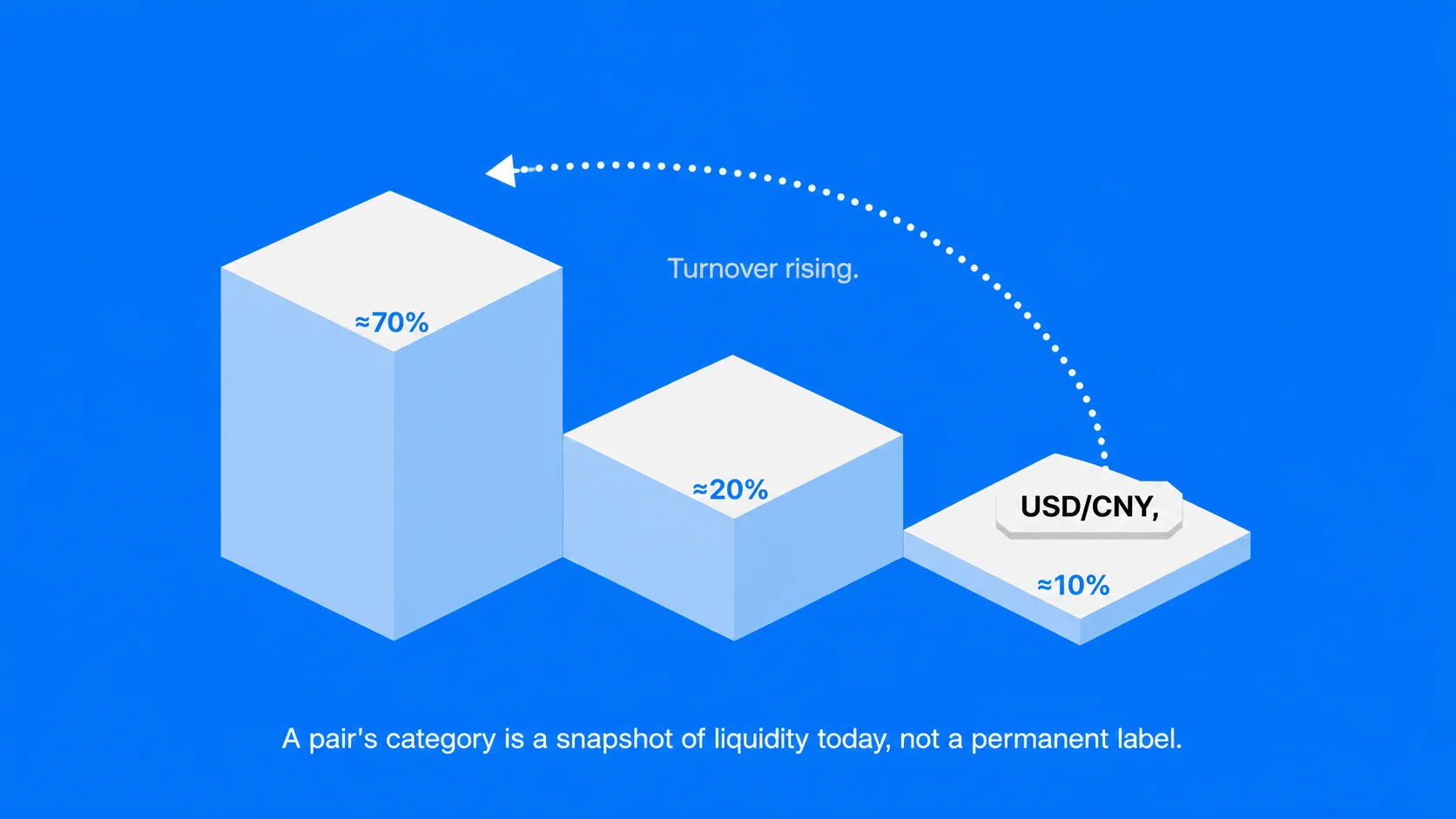
Trading cost is the practical reason the categories exist, because a pair’s category is a usable proxy for the liquidity behind it and the amount you give up simply by entering. Majors sit at the deep, low-cost end, crosses occupy a middle tier where the dollar leg is absent, and exotics sit at the expensive end where spreads are widest and least stable. That tiering makes categories worth checking before you place an order, with one caution: forex trading carries a real risk of loss, and understanding spread, liquidity, and leverage matters more than picking an exciting market. Cost is half the story, though, since two pairs in the same tier can behave very differently depending on what drives the price.
What Moves Currency Pair Prices?
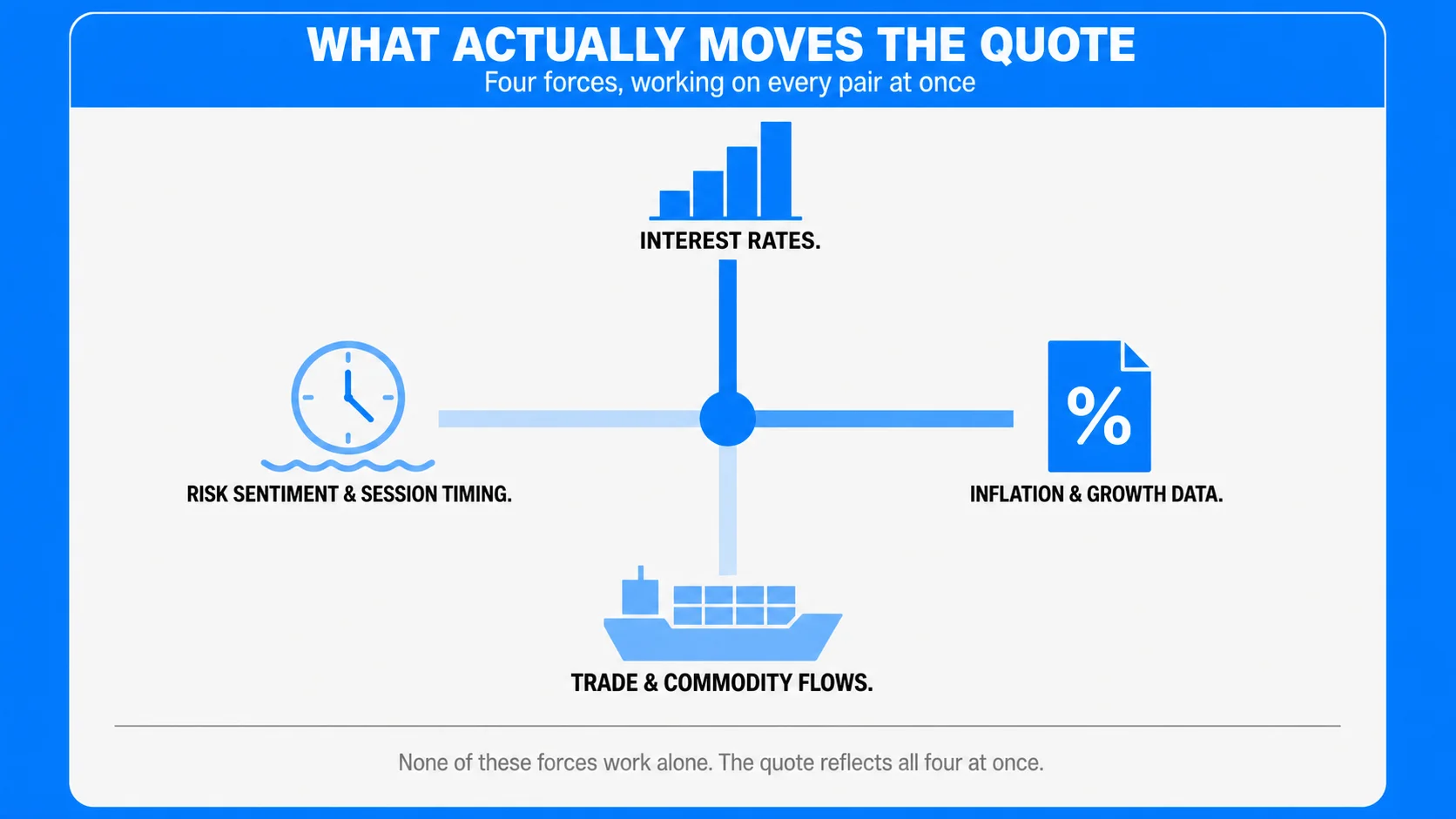
The currency pair’s price reflects the relative strength of two economies, so anything that shifts that balance moves the quote, often within seconds.
- Interest rates: higher relative rates tend to attract capital and support a currency.
- Inflation and growth data: releases that change rate expectations move pairs quickly.
- Trade and commodity flows: exporters’ currencies react to demand for what they sell.
- Risk sentiment and session timing: liquidity thins outside major sessions, amplifying moves.
Anyone wanting more depth can review forex market fundamentals alongside an economic calendar before trading around scheduled releases.
How Can Beginners Practice Currency Pair Trading?
The lowest pressure way to learn quote mechanics is a simulated trading environment, where prices track the live market but positions are funded with virtual money. It is worth opening a demo trading account to compare pip costs across majors, crosses, and exotics, and to watch how an open position reacts to a scheduled data release. Simulated results carry none of the emotional weight of live trading, and demo fills can be more forgiving than a fast market, so treat it as rehearsal rather than proof. Practising the mechanics first turns the eventual move to live capital into a decision about risk tolerance rather than about how the platform works.
Do Minor Currency Pairs Involve the U.S. Dollar?
No, minor currency pairs, also called crosses, do not involve the U.S. dollar.
They pair two other actively traded currencies, such as the euro and sterling in EUR/GBP, and usually trade on lower volume than dollar-based majors.
Are Exotic Currency Pairs More Expensive to Trade?
Yes, exotic currency pairs typically have wider spreads and lower liquidity, which can increase trading costs. A position opened at a ten-pip spread starts ten times further from breakeven than the same size opened at one pip, and that gap can widen during volatile periods.
Conclusion
Once the quote structure makes sense, practice turns into an informed choice: majors for depth and tighter spreads, crosses exposure without a dollar leg, exotics for wider ranges at higher cost. Before committing to a pair, compare its typical spread and liquidity against your trade size and holding period, and treat currency pair trading as a skill to build gradually. Regulation of retail forex differs by jurisdiction, so check the rules and protections that apply where you live before opening a live account.