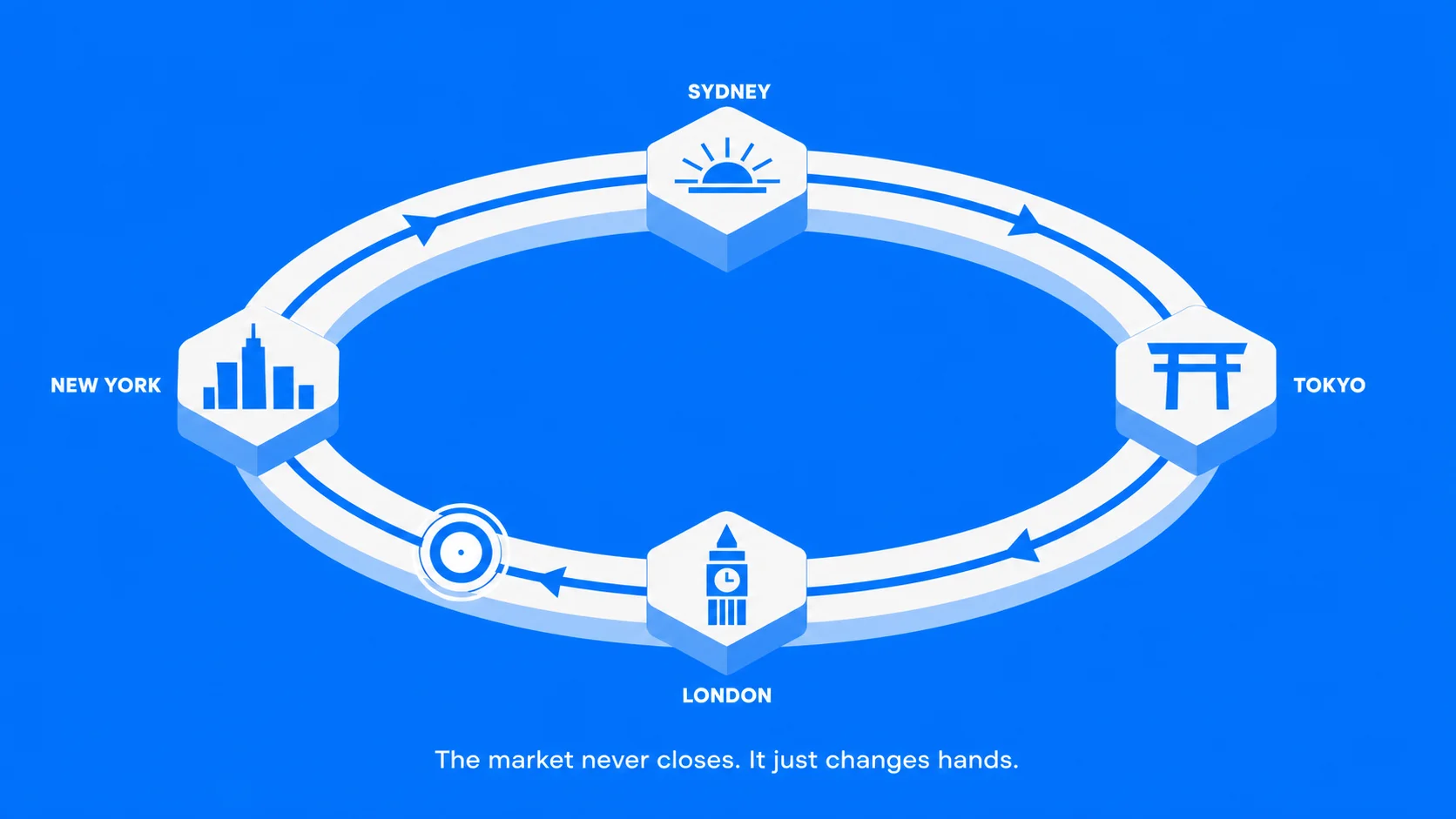
Key takeaways
- The forex market is open 24 hours a day, five days a week: Sunday 22:00 UTC to Friday 22:00 UTC (21:00 UTC during US daylight saving).
- Four sessions hand off in sequence: Sydney, Tokyo, London, New York, each running roughly nine hours.
- The London–New York overlap (12:00–16:00 UTC in northern summer, 13:00–17:00 UTC in winter) is the most liquid window of the day.
- The thinnest hour is the daily rollover, 21:00–22:00 UTC, when spreads widen and swaps are charged.
- Session times shift twice a year with daylight saving; Tokyo is the only major centre that never moves.
Why Forex Trades 24 Hours
Forex is a decentralised, over-the-counter market: banks, institutions, and brokers trade currency electronically across the globe rather than through one exchange. Daily turnover reached $9.6 trillion in April 2025 according to the BIS Triennial Survey, up 28 percent from 2022 and larger than every other financial market. As business hours end in one financial centre, they begin in the next: Sydney hands to Tokyo, Tokyo to London, London to New York, and New York back to Sydney. London alone handles around 38 percent of global turnover, which is why its session sets the tone for the trading day; retail traders contribute roughly $242 billion daily, about 2.5 percent of the total.
The only scheduled break is the weekend, from Friday’s New York close to Sunday’s Sydney open, plus market-wide holidays such as Christmas Day and New Year’s Day. Prices still move while the market is closed, which is why weekend gaps appear at Sunday’s open.
The Four Forex Market Sessions
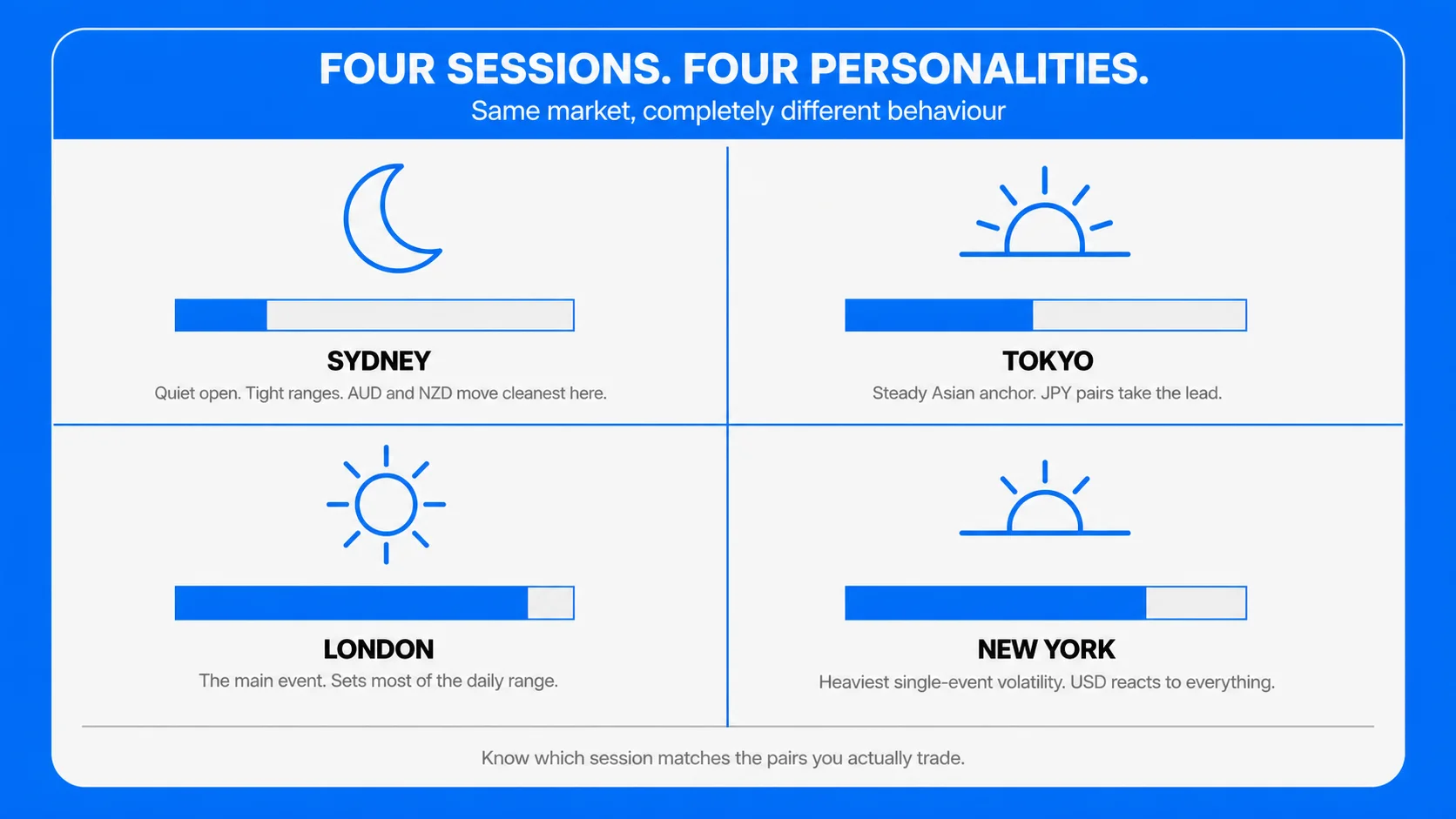
Session times shift by one hour when the UK, US, and Australia change their clocks for daylight saving. The times below use both standards, with US Eastern Time shown for reference; Tokyo is the only major centre that never shifts. To get your local times, apply your UTC offset to the column matching the current season.
| Session | UTC (Nov–Mar) | UTC (Mar–Nov) | EST/EDT (Mar–Nov) |
| Sydney | 21:00–06:00 | 22:00–07:00 | 6:00 PM–3:00 AM |
| Tokyo | 00:00–09:00 | 00:00–09:00 | 8:00 PM–5:00 AM |
| London | 08:00–17:00 | 07:00–16:00 | 3:00 AM–12:00 PM |
| New York | 13:00–22:00 | 12:00–21:00 | 8:00 AM–5:00 PM |
Sydney Session
The quietest of the four, Sydney opens the trading week. Ranges are typically tight and spreads slightly wider on non-Pacific pairs. The main scheduled activity is Australian and New Zealand economic data (RBA and RBNZ releases), so AUD and NZD pairs see their cleanest moves here.
Tokyo Session
Tokyo anchors the Asian trading day. Volatility runs higher than Sydney but well below London, with activity concentrated in JPY pairs and, to a lesser degree, AUD and NZD crosses. Bank of Japan decisions and Japanese data releases land in this window. Range-bound strategies tend to suit the Asian session; breakout traders often wait for London.
London Session
London is the largest forex centre in the world by daily turnover and the most volatile session. It overlaps Tokyo for its first hour or two and New York for its final hours, making it the only session that bridges two regional cycles. Most of the daily range on EUR/USD and GBP/USD is set here, and European data releases plus ECB and Bank of England decisions drive the sharpest moves in EUR, GBP, and CHF pairs.
New York Session
The second-largest session. US economic releases (Nonfarm Payrolls, CPI, FOMC decisions) generate the heaviest single-event volatility of the week, and USD is on one side of nearly 90 percent of all forex trades, so every major pair reacts. The first four hours, while London is still open, carry most of the volume; the final hours after London closes thin out noticeably.
Session Overlaps: Where Liquidity Peaks
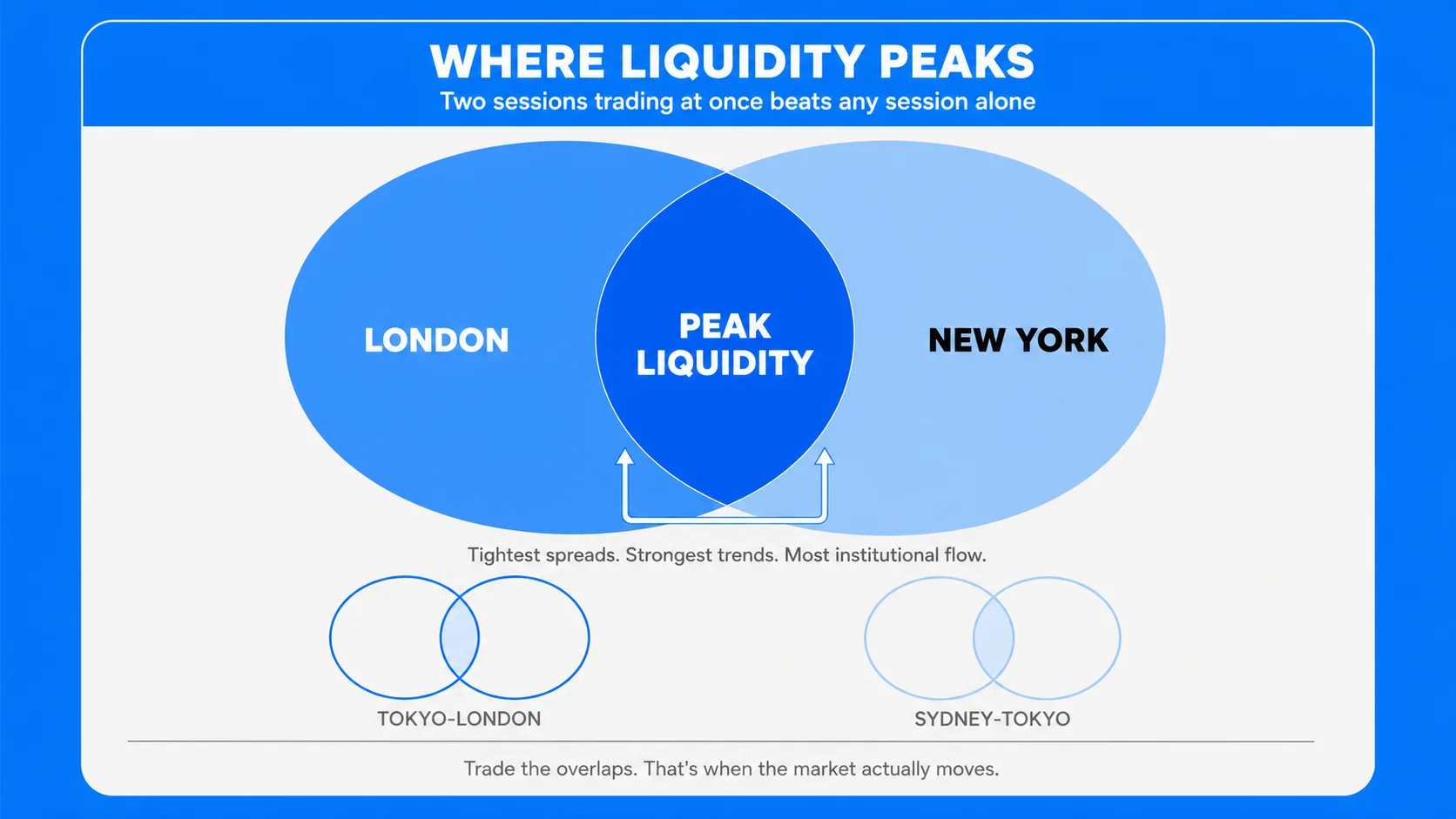
Overlaps are the windows when two centres trade simultaneously, and they matter more than the sessions themselves.
London–New York (13:00–17:00 UTC winter, 12:00–16:00 UTC summer; 8:00 AM–12:00 PM Eastern year-round). The most liquid four hours of the trading day. Both largest centres are active, spreads on majors compress to their tightest, and the biggest institutional flows go through. Most short-term traders concentrate their activity here.
Tokyo–London (07:00–09:00 UTC winter). A shorter, secondary overlap. Useful for catching the transition as European traders react to the Asian session, particularly on EUR/JPY and GBP/JPY.
Sydney–Tokyo (00:00–06:00 UTC winter). The Asian-Pacific overlap. Liquidity is moderate and concentrated in AUD, NZD, and JPY pairs; volatility stays lower than the European windows.
Optimal Trading Times
The general rule: trade when the pairs you hold are backed by an open home session and prefer overlaps for anything short-term.
- Best overall window: the London–New York overlap, for maximum liquidity, tightest spreads, and the strongest trends on majors.
- EUR, GBP, CHF pairs: London session, especially the first two hours and the New York overlap.
- JPY, AUD, NZD pairs: Tokyo session and the Sydney–Tokyo overlap.
- USD and CAD pairs: New York morning, when US and Canadian data are released.
- News traders: the minutes around scheduled releases (NFP on the first Friday of each month, CPI, central bank decisions). Expect spread widening and slippage at the release itself.
Where these windows fall in your day depends on your longitude. For traders in the Americas, the London–New York overlap is the morning; in Europe and Africa, the afternoon; in the Middle East and India, the evening; in East Asia and Australia, it runs overnight, which is why many Asia-Pacific traders focus on the Tokyo session or set pending orders instead. Convert once from UTC using your own offset, remembering that only the northern-hemisphere DST changes move these windows if your country does not observe daylight saving.
Times to Avoid Trading
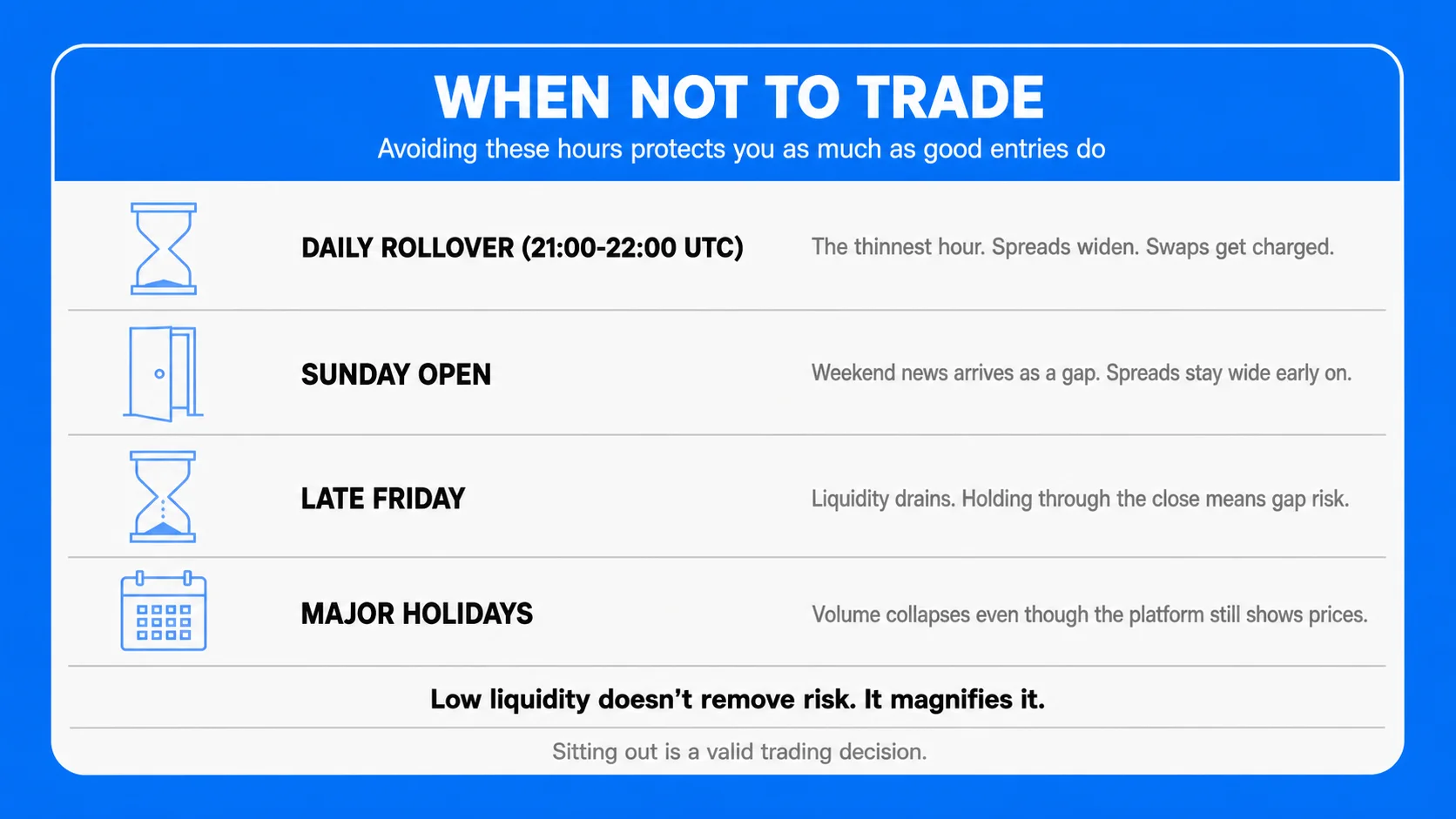
Low liquidity magnifies costs and randomness. The windows most traders sit out:
- The daily rollover (21:00–22:00 UTC). New York has closed, Sydney is barely open, spreads widen sharply, and swap charges are applied. The thinnest hour of the day.
- Sunday open. Weekend news gets priced in as a gap; spreads stay wide for the first hours.
- Late Friday. Liquidity drains ahead of the weekend and holding through the close exposes you to gap risk you cannot manage.
- Major holidays. Around Christmas and New Year, and on regional bank holidays, volume collapses even though platforms show prices.
- DST transition weeks. In March–April and October–November, the US, UK, and Australia change clocks on different dates, so overlaps temporarily shift or shorten by an hour. Check your platform’s market-watch clock rather than assuming.
One more consideration for position traders: swap charges apply to positions held through rollover, and Wednesday rollover typically charges triple swaps to cover the weekend. Swap-free accounts remove this variable where offered.
How to Track Sessions on Your Platform
MT4 and MT5 display server time, which usually differs from your local time; many brokers run server clocks on UTC+2 or UTC+3 so that daily candles align with the New York close. Confirm your broker’s server offset once, then either add a session-indicator overlay to your charts or keep a session clock beside your trading platform. Volatility is visible directly on the chart: compare average candle ranges in the Asian window against the London open on any major pair and the session structure appears immediately.
Trading conditions also depend on your account: spreads quoted during the London–New York overlap differ meaningfully between commission-free and raw-spread accounts, so match your forex trading account type to the sessions you plan to trade. A demo account is the zero-cost way to observe each session’s behaviour live before committing capital.
What time does the forex market open and close?
It opens Sunday at 22:00 UTC with the Sydney session and closes on Friday at 22:00 UTC with New York (21:00 UTC for both when the US is daylight saving). In US Eastern Time, that is Sunday 5:00 PM to Friday 5:00 PM.
Is the forex market open on weekends?
No. Retail forex closes from Friday’s New York close to Sunday’s Sydney open. Interbank and crypto markets may move in that window, which is why prices can gap at the Sunday open.
What is the best time to trade forex?
The London–New York overlap (13:00–17:00 UTC in winter, 12:00–16:00 UTC in summer) offers the deepest liquidity and tightest spreads. The best time for a specific pair is when its home session is open.
What is the best time to trade forex in my time zone?
Convert the London–New York overlap (12:00–16:00 UTC in northern summer, 13:00–17:00 UTC in winter) to your local time using your UTC offset. That window is the morning in New York, the afternoon in London, the evening in Dubai and Mumbai, and overnight in Singapore, Tokyo, and Sydney, where the Tokyo session is the practical alternative.
Why are spreads wider at certain times?
Spreads reflect liquidity. During the daily rollover hour, the Sunday open, and holidays, fewer participants are quoting prices, so the gap between bid and ask widens. During major news releases, spreads widen because of volatility rather than absence of participants.
Do forex trading hours change with daylight saving time?
Yes. London, New York, and Sydney shift their clocks (on different dates), moving session times by an hour in UTC twice a year. Tokyo never changes. Sessions on your platform follow the broker’s server time, so verify the offset after each transition.
Which session is most volatile?
London, by overall range, with the single sharpest moves clustering around US news releases in the New York morning. Sydney is the calmest.