Key takeaways
- The spread is a round-turn cost: you buy at the ask and sell at the bid, so it is paid once per trade.
- Commission-based accounts charge a flat per-lot fee against raw spreads; spread-only accounts bundle the fee into a wider spread.
- Swap is charged on the full notional position, not on the margin posted, and Wednesday rollover charges three days at once.
- Leverage does not change the cost per lot, but it changes what that cost represents as a percentage of your capital.
- Total cost matters in proportion to your profit target: 1.6 pips is 16% of a 10-pip scalp and 1.6% of a 100-pip swing.
Spreads
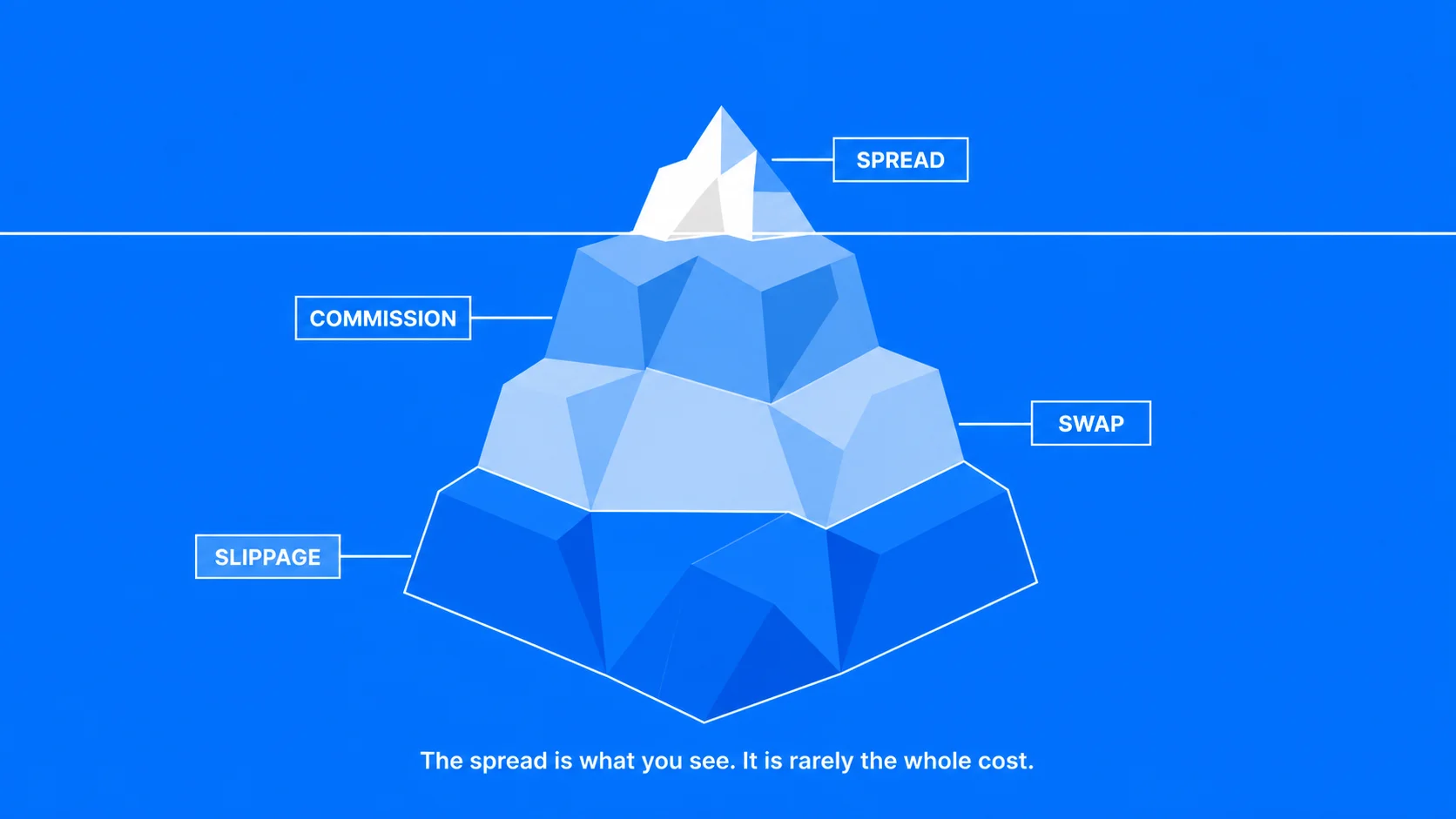
The spread is the difference between the bid (sell) price and the ask (buy) price of a currency pair, measured in pips. It is the most common forex trading cost and the only one that applies to every trade on every account type.
A long position opens at the ask and closes at the bid, so a trade is negative by the width of the spread the instant it opens. On EUR/USD quoted 1.08500 / 1.08516, the spread is 1.6 pips. On a standard lot (100,000 units, $10 per pip), that is $16 for the round turn.
Spread comes in two forms. Fixed spreads stay constant regardless of market conditions, which makes costs predictable but usually means a wider average. Variable (floating) spreads track live interbank liquidity, tightening during active sessions and widening during news, rollover, and thin markets. Most brokers offering raw or near-raw pricing use variable spreads.
Spread width depends on the pair. Majors carry the tightest spreads because they carry the deepest liquidity; minors sit wider; exotics such as USD/TRY or USD/ZAR can run 20 to 100 pips or more. Live spreads per instrument are listed on the forex pairs page. It also depends on the hour: spreads on majors compress during the London-New York overlap and widen sharply at the daily rollover and at the Sunday open, which is covered in the forex trading hours guide.
Commissions
A commission is a flat fee charged per lot traded, separate from the spread. It applies on ECN account types, where the broker passes through interbank pricing rather than marking it up.
Commission is quoted two ways and confusing them is the most common costing error traders make. Per side means the fee is charged once on entry and again on exit: $3.50 per side is $7 per round turn. Per round turn means the total for both legs. Always convert to a round-turn figure before comparing accounts.
The advantage of commission pricing is predictability. Spreads move with market conditions; the commission is a known constant, so a trader modelling costs in advance can rely on it. The disadvantage is that the fee is charged per lot regardless of the pair, which makes it proportionally expensive on pairs where the raw spread is already tight and negligible on exotics where the spread dominates.
Spread-Only vs Commission: Which Is Actually Cheaper
Compare accounts on all-in cost per standard lot, never on the advertised spread alone. Using UEXO’s three trading accounts on EUR/USD:
| Account | Spread from | Commission | All-in per standard lot | Break-even distance |
| Standard | 1.6 pips | None | $16.00 | 1.6 pips |
| Pro | 0.8 pips | $4 round turn | $12.00 | 1.2 pips |
| ECN | 0.0 pips | $7 round turn | $7.00 | 0.7 pips |
Full tier specifications and minimum deposits are on the forex account types page. The commission account is cheaper here by $9 per lot, or 56%. That gap is not a rounding error at volume: a trader placing one standard lot per trading day pays roughly $4,000 a year on Standard pricing against $1,750 on ECN, a difference of $2,250.
Two qualifications that most cost guides omit.
First, the cheapest pricing is gated by capital. ECN tiers typically carry minimum deposits of several thousand dollars, so the trader with $500 pays the widest spread available precisely because they have the least capital to absorb it. Cost efficiency in forex scales with account size, and this is the mechanism.
Second, the crossover depends on the pair. Commission is flat per lot; raw spreads are not. On EUR/USD, where the raw spread is near zero, a $7 commission is the entire cost. On an exotic quoted at 40 pips raw, the same $7 is 1.7% of a $407 total, and the spread-only account may price competitively. Run the comparison on the pairs you actually trade, not on EUR/USD by default.
Trade on raw spreads from 0.0 pips. Open a live account in minutes and pick the pricing tier that matches your volume, or compare all three tiers first.
Swaps (Overnight Financing)
A swap is the interest paid or received for holding a position past the daily rollover, reflecting the interest rate differential between the two currencies in the pair. Hold a higher-yielding currency against a lower-yielding one and the swap may be positive (credited); hold the reverse and it is negative (debited).
Three mechanics are consistently misunderstood.
Swap is calculated on notional, not margin. A single standard lot is 100,000 units of exposure regardless of whether you posted $1,000 or $10,000 in margin. If the swap is -$7 per night, ten nights costs $70, which is 7% of a $1,000 margin position and 0.7% of a $10,000 one. Traders who use high leverage to hold positions for weeks are paying financing on exposure many times their equity.
Wednesday charges triple. Spot forex settles two business days forward, so the Wednesday rollover carries the weekend, charging three days of swap in one debit. A carry trade that looks marginal on a daily basis can be net negative once the Wednesday multiple is included.
The two sides are rarely symmetrical. Brokers apply a markup to the underlying interest differential, which usually makes the negative swap more negative than the positive swap is positive on the same pair. Check both directions in your platform’s contract specifications rather than assuming a mirror.
Swaps are the dominant cost for swing and position traders. On a two-week hold, accumulated swap frequently exceeds the spread and commission combined, which reverses the ranking of “cheap” accounts entirely for that trading style. Swap-free accounts remove the charge but substitute a fixed administration fee or wider spreads, so compare that structure against the swap you would otherwise pay rather than assuming it is free.
How Leverage Multiplies Every Cost
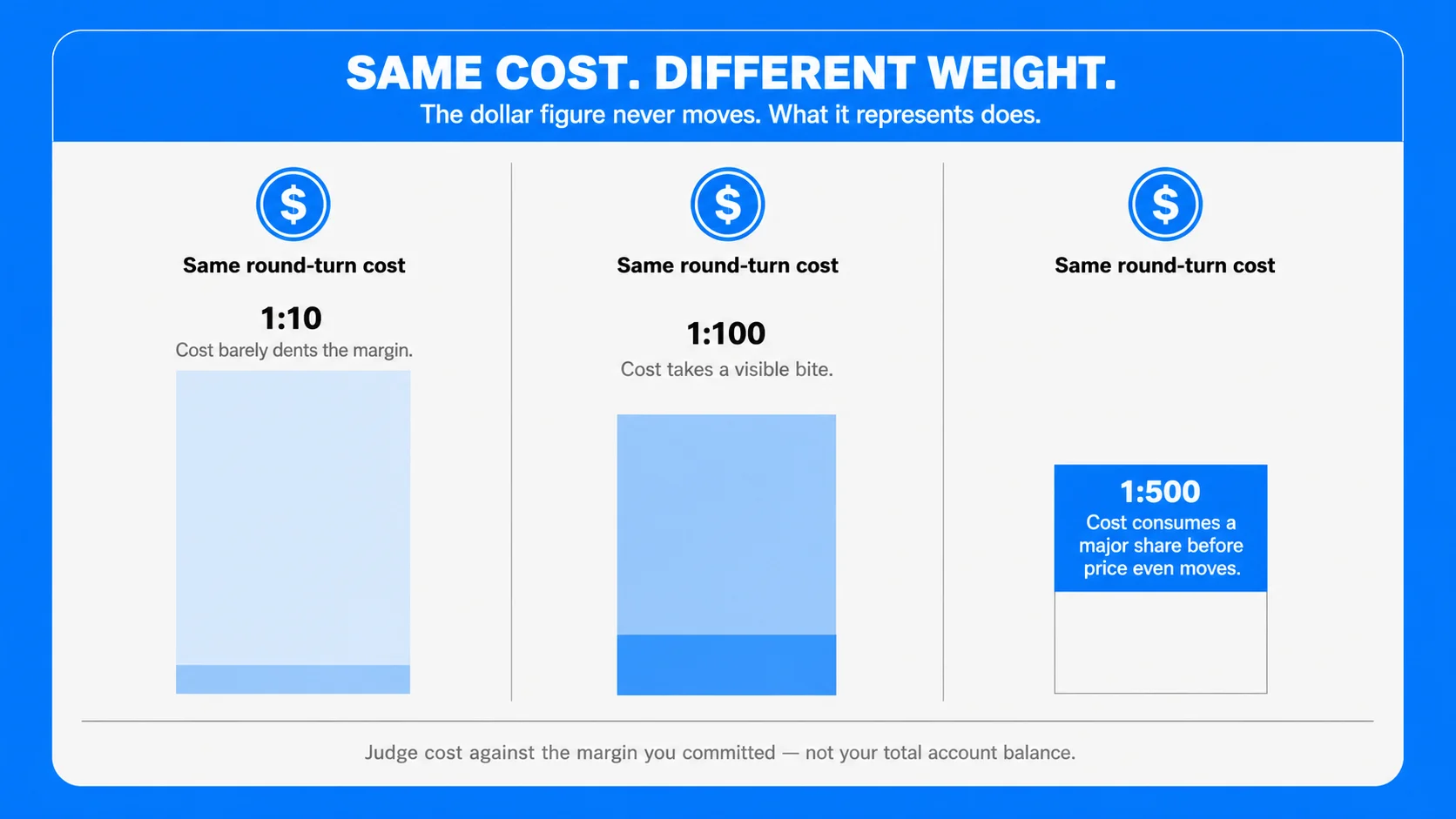
Leverage is not a cost in itself. No broker charges a fee for using 1:100 rather than 1:10. What leverage changes is the relationship between a fixed cost and the capital exposed to it, and this is where most cost analysis stops short.
The same one-lot EUR/USD trade costs $16 on Standard pricing at every leverage ratio. What changes is the margin backing it:
| Leverage | Margin required | Cost as % of margin |
| 1:10 | $10,000 | 0.16% |
| 1:100 | $1,000 | 1.6% |
| 1:500 | $200 | 8.0% |
At 1:500, the round-turn cost consumes 8% of the capital committed before price has moved at all. Leverage multiplies profit, loss, and cost-to-equity by the identical factor. A trader running high leverage on a spread-only account is therefore paying a cost that is trivial in dollars and severe in proportion, which is a large part of why high-leverage retail accounts fail faster than the underlying strategy would predict.
The practical rule: judge cost against margin committed, not against account balance.
Break-Even Distance: The Metric That Replaces Spread Comparison
Convert your all-in cost into pips and compare it to your profit target. That single number tells you what proportion of your edge the broker takes.
| Strategy | Typical target | Cost at 1.6 pips | Cost at 0.7 pips |
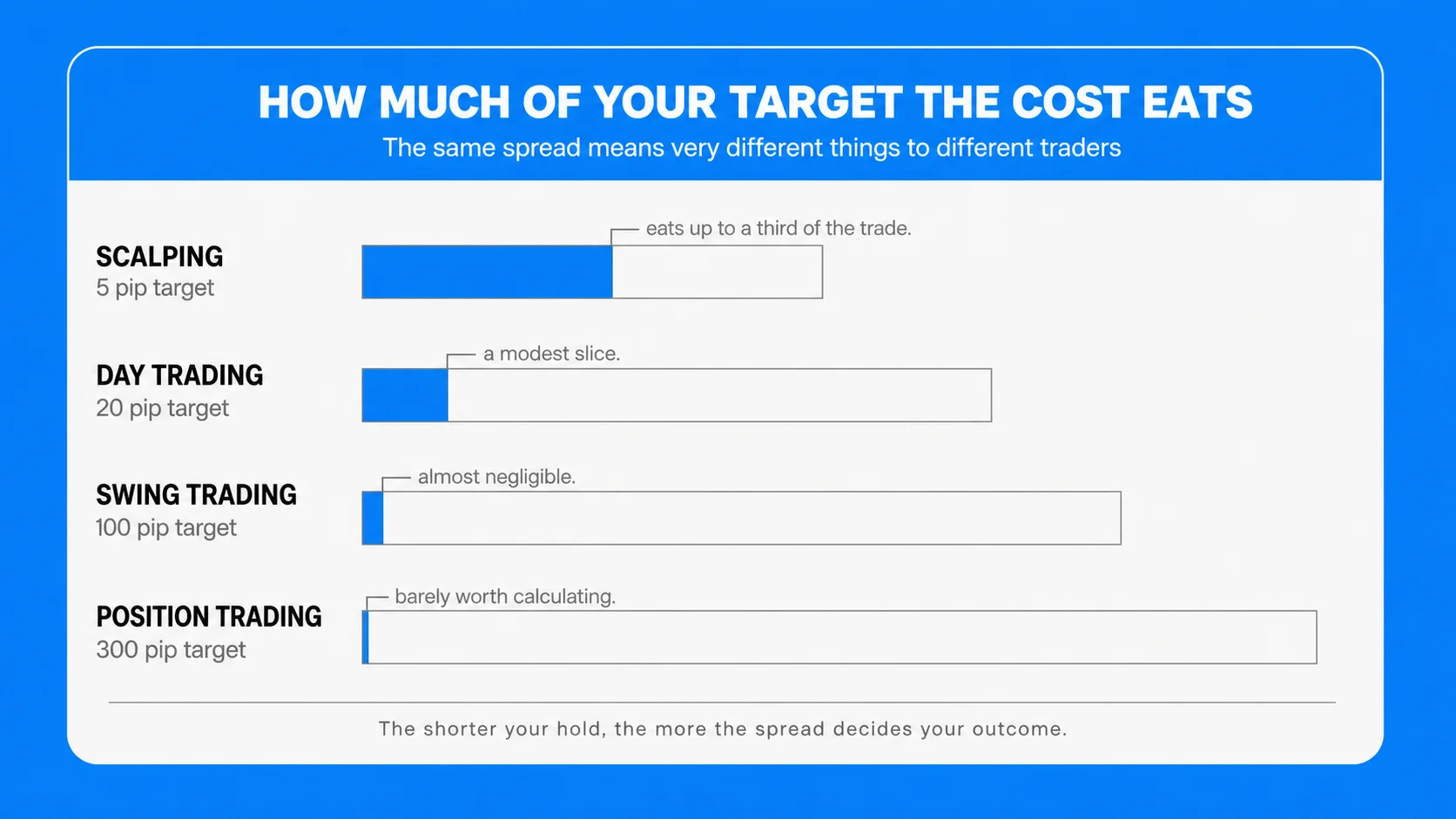
| Scalping | 5 pips | 32% of target | 14% of target |
| Day trading | 20 pips | 8% | 3.5% |
| Swing trading | 100 pips | 1.6% | 0.7% |
| Position trading | 300 pips | 0.5% | 0.2% |
The conclusion follows directly: the shorter your holding period, the more account pricing determines profitability, and the longer your holding period, the more swap does. A scalper on spread-only pricing gives up roughly a third of every winning trade before slippage. A position trader can largely ignore the spread and should be scrutinising swap rates instead.
Slippage and Execution Costs
Slippage is the difference between the price you requested and the price you received. It is not a fee, so it appears in no fee schedule, but it is a real and recurring cost that shows up in the gap between backtested and live results.
Slippage concentrates in predictable conditions: high-impact news releases, the market open after a weekend, thin liquidity at rollover, and large orders relative to available depth. It runs in both directions, though brokers with poor execution show a consistent negative skew. Limit orders control it by refusing worse fills; market orders accept whatever is available.
One practical consequence for stop placement: because a long position exits at the bid, a stop placed within the spread’s normal widening range can be triggered by the spread alone, without the market ever trading to your level. Tight stops on spread-only accounts during rollover or news are a specific and avoidable way to lose money.
Demo accounts typically do not model slippage, which is why demo results overstate the performance of short-term strategies.
Non-Trading Fees
These sit outside the trade lifecycle and are the easiest to overlook because they are charged monthly or on transfer rather than per position.
- Deposit and withdrawal fees: often free on card and e-wallet, sometimes charged on bank wires or after a monthly free allowance.
- Inactivity fees: a monthly charge applied after a dormancy period, commonly 6 to 12 months. Small balances can be eroded substantially by these.
- Currency conversion: applies when your deposit currency, account base currency, or the instrument’s profit currency differ. Trading EUR/GBP in a USD account means every realised profit is converted, at a markup. Choosing a base currency that matches your funding source removes the recurring version of this cost.
- Guaranteed stop-loss fees: where offered, GSLOs carry a premium, usually a widened spread on the position.
Total Cost by Trading Style
| Scalping | Day trading | Swing trading | Position trading | |
| Dominant cost | Spread + commission | Spread + commission | Swap | Swap |
| Slippage exposure | High | Moderate | Low | Low |
| Best-fit pricing | Raw spread + commission | ECN or Pro | Compare swap rates first | Compare swap rates first |
| Secondary factor | Execution speed | News-hour spreads | Triple-swap Wednesday | Conversion on long holds |
How to Reduce Forex Trading Costs
Trade major pairs during the London-New York overlap, where spreads on liquid instruments are at their daily tightest. Match the account tier to your volume: raw pricing pays for itself above a break-even lot count you can calculate from the commission and spread difference, and you can compare account pricing tier by tier before funding. Avoid holding through Wednesday rollover on negative-swap pairs unless the trade thesis justifies three days of financing. Set your account base currency to your funding currency. Use limit orders around news. And size positions so that cost is a defensible percentage of margin, not just a small dollar figure.
What is the average cost of a forex trade?
On a standard lot of EUR/USD, all-in transaction costs typically run $7 to $16 per round turn depending on account type, equivalent to 0.7 to 1.6 pips. Overnight holds add swap on top.
Is a zero-spread account actually free?
No. Zero or raw spread accounts recover the cost through a per-lot commission, usually $3 to $7 per round turn. The all-in figure is what matters, not the spread label. UEXO publishes spread and commission per tier on the accounts page.
What is the difference between spread and commission?
The spread is built into the price you trade at and varies with market conditions. Commission is a separate flat charge per lot that stays constant. Both are transaction costs paid on the same round turn.
Why was I charged the swap three times on Wednesday?
Spot forex settles two business days forward, so Wednesday’s rollover covers the weekend. This is standard across brokers, not an error.
Do swap-free accounts have no costs?
They have no overnight interest charge, but brokers substitute a fixed administration fee, wider spreads, or both. Compare that structure against the swap you would otherwise have paid.
Does higher leverage cost more?
Not in dollars: the spread and commission on one lot are identical at 1:10 and 1:500. But because higher leverage means less margin posted, the same cost consumes a much larger share of the capital committed to the trade.
Which cost matters most for my strategy?
Spread and commission for anything intraday, swap for anything held more than a few days. Convert your all-in cost to pips and compare it against your average profit target to see which one is eroding your edge.
Start Trading with Transparent Pricing
Costs are the one variable in trading you control before the market opens. UEXO publishes spread and commission per tier with no markup on withdrawals, across MT4 and MT5 on desktop, web, and mobile.
Start trading on a Standard, Pro, or ECN account, or try a free demo first to see live spreads on your own pairs before funding.