Key Takeaways
- Spot forex is about three to four times global equity turnover, not the ten to twenty times usually claimed — the $9.6 trillion headline includes swaps, forwards, and options.
- Forex trading is over the counter, so your quote is your counterparty’s price; two brokers can show the same pair differently at the same instant and neither is wrong.
- Open around the clock is not liquid around the clock: the UK, US, Singapore, and Hong Kong handle 72% of turnover, and spreads widen sharply outside those hours.
- Regulatory leverage caps are a ranking of volatility — 30:1 on major pairs against 2:1 on crypto — and leverage puts calmer markets back on similar footing.
- Forex is a relative market with a small instrument set: the US dollar is on one side of 89.2% of all trades, so most positions are partly a dollar position.
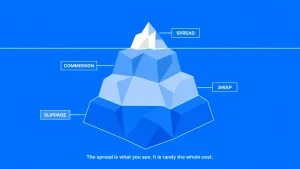
- Costs differ in kind, not just size — spread plus commission plus daily swap in forex, versus commission and borrow fees in equities, with settlement now diverging at T+2 against T+1.
What Makes Forex Different from Other Markets?
Forex is an over-the-counter market with no central exchange, and every price is a ratio between two currencies rather than a value attached to one thing. Both features separate it from equities in ways that affect a trader daily.
A stock has a price because a company has a value. A currency has a price only relative to another currency, so EUR/USD falling can mean a weaker euro, a stronger dollar, or both at once. That makes every forex position a simultaneous bet on two economies, and it removes the possibility of the whole market going up or down together, which happens routinely in equities and crypto.
The absence of a central exchange matters just as much. Stocks trade on venues with published order books and closing auctions. Currencies trade through a network of banks and brokers, so your quoted price is your counterparty’s price rather than a single consolidated market price. Two brokers can quote the same pair differently at the same instant, and neither is wrong. That is also why the instrument list matters: a broker’s forex trading coverage of major, minor, and exotic pairs sets the boundary of what you can actually act on. This market structure explains most of the comparisons that follow.
How Do Forex, Stocks, Crypto, and Commodities Compare?
Market structure sets the terms for everything else, so the table below compares the four across the dimensions that actually change a trading decision. Retail leverage caps shown are the European and UK limits, which differ by jurisdiction.
| Dimension | Forex | Stocks | Crypto | Commodity futures |
| What you trade | One currency against another | Ownership in a single company | A digital asset against fiat or another token | A contract on a physical good |
| Structure | Over the counter, no central venue | Regulated exchange with order book | Multiple independent exchanges, no consolidated tape | Regulated futures exchange |
| Hours | 24 hours, five days a week | Exchange hours plus limited extended sessions | 24 hours, seven days a week | Near-continuous on weekdays, with breaks |
| Retail leverage cap (EU/UK) | 30:1 on majors | 5:1 on individual equities | 2:1 | 10:1 on non-gold commodities |
| Settlement | Spot T+2 | T+1 in North America, T+1 in Europe from October 2027 | Minutes, on chain | Contract expiry or rollover |
| Instruments to choose from | Roughly 7 major pairs | About 60,900 listed companies globally | Thousands of tokens, quality varies | Dozens of liquid contracts |
| Primary driver | Relative interest rates and growth | Company earnings and guidance | Flows, sentiment, and adoption | Physical supply and demand |
Traders who want exposure to more than one of these columns generally do it through a single multi-asset account rather than four separate ones, since brokers now list forex, indices, commodities, and crypto CFDs side by side. Two rows deserve expanding, because both are routinely misreported: the turnover comparison and the leverage tiering.
How Does Trading Volume Actually Compare?

Comparing headline forex turnover with stock market turnover is not a like-for-like comparison, and the correct one is much closer than the usual claim. Most articles pit $9.6 trillion a day in forex against equity volumes and conclude that currencies are ten or twenty times larger. The comparison breaks down on inspection.
The BIS 2025 Triennial Survey puts total OTC currency turnover at $9.6 trillion a day in April 2025, but it also breaks that figure down by instrument. FX swaps account for 42%, outright forwards 19%, and options 2%. Spot trading, the part that resembles what a directional trader does, is 31%, or about $3 trillion a day. The rest is largely corporate hedging and bank funding, activity that exists because someone needs currency, not because someone has a view on it.
Now compare like with like. The World Federation of Exchanges reported global equity trading value of $203.6 trillion across 2025, up 36.8% on the previous year. Spread over roughly 250 trading sessions, that averages near $800 billion a day. So spot forex runs about three to four times global equity turnover, not the order of magnitude usually claimed, and the gap narrows further on heavy equity days.
One more figure change how a beginner should read all of this. Inter-dealer trading was 46% of global forex turnover in 2025. Nearly half the market is banks trading with banks, and retail flow does not register in the survey at all. The depth is real, and so is the fact that you are the smallest participant in it.
How Do Trading Hours and Sessions Differ?
Forex runs 24 hours across five days, crypto runs continuously, and equities trade in defined sessions, but continuous trading is not the same as continuous liquidity. The distinction is where most session comparisons stop short.
Forex liquidity is concentrated by geography as well as by clock. The BIS 2025 survey found that the United Kingdom alone accounted for 38% of global turnover, and that the UK, United States, Singapore, and Hong Kong together handled 72%. Spreads tighten when those desks are active and widen when they are not, so a pair quoted at 0.8 pips during the London afternoon can cost several times that at 03:00 UTC. The market is open around the clock; it is liquid for a fraction of it.
Equities work the opposite way. Liquidity is compressed into a session with an opening auction and a closing auction, which concentrates volume and produces predictable daily rhythms. Crypto never closes, which sounds like an advantage until a weekend gap arrives with thin books and no session structure to absorb it. Each pattern demands a different relationship with leverage.
How Much Leverage Does Each Market Allow?

European and UK regulators cap retail leverage at 30:1 for major currency pairs, 20:1 for minors and gold, 10:1 for other commodities, 5:1 for individual equities, and 2:1 for cryptocurrency. Read as a single scale, that tiering is a regulator’s own ranking of how violently each asset class moves.
The ranking is instructive. A supervisor comfortable letting a retail client hold thirty times their margin in EUR/USD allows only twice their margin in bitcoin, a fifteen-fold difference in permitted exposure. The judgement behind it is that major currency pairs move in fractions of a percent on a normal day while single stocks and tokens routinely move several percent, so equivalent leverage would produce very different loss distributions.
Caps vary by jurisdiction, and the variation is wide. The ESMA limits above have applied in the EU since 2018 and the FCA has maintained matching caps in the UK. Australia’s ASIC set the same 30:1 ceiling for major pairs in March 2021. Japan’s FSA has held retail forex leverage at 25:1 since 2010, and in the United States the NFA permits 50:1 on majors and 20:1 on other pairs. Some offshore venues advertise several hundred to one, which tells you about the venue rather than about the market.
The practical reading is uncomfortable but simple: forex looks calmer than crypto per unit of price movement, and then leverage puts the two back on similar footing. A 30:1 position in a pair that moves 0.5% has the same effect on your account as a 3:1 position in something that moves 5%. Anyone sizing positions across more than one market should work through how margin requirements change position sizing before assuming a familiar lot size carries familiar risk. Which is why the cost of holding either one matters.
How Do Costs and Settlement Compare?
Forex costs arrive as spread, commission, and overnight financing, while equity costs arrive as commission and, for short positions, borrowing fees. The structures are not comparable line by line, so compare the total per round turn instead.
In forex, a raw-spread account charges a commission that converts to a pip equivalent: on a standard lot of a USD-quoted pair, one pip is $10, so a $4 round-turn commission equals 0.4 pips. Add the quoted spread and you have the full entry cost, which is why it pays to compare how spread and commission pricing differs by account type rather than reading a single advertised number. Hold past rollover and a swap charge or credit applies daily, driven by the interest rate difference between the two currencies, which is a cost line equities do not have in the same form.
Settlement is diverging across markets right now, which is worth knowing before assuming they behave alike. North American equities moved to T+1 settlement in May 2024, and the UK, EU, and Switzerland are scheduled to follow on 11 October 2027. Spot forex still settles T+2 by convention, though retail positions are rolled rather than settled. Crypto settles on chain in minutes, with no counterparty to fail but no recall mechanism either.
Those mechanics decide what a position costs to hold. What it does while you hold it depends on the drivers.
What Drives Prices in Each Market?
A stock can rise on its own earnings, but a currency can only rise against something else, which makes forex a market of relative rather than absolute performance. The consequence is a much smaller research surface and a much larger macro dependency.
Currency prices respond to interest rate differentials, inflation and growth data, trade flows, and central bank policy, all measured against another country’s version of the same. Roughly seven major pairs carry most of the liquidity, and the US dollar sits on one side of 89.2% of all trades, according to the BIS 2025 survey. That means most forex positions are partly a dollar position whether the trader intends it or not.
Equities are the opposite shape. The WFE counted about 60,889 listed companies globally at the end of 2025, each with its own earnings, management, and sector dynamics. The research burden is thousands of times larger, and the reward is genuine diversification, since two unrelated stocks can move independently in a way EUR/USD and GBP/USD generally cannot.
Commodities respond to physical supply and demand, weather, and inventory. Crypto responds mostly to flows, sentiment, and adoption, with no cash flow to anchor a valuation. Neither offers the tight macro logic of currencies, which cuts both ways: fewer variables to track, and nowhere to hide when the macro call is wrong.
Which Market Suits Which Kind of Trader?

No market is easier than another, and the honest question is which set of trade-offs matches your time, capital, and temperament. The differences above sort into a few practical patterns.
Forex suits traders who prefer a small instrument set they can learn deeply, want session flexibility around a day job, and can respect leverage that is generous by regulatory standards. It suits macro thinkers more than stock pickers.
Equities suit traders who enjoy company-level research, want position exposure without heavy leverage, and can trade during exchange hours. Commodity futures suit traders comfortable with contract mechanics and expiry. Crypto suits traders who can tolerate genuine weekend gap risk and the counterparty risk of holding assets on an exchange.
The fit that matters is between the market’s structure and your actual schedule and risk tolerance, not between the market and a marketing claim about opportunity. Traders who have settled on a market can then review the steps to open a trading account and match the account to that decision.
How Do You Choose Between Markets Without Guessing?
Fit is testable rather than intuited. Take one pair, one stock, and one contract, and track them for a month in a simulated environment: note when spreads widen, what the holding cost is over a week, and which price drivers you actually understood in advance. The market that produced fewest surprises is the honest starting point.
That turns market choice into a shortlist question, and the shortlist then points at account selection.
What Should You Check Before Opening a Trading Account?
Account selection applies the same evidence standard as market selection. Confirm the licensing entity and jurisdiction on the relevant public register, compare average spreads rather than minimum ones, read the swap and overnight financing terms for the market you intend to trade, and practise in a simulated environment with virtual funds first. UEXO publishes the full specification for UEXO’s Standard, Pro, and ECN accounts, including minimum deposits, spread floors, and commission per round turn, and it deserves the same checks as any other provider you are weighing.
Is forex easier to trade than stocks?
No, forex is not easier, though it involves fewer instruments to learn. Higher permitted leverage and continuous sessions mean errors compound faster than they do in an unleveraged equity position.
Is forex riskier than crypto?
Not inherently, but leverage changes the comparison. Major currency pairs move far less than most tokens per day, while regulators permit fifteen times more leverage on those pairs, which can equalise the risk of an equivalent position.
Conclusion
Market selection comes down to structure rather than slogans: forex offers deep spot liquidity in a handful of instruments with high permitted leverage and a macro-driven price, while equities, commodities, and crypto each trade a different bargain on hours, research load, and holding cost. Test the fit in a simulated environment before funding anything, and when the checks are complete, opening a UEXO trading account is one option to consider.