What is CFD Trading?
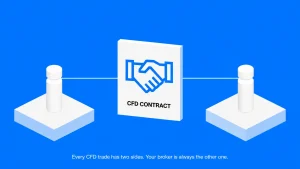
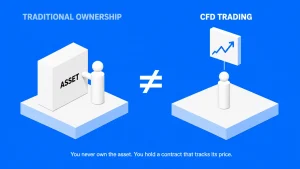
A Contract for Difference is a leveraged derivative: you agree with a broker to settle the difference between an asset price when you open a position and when you close it, with no ownership of the asset at any point. The leverage is what makes CFDs both powerful and demanding, since gains and losses are both calculated on the full position value rather than just the margin you put up. If you are new to the instrument, our in-depth guide to CFD trading covers the contract structure, margin mechanics, and cost calculation before you continue here.
How do CFDs Trading Work?
When you open a CFD, you choose a direction: long if you expect the price to rise, short if you expect it to fall. The position tracks the underlying market in real time, and your profit or loss is the price movement multiplied by your position size, settled in cash the moment you close. The core mechanics of margin, leverage ratios, spreads, and overnight financing are covered in detail in our what is CFD trading , so this article focuses on the practical steps that follow.
What are the Advantages of CFD Trading?
Before committing capital, it helps to know what CFDs offer over direct asset ownership. The main reasons traders choose them are leverage on smaller deposits, the ability to go short without borrowing the underlying, access to shares, indices, forex, commodities, and crypto from a single account, and positions that settle immediately in cash when closed. These are the characteristics that make CFDs suited to active, short-to-medium-term strategies rather than long-term investing.
What are the Risks of CFD Trading?
CFD trading is not suitable for everyone, and understanding the risks before placing a first trade is a regulatory requirement in most jurisdictions, not just good practice. The core risks to weigh are leverage amplifying losses beyond the deposit, counterparty exposure to the broker in an OTC market, automatic liquidation if margin falls below maintenance, gap risk on overnight positions, and the cumulative drag of spreads and financing on any strategy held over time.
Industry disclosures across regulated markets typically show that 63% to 80% of retail CFD accounts lose money. Losses can exceed deposits.
Each of these risks has a corresponding management tool, covered in the stops and limits section below.
What are the Costs of CFD Trading?
CFD trades carry explicit and implicit costs that quietly determine whether a strategy is profitable. The main cost categories are:
- Spread - the difference between buy and sell quotes, paid at entry.
- Commission - usually charged on share and ETF CFDs as a percentage of trade value or per-share fee; forex, indices, and commodities embed the cost in the spread.
- Overnight financing - charged daily on leveraged positions held past the broker’s cut-off, calculated as Position Size multiplied by (Benchmark Rate plus Broker Markup), divided by 365.
- Other fees - some brokers charge a premium for guaranteed stops or apply platform and inactivity fees.
On a position held for weeks, financing alone can absorb a meaningful share of gross profit, so understanding these costs shapes how an account is set up. Explore our different trading account types to understand the different cost structures.
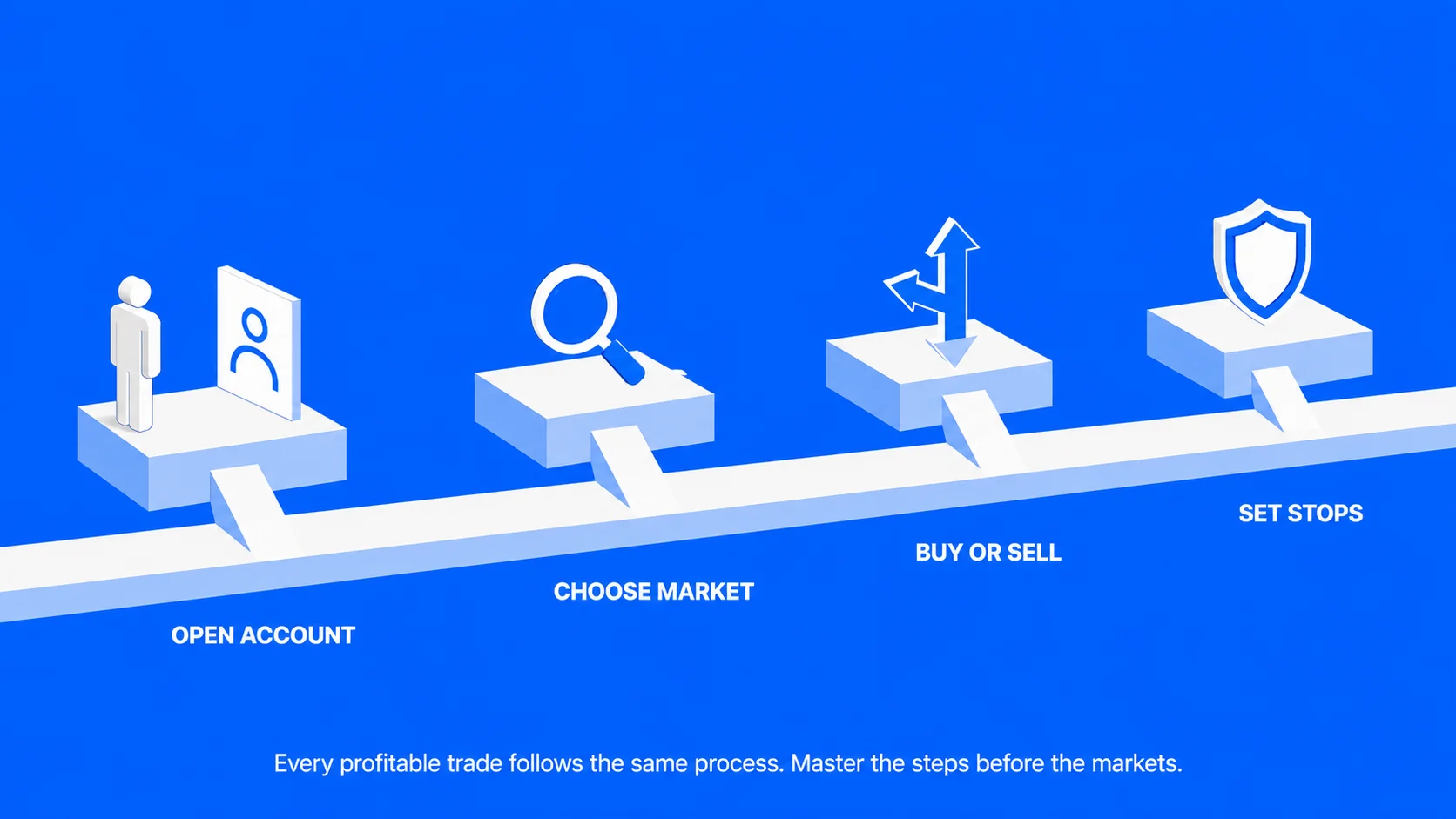
How to Open a CFD Trading Account
Opening a CFD account is straightforward, but regulated brokers must perform Know Your Customer (KYC) checks before allowing live trading:
- Complete the application - personal details and a trading experience questionnaire used to assess suitability.
- Verify identity - upload a government-issued ID and, where required, proof of address.
- Fund the account - deposit the minimum required and confirm withdrawal options.
- Practise on a demo - most regulated brokers offer a demo funded with virtual money for testing strategies before risking real capital.
Once the account is approved and funded, the next decision is which market to trade.
How to Choose Your Market and Timeframe
A single CFD account typically gives access to thousands of instruments across asset classes. The main categories are:
- Shares - individual companies on major global exchanges.
- Indices - benchmarks such as the FTSE 100, S&P 500, DAX, and Nikkei 225.
- Forex - majors, minors, and exotic pairs.
- Commodities - gold, silver, oil, and agricultural products.
- Cryptocurrencies - leading digital assets where regulators permit.
Timeframe matters as much as the instrument. Spot CFDs suit short-term trading because they have no fixed expiry, while futures CFDs better fit medium-term views. Matching the market to the timeframe sets up the next decision, which is direction.
How to Decide Whether to Buy or Sell
Going long means buying a CFD in the expectation that the underlying price will rise; the position becomes profitable as the price climbs above the entry. Going short is the mirror image: selling a CFD on the expectation that the price will fall, with profit accruing as the price drops below entry.
If a trader opens a long CFD on a major index at 5,000 and closes at 5,100, the gross gain is 100 points multiplied by the position size; reversed, a short at 5,000 closed at 4,900 gives the same gross gain. Either way, price must move beyond the spread before the trade turns profitable, so risk controls have to be set before the trade goes live.
How to Set Stops and Limits
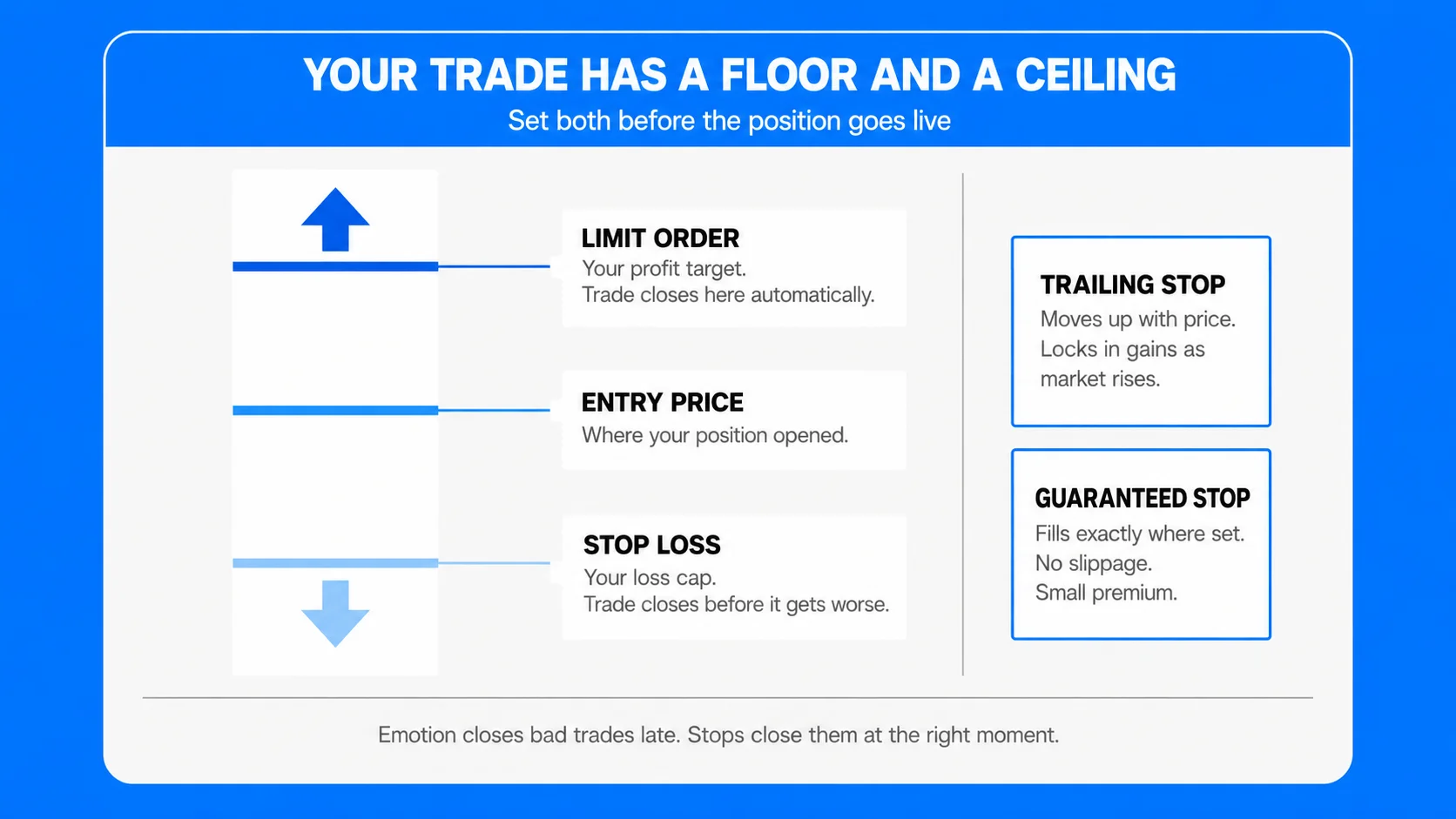
Stop and limit orders are the core risk-management tools in CFD trading, and they should be set the moment a position is opened. They automate the exit and remove emotion from the close decision:
- Stop-loss order - closes a position when price moves against the trader to a preset level, capping the loss.
- Limit order - closes the position when price hits the present profit target.
- Trailing stop - moves with the market in the favourable direction, then triggers if price reverses by a set amount.
- Guaranteed stop - for a premium, ensures closure at the exact level regardless of slippage or gaps.
Are stop-loss orders fail-safe?
Not entirely. Standard stops can suffer slippage in fast markets and may be skipped by overnight gaps, so a stop at 5,000 might fill at 4,985 if the market jumps. Guaranteed stops eliminate that risk for a small fee on triggered fills.
How to Monitor and Close Your CFD Trade
Once the position is live and the stops are set, the trader’s job shifts to monitoring. The platform shows the open position, running profit or loss, applied margin, and the distance to any stop or limit; checking these regularly is enough for most retail strategies, while intraday trading needs closer attention.
A position closes in one of three ways: manually on the platform, automatically when a stop or limit triggers, or through margin liquidation if the account falls below maintenance. Closure settles immediately in cash, with the net result credited or debited after spread, commission, and accumulated financing. Reviewing each closed position is what turns experience into improvement.
What are the Most Common CFD Trading Mistakes?
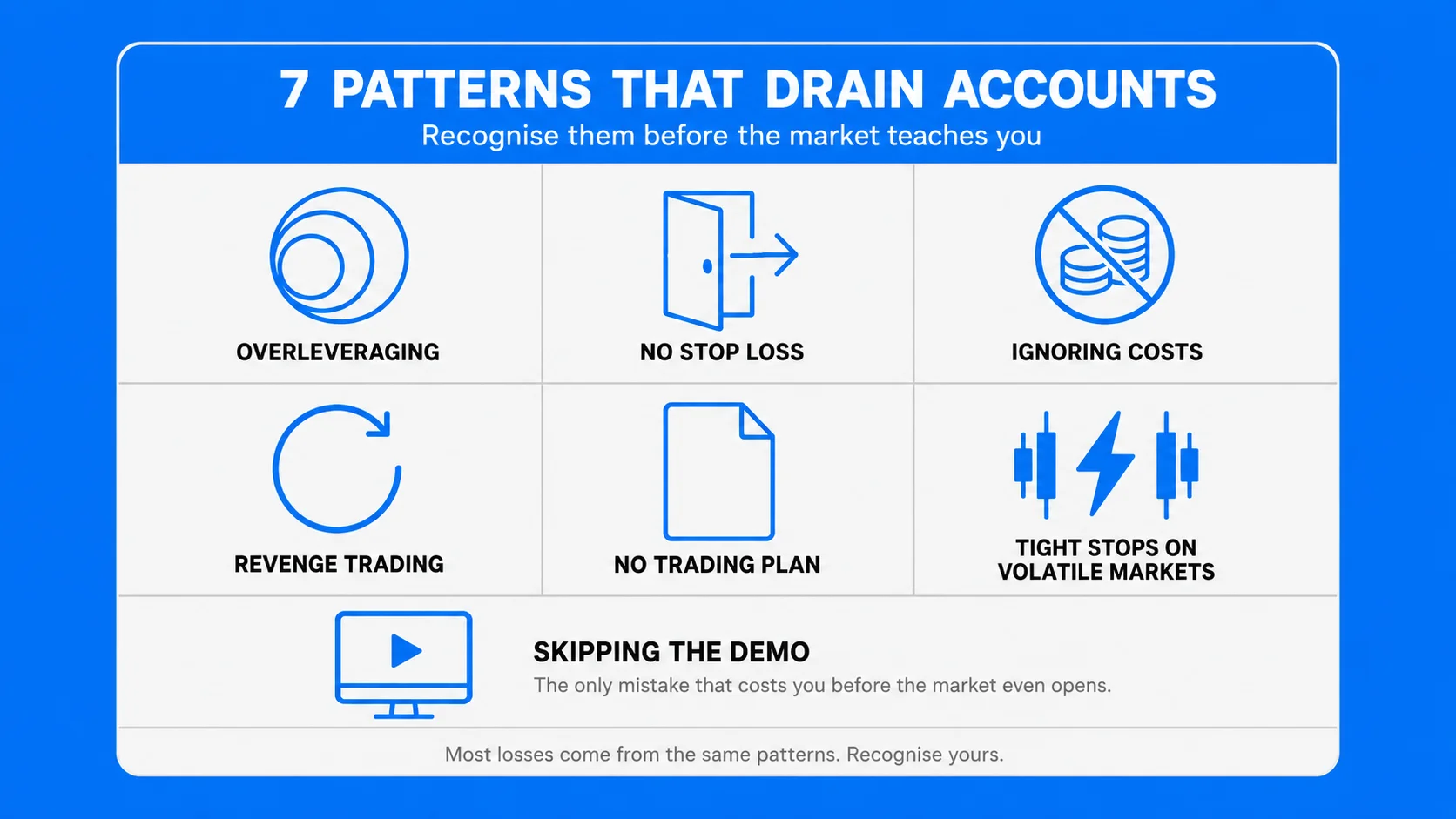
Most losses come from a small set of repeated errors rather than unusual market behaviour:
- Overleveraging - using maximum available leverage and exposing the account to wipeout on a small adverse move.
- Trading without stops - leaving positions open with no automated protection.
- Ignoring costs - underestimating how spread, commission, and financing erode returns.
- Revenge trading - chasing losses with larger, less considered positions.
- No trading plan - entering without entry, exit, and position-size rules.
- Tight stops on volatile markets - placing stops so close that normal noise triggers them.
- Skipping the demo - moving to live capital before strategies have been tested.
Avoiding these mistakes is one half of trading well; the other half knowing what is available to trade.
What Markets Can You Trade with CFDs?
CFDs span most major asset classes, which is why the same account can serve very different trading styles, from short-term intraday strategies on indices and forex to longer-term views on commodities or single shares. A full list of CFD markets is available on the broker’s website, with spread, leverage, and trading hours per instrument.
Why Trade CFDs with UEXO?
Once the process is understood, the decision narrows to where to apply it. The criteria worth weighing in any broker are regulation and oversight, transparent spread and commission structures, execution speed and platform reliability, and the depth of educational and risk-management resources.
UEXO offers a streamlined account-opening process, competitive trading conditions across global CFD markets, and a demo for testing strategies with virtual funds. Educational resources and platform tools follow the workflow described in this guide, from market selection through stop placement to closing the trade. Anyone ready to move from theory to practice can open a UEXO trading account and begin in the demo before going live.
Can I trade CFDs in the United States?
No. The U.S. Securities and Exchange Commission prohibits CFD trading for retail investors. Residents of other jurisdictions can trade CFDs through brokers regulated in their region, subject to local rules.
Do I need a lot of capital to start CFD trading?
No. Leverage allows positions to be opened with a small margin of deposit, often a few hundred dollars or equivalent, but smaller accounts also magnify the relative impact of costs and any losses, so prudent position sizing matters more than starting capital.
Conclusion
Trading CFDs profitably is less about predicting markets than applying a methodical process: understand the contract, respect the leverage, control costs, set stops before the trade goes live, and review every position once it closes. Doing all of this with capital one can afford to lose, after time on a demo, is what separates disciplined traders from the majority who lose money. With that foundation in place, the practical next step is to open a UEXO account, start in the demo, and only move to live funds once the workflow feels reliable.