Key takeaways
- The forex market is open 24 hours a day, five days a week: Sunday 22:00 UTC to Friday 22:00 UTC (21:00 UTC during US daylight saving) – Monday 02:00 to Saturday 02:00 in Gulf Standard Time, an hour earlier in Arabia Standard Time.
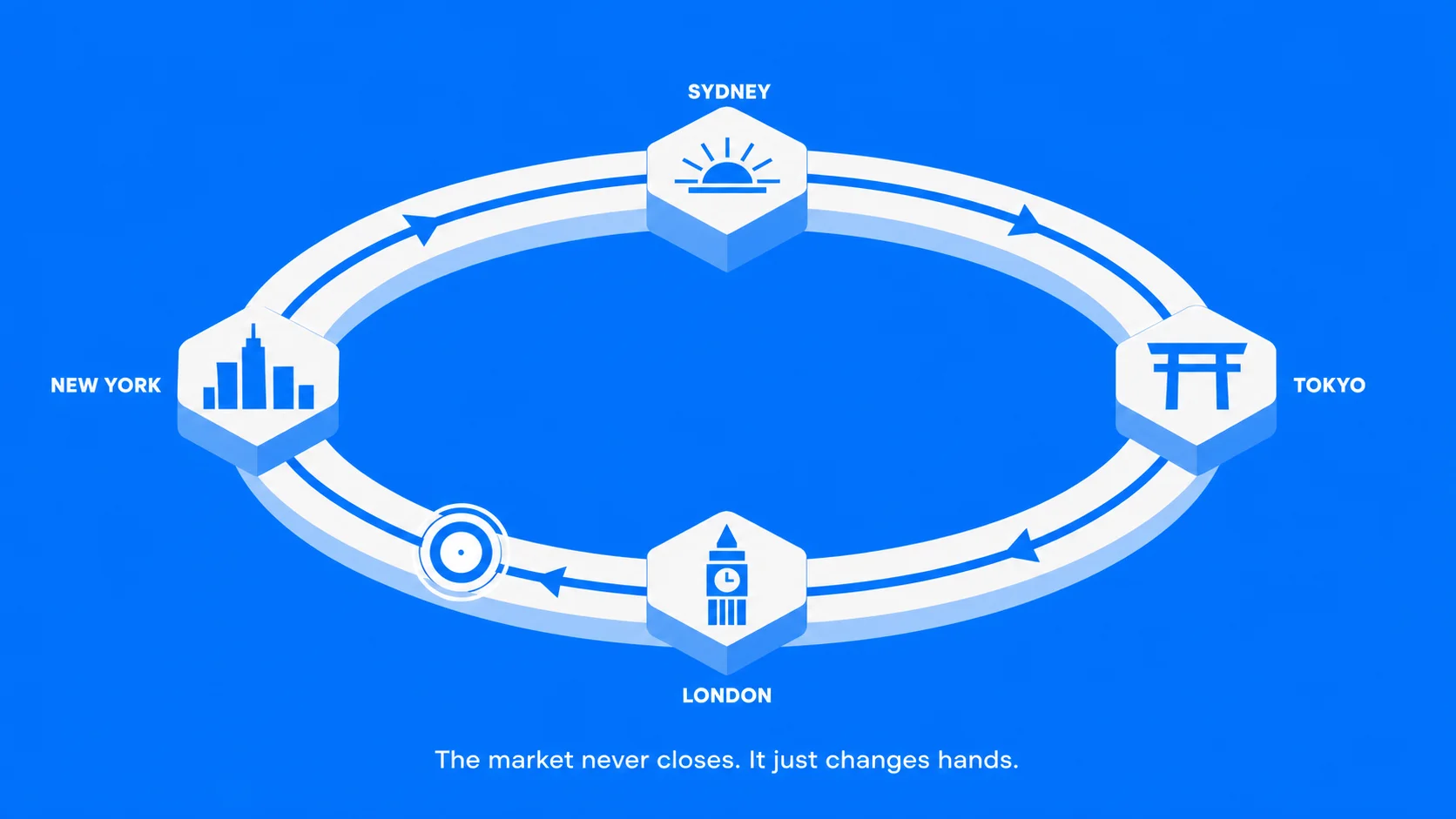
- Four sessions hand off in sequence: Sydney, Tokyo, London, New York, each running roughly nine hours.
- The London–New York overlap is the most liquid window of the day, and it falls conveniently in the MENA evening: 16:00–20:00 GST in northern summer and 17:00–21:00 GST in winter (15:00–19:00 and 16:00–20:00 AST).
- The thinnest hour is the daily rollover, 21:00–22:00 UTC – 01:00–02:00 GST, the middle of the Gulf night – when spreads widen and swaps are charged. Swap-free (Islamic) accounts remove the swap element of that cost.
- Session times shift twice a year with daylight saving; Tokyo is the only major centre that never moves. The Gulf states do not observe daylight saving either, so Gulf-based traders see the sessions move around them – Egypt and Morocco do change their clocks, which cancels part of the shift.
- The forex weekend does not match the local one. In most of the region the rest days are Friday and Saturday (Saturday and Sunday in the UAE), so Sunday is a working day with no market and Friday’s close arrives late on a day off.
Why Forex Trades 24 Hours
Forex is a decentralised, over-the-counter market: banks, institutions, and brokers trade currency electronically across the globe rather than through one exchange. Daily turnover reached $9.6 trillion in April 2025 according to the BIS Triennial Survey, up 28 percent from 2022 and larger than every other financial market. As business hours end in one financial centre, they begin in the next: Sydney hands to Tokyo, Tokyo to London, London to New York, and New York back to Sydney. London alone handles around 38 percent of global turnover, which is why its session sets the tone for the trading day; retail traders contribute roughly $242 billion daily, about 2.5 percent of the total.
The MENA region has no session of its own in this relay. Regional hubs such as the DIFC in Dubai, the ADGM in Abu Dhabi and the QFC in Doha are growing centres for institutional and retail flow, but their trading day sits between the Tokyo and London handoffs, which is why regional desks work to the London and New York clocks rather than to a local one.
The only scheduled break is the weekend, from Friday’s New York close to Sunday’s Sydney open, plus market-wide holidays such as Christmas Day and New Year’s Day. Prices still move while the market is closed, which is why weekend gaps appear at Sunday’s open.
The Four Forex Market Sessions
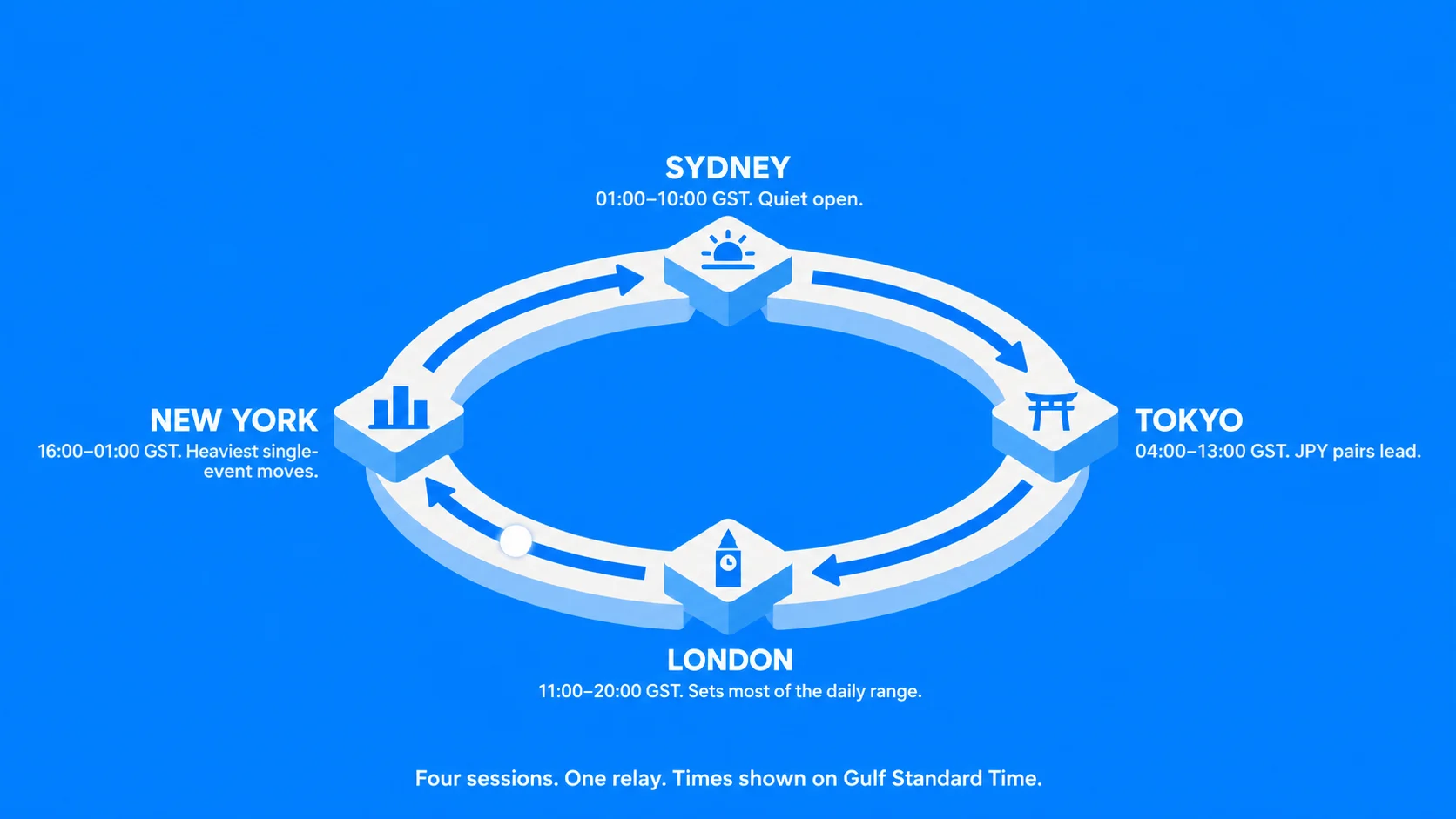
Session times shift by one hour when the UK, US and Australia change their clocks for daylight saving. Because no Gulf state observes daylight saving, those shifts move the sessions relative to your clock rather than the other way round. The table below gives UTC alongside Gulf Standard Time (UTC+4: UAE and Oman) for both halves of the year; Tokyo is the only major centre that never shifts.
| Session | UTC (Nov–Mar) | GST / UTC+4 (Nov–Mar) | UTC (Mar–Nov) | GST / UTC+4 (Mar–Nov) |
| Sydney | 21:00–06:00 | 01:00–10:00 | 22:00–07:00 | 02:00–11:00 |
| Tokyo | 00:00–09:00 | 04:00–13:00 | 00:00–09:00 | 04:00–13:00 |
| London | 08:00–17:00 | 12:00–21:00 | 07:00–16:00 | 11:00–20:00 |
| New York | 13:00–22:00 | 17:00–02:00 | 12:00–21:00 | 16:00–01:00 |
Converting for the rest of MENA: subtract one hour from the GST columns for Riyadh, Doha, Manama, Kuwait City, Baghdad, Amman and Sana’a (UTC+3). Subtract two hours for Cairo, Beirut, Tripoli and Khartoum in winter (UTC+2) – but Egypt, Lebanon and Palestine advance to UTC+3 from late April to late October, which keeps their evening trading window unchanged across the year. Subtract three hours for Tunis, Algiers and Casablanca (UTC+1), and a fourth during Ramadan, when Morocco reverts to UTC+0.
Sydney Session
The quietest of the four, Sydney opens the trading week – 01:00–10:00 GST in winter, 02:00–11:00 GST in summer, which for most of the region means overnight into the early morning. Ranges are typically tight and spreads slightly wider on non-Pacific pairs, so there is little reason for a MENA-based trader to lose sleep over it. The main scheduled activity is Australian and New Zealand economic data (RBA and RBNZ releases), so AUD and NZD pairs see their cleanest moves here.
Tokyo Session
Tokyo anchors the Asian trading day and runs 04:00–13:00 GST year-round, overlapping the start of the working day across the Gulf, the Levant and North Africa. Volatility runs higher than Sydney but well below London, with activity concentrated in JPY pairs and, to a lesser degree, AUD and NZD crosses. Bank of Japan decisions and Japanese data releases land in this window. Range-bound strategies tend to suit the Asian session; breakout traders often wait for London.
London Session
London is the largest forex centre in the world by daily turnover and the most volatile session. It opens at 12:00 GST in winter and 11:00 GST in summer – early afternoon in the Gulf, late morning in Cairo and mid-morning in Casablanca – which makes it the first session most MENA traders can follow without disrupting their working day. It overlaps Tokyo for its first hour or two and New York for its final hours, making it the only session that bridges two regional cycles. Most of the daily range on EUR/USD and GBP/USD is set here, and European data releases plus ECB and Bank of England decisions drive the sharpest moves in EUR, GBP, and CHF pairs.
New York Session
The second-largest session, running 17:00–02:00 GST in winter and 16:00–01:00 GST in summer – the Gulf evening, and for most traders in the region the only session available after work. US economic releases (Nonfarm Payrolls, CPI, FOMC decisions) generate the heaviest single-event volatility of the week, and USD is on one side of nearly 90 percent of all forex trades, so every major pair reacts. This matters doubly in the Gulf: the dirham, riyal, Qatari riyal and Bahraini dinar are pegged to the dollar and the Kuwaiti dinar tracks a dollar-weighted basket, so US data effectively sets the monetary backdrop for the region’s own currencies. The first four hours, while London is still open, carry most of the volume; the final hours after London closes thin out noticeably.
Session Overlaps: Where Liquidity Peaks
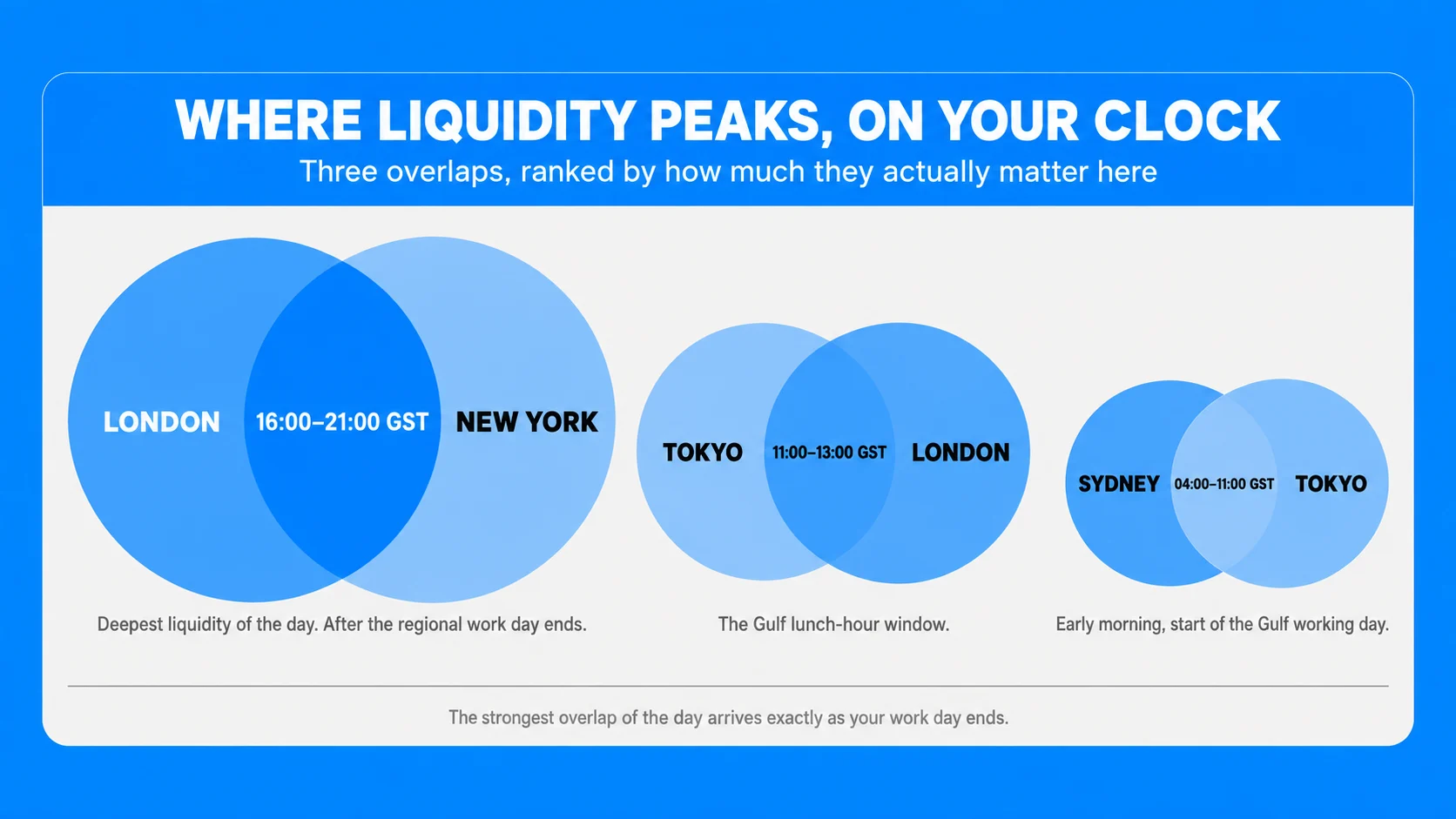
Overlaps are the windows when two centres trade simultaneously, and they matter more than the sessions themselves.
London–New York (17:00–21:00 GST winter, 16:00–20:00 GST summer; 16:00–20:00 and 15:00–19:00 AST; 15:00–19:00 in Cairo year-round). The most liquid four hours of the trading day, and the single strongest argument for trading forex from this region: peak global liquidity arrives after the regional working day ends. Both largest centres are active, spreads on majors compress to their tightest, and the biggest institutional flows go through. Most short-term traders concentrate on their activity here.
Tokyo–London (08:00–09:00 UTC in winter, 07:00–09:00 UTC in summer; 12:00–13:00 and 11:00–13:00 GST). A shorter, secondary overlap that lands around midday in the Gulf – the practical lunch-hour window for traders who cannot stay at the screen in the evening. Useful for catching the transition as European traders react to the Asian session, particularly on EUR/JPY and GBP/JPY.
Sydney–Tokyo (00:00–06:00 UTC in winter, 00:00–07:00 UTC in summer; 04:00–10:00 and 04:00–11:00 GST). The Asian-Pacific overlap, which covers the early morning and the first hours of the Gulf working day. Liquidity is moderate and concentrated in AUD, NZD and JPY pairs; volatility stays lower than the European windows.
Optimal Trading Times
The general rule: trade when the pairs you hold are backed by an open home session and prefer overlaps for anything short-term.
- Best overall window: the London–New York overlap – 16:00–21:00 GST depending on the season – for maximum liquidity, tightest spreads and the strongest trends on majors.
- EUR, GBP, CHF pairs: London session, especially the first two hours (from 11:00–12:00 GST) and the New York overlap.
- JPY, AUD, NZD pairs: Tokyo session and the Sydney–Tokyo overlap – 04:00–13:00 GST, the only major window that fits a pre-work or early-office routine in the Gulf.
- USD and CAD pairs: New York morning – 16:00–20:00 GST – when US and Canadian data are released. Oil-linked flows also matter here: WTI and Brent react to the weekly US inventory report on Wednesdays, 18:30 GST in northern summer and 19:30 GST in winter, and CAD moves with them.
- News traders: the minutes around scheduled releases. US Nonfarm Payrolls lands on the first Friday of each month at 17:30 GST in northern summer and 18:30 GST in winter, with CPI and FOMC decisions in the same evening band. Expect spread widening and slippage at the release itself.
The regional advantage is real. In New York the peak window is the morning and in Singapore it is the middle of the night, but from Dubai to Casablanca it falls between the end of the working day and a reasonable bedtime. A trader in the Gulf can hold a full-time job, sit down at 16:00 or 17:00, and still catch the deepest liquidity of the day and every major US release.
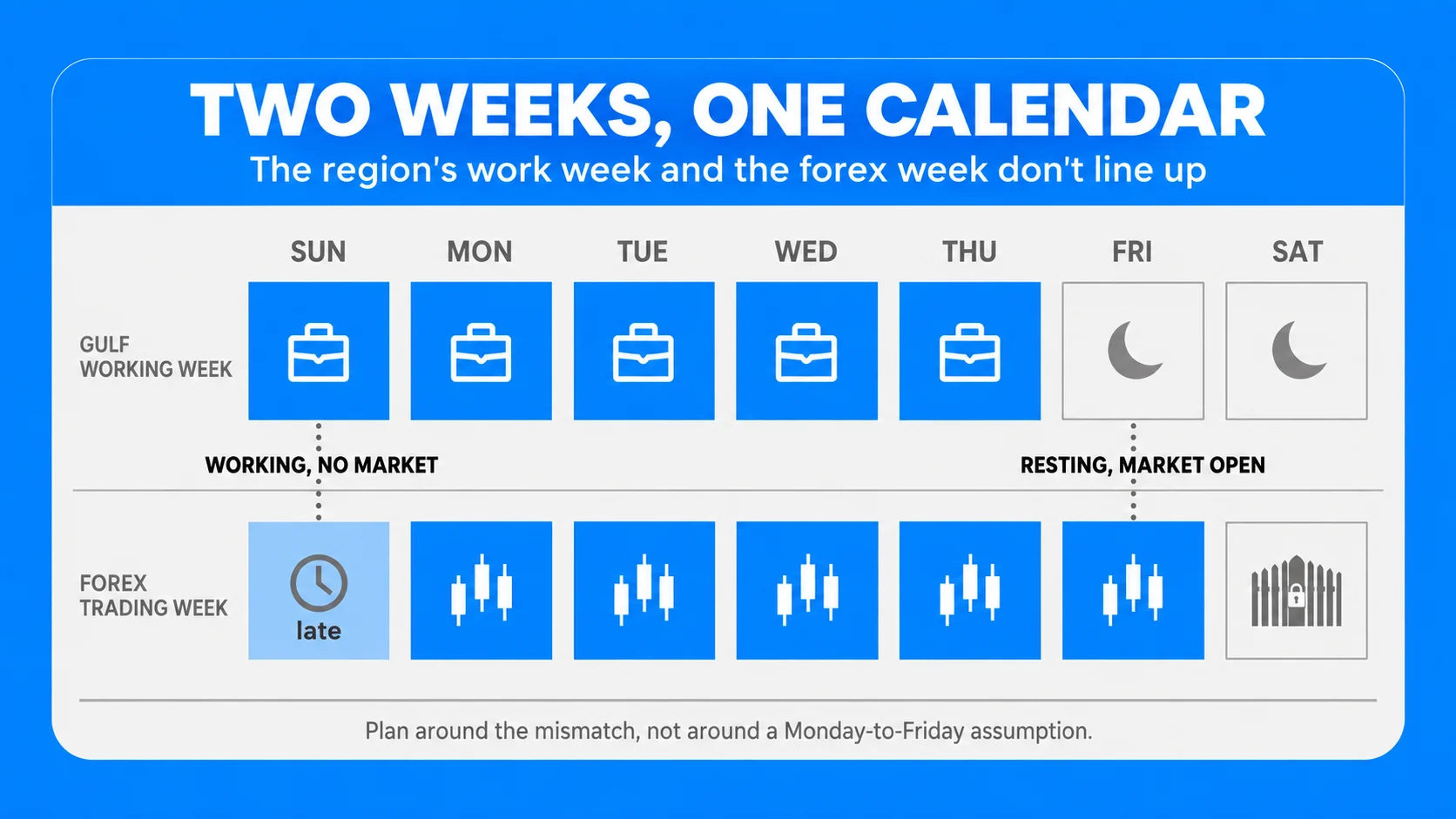
The trade-off is the weekly calendar. The market’s Sunday open arrives late on Sunday night GST, so the first working day of the week in Saudi Arabia, Egypt and Kuwait has no live market for most of its hours. Friday, a rest day across most of the region, is when liquidity drains and the week closes at 01:00 or 02:00 on Saturday morning. Plan position management around that mismatch rather than around a Monday-to-Friday assumption.
Times to Avoid Trading
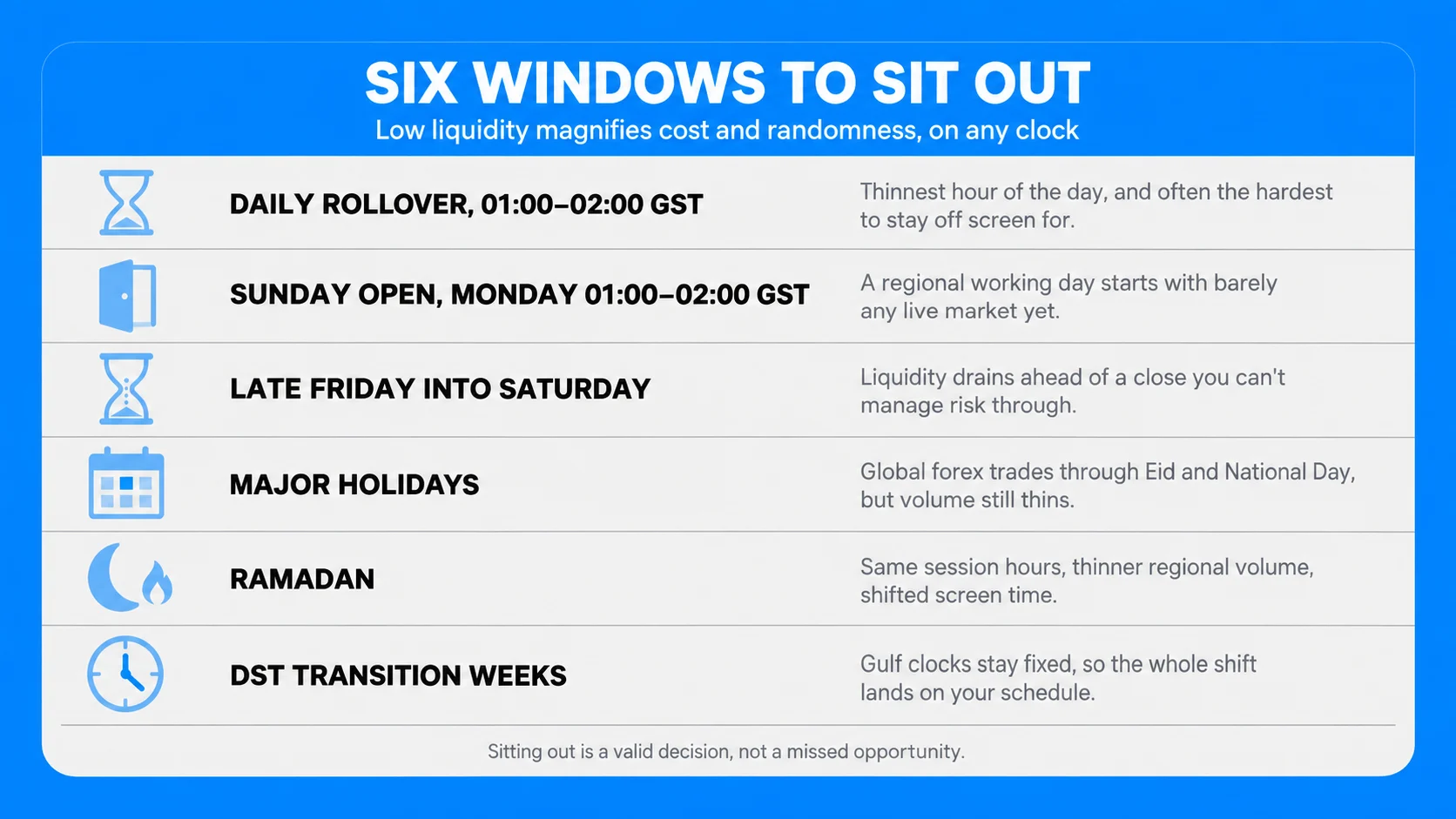
Low liquidity magnifies costs and randomness. The windows most traders sit out:
- The daily rollover (21:00–22:00 UTC; 01:00–02:00 GST, 00:00–01:00 AST). New York has closed, Sydney is barely open, spreads widen sharply and swap charges are applied. The thinnest hour of the day – and one that falls late at night regionally, which is exactly when a tired trader is most likely to be in front of the screen.
- The Sunday open, which for the region is Monday 01:00–02:00 GST. Weekend news gets priced in as a gap and spreads stay wide for the first hours. Note that the market does not open at the start of the Sunday-to-Thursday working week observed in Saudi Arabia, Egypt, Kuwait and Qatar.
- Late Friday, meaning Friday evening and the small hours of Saturday GST. Liquidity drains ahead of the weekend and holding through the close exposes you to gap risk you cannot manage for two days.
- Major holidays. Around Christmas and New Year, and on US and UK bank holidays, volume collapses even though platforms show prices. Regional holidays work the other way: global forex trades straight through Eid al-Fitr, Eid al-Adha and National Day, so a Gulf trader on leave still carries live market risk, while local banks and payment systems may be closed for funding or withdrawals.
- Ramadan. Global session times do not change, but regional working hours compress and many traders shift to late-evening and post-iftar activity. Volumes in regionally focused instruments thin out, and the London–New York overlap can collide with iftar depending on the season – worth planning for rather than discovering mid-trade.
- DST transition weeks. In March–April and October–November the US, UK and Australia change clocks on different dates, so overlaps temporarily shift or shorten by an hour. Gulf clocks stay fixed, so the entire shift lands on your schedule; Egypt, Lebanon and Morocco change on their own dates as well. Check your platform’s market-watch clock rather than assuming.
One more consideration for position traders: swap charges apply to positions held through rollover, and Wednesday rollover typically charges triple swaps to cover the weekend. This is the point at which timing and Sharia compliance intersect. Swap-free – commonly marketed as Islamic – accounts replace overnight interest with a flat administration fee or none at all, which removes the riba element and, incidentally, removes the triple-swap penalty from holding through Wednesday. If you trade multi-day positions from this region, confirm the terms before you need them: some providers cap the number of swap-free days, exclude exotic pairs, or apply the fee per lot rather than per position.
How to Track Sessions on Your Platform
MT4 and MT5 display server time, not your local time. Many brokers run server clocks on UTC+2 or UTC+3 so that daily candles align with the New York close – which happens to put the server within an hour or two of most MENA time zones, and exactly on local time in Riyadh, Doha, Kuwait City and Amman. Convenient, but do not assume it: a GST-based trader on a UTC+2 server is reading charts two hours behind the wall clock. Confirm your broker’s server offset once, then either add a session-indicator overlay to your charts or keep a session clock beside your trading platform. Volatility is visible directly on the chart: compare average candle ranges in the Asian window against the London open on any major pair and the session structure appears immediately.
Trading conditions also depend on your account: spreads quoted during the London–New York overlap differ meaningfully between commission-free and raw-spread accounts, so match your forex trading account type to the sessions you plan to trade. If you hold positions overnight, decide on swap-free terms at the same time.
Where you open the account matters too. Traders in the region typically deal with brokers licensed by the SCA or the DFSA in the UAE, the CMA in Saudi Arabia, the QFCRA in Qatar, the CBB in Bahrain, the CMA in Oman or the FRA in Egypt, and local licensing affects leverage caps, funding methods and how disputes are handled. Verify the licence covers retail forex for your country of residence rather than relying on a group-level claim.
A demo account is the zero-cost way to observe each session’s behaviour live before committing capital – run it for two weeks and watch the same pair at 06:00, 13:00 and 18:00 GST to see the difference for yourself.
What time does the forex market open and close in the UAE?
It opens on Sunday at 22:00 UTC with the Sydney session and closes on Friday at 22:00 UTC with New York (21:00 UTC for both when the US is daylight saving). In Gulf Standard Time that is Monday 02:00 to Saturday 02:00, or Monday 01:00 to Saturday 01:00 in the northern winter. Subtract an hour for Saudi Arabia, Qatar, Bahrain and Kuwait.
Is the forex market open on the Gulf weekend?
Partly, and this is the most common source of confusion in the region. Retail forex closes from Friday’s New York close to Sunday’s Sydney open, so Friday daytime is fully tradable even though it is a rest day in most MENA countries, while Sunday daytime is a working day with no live market. Interbank and crypto markets may move in the closed window, which is why prices can gap at the Sunday open.
What is the best time to trade forex?
The London–New York overlap -17:00–21:00 GST in winter and 16:00–20:00 GST in summer – offers the deepest liquidity and tightest spreads. The best time for a specific pair is when its home session is open.
What is the best time to trade forex in Dubai, Riyadh or Cairo?
Dubai and Abu Dhabi: 16:00–20:00 in northern summer, 17:00–21:00 in winter. Riyadh, Doha, Manama and Kuwait City: an hour earlier, 15:00–19:00 and 16:00–20:00. Cairo and Beirut: 15:00–19:00 for most of the year, because their own clock change offsets the European one. Casablanca and Tunis: 14:00–18:00. In every case that is late afternoon into evening, after the working day.
Does Ramadan affect forex trading hours?
Not the market’s hours – the four sessions run on their normal schedule. What changes is your side of the screen: shortened regional working hours, shifted sleep patterns and lower participation in regionally focused instruments. Many traders in the region move to post-iftar sessions, which overlap well with the New York afternoon.
Are swap-free accounts genuinely Sharia-compliant?
Swap-free accounts remove the overnight interest charge, which addresses riba, and that is why they are standard across the region. Whether a particular account structure satisfies your own requirements is a question for your provider’s documentation and, if it matters to you, your own religious guidance – the terms vary between brokers and some charge an administration fee in place of swaps.
Why are spreads wider at certain times?
Spreads reflect liquidity. During the daily rollover hour, the Sunday open, and holidays, fewer participants are quoting prices, so the gap between bid and ask widens. During major news releases, spreads widen because of volatility rather than absence of participants.
Do forex trading hours change with daylight saving time?
Yes. London, New York and Sydney shift their clocks on different dates, moving session times by an hour in UTC twice a year. Tokyo never changes, and neither do the Gulf states – so if you trade from the UAE, Saudi Arabia, Qatar, Kuwait, Bahrain or Oman, the sessions move on your clock while your clock stays still. Egypt, Lebanon, Palestine and Morocco do change, which partly cancels the shift. Verify your broker’s server offset after each transition.
Which session is most volatile?
London, by overall range, with the single sharpest moves clustering around US news releases in the New York morning – the Gulf evening, roughly 16:00–20:00 GST. Sydney, which falls overnight regionally, is the calmest.