What is trading?
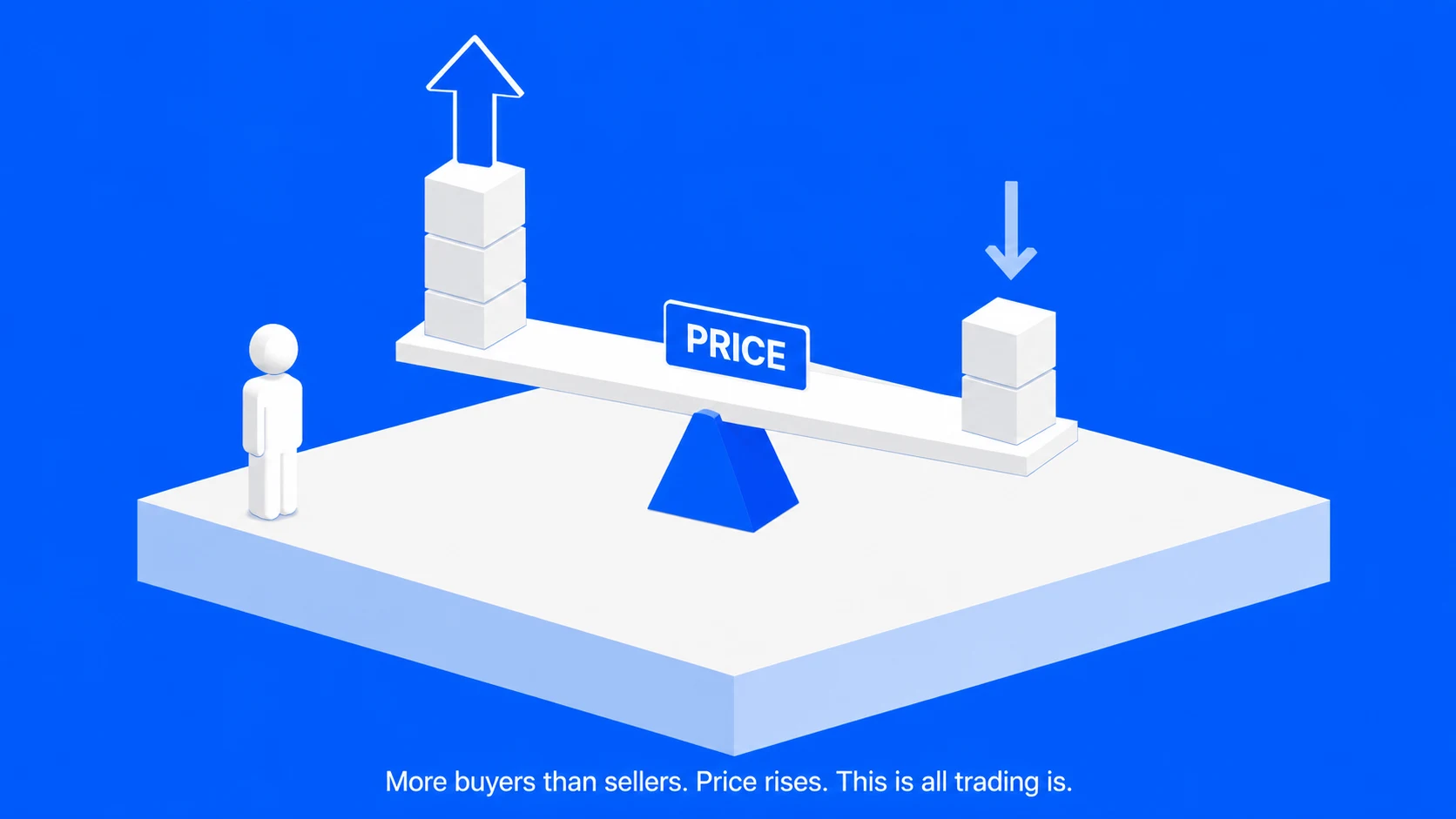
Trading means exchanging one asset for another (for example, cash for shares of a company) because the trader believes the asset’s price will move in a favorable direction in the future. Traders may hold positions for seconds, days, or months, but the basic idea is the same: buy at one price, sell at another, and keep the difference after costs.
Most modern trading occurs electronically on platforms that connect buyers and sellers, allowing them to transact quickly at current market prices. Traders use information such as charts, news, and economic data to decide when to open and close positions, and they manage risk using position sizing, stop-loss orders, and diversification.
How do Financial Markets Work?
Financial markets are organized systems, physical exchanges or electronic networks where financial instruments like stocks, bonds, currencies (forex), and commodities are issued and traded. They connect those who need capital (companies, governments) with those who have capital to invest (individuals, institutions), helping allocate money efficiently and enabling participants to buy and sell assets with ease.
Markets operate in two layers: the primary market, where new securities are created and sold for the first time (such as an IPO or a government bond issuance), and the secondary market, where existing instruments are actively traded between investors covering everything from equities on the NYSE to currency pairs on the global forex market.
Major Market Categories
| Market | What Is Traded | Structure |
| Stock Market | Company shares/equities | Centralized exchanges |
| Forex Market | Currency pairs (EUR/USD, GBP/JPY) | OTC, decentralized, 24/5 |
| Bond Market | Government & corporate debt | Mostly OTC |
| Commodity Market | Oil, gold, wheat | Exchanges & OTC |
Trading occurs either on centralized exchanges (with a transparent order book) or over the counter (OTC) directly between parties via dealer networks.
The forex market is entirely OTC, making it the world’s largest and most liquid financial market. A core function across all markets is price discovery where bids and offers continuously interact to establish fair prices alongside liquidity, which determines how quickly and cheaply positions can be entered or exited.
Price Discovery and Liquidity
A key function of financial markets is price discovery determining a fair price for an asset based on all available buy and sell orders at a given moment. In auction-style markets, buyers post bids (prices they are willing to pay) and sellers post asks or offers (prices they are willing to accept), and trades occur when these prices match.
Markets also provide liquidity, meaning the ability to buy or sell reasonably quickly without moving the price too much. High-liquidity markets such as major stock indices or major currency pairs typically have tight bid–ask spreads and large trading volumes, while less liquid markets may have wider spreads, larger slippage, and greater price gaps.
How do orders Work?
An order is an instruction you send to the market via your broker that tells the system what you want to buy or sell, how much, and under what conditions. When your order is matched with an opposite order (a buyer with a seller), the trade is executed, and a position is opened or closed in your account.
Core Order Types
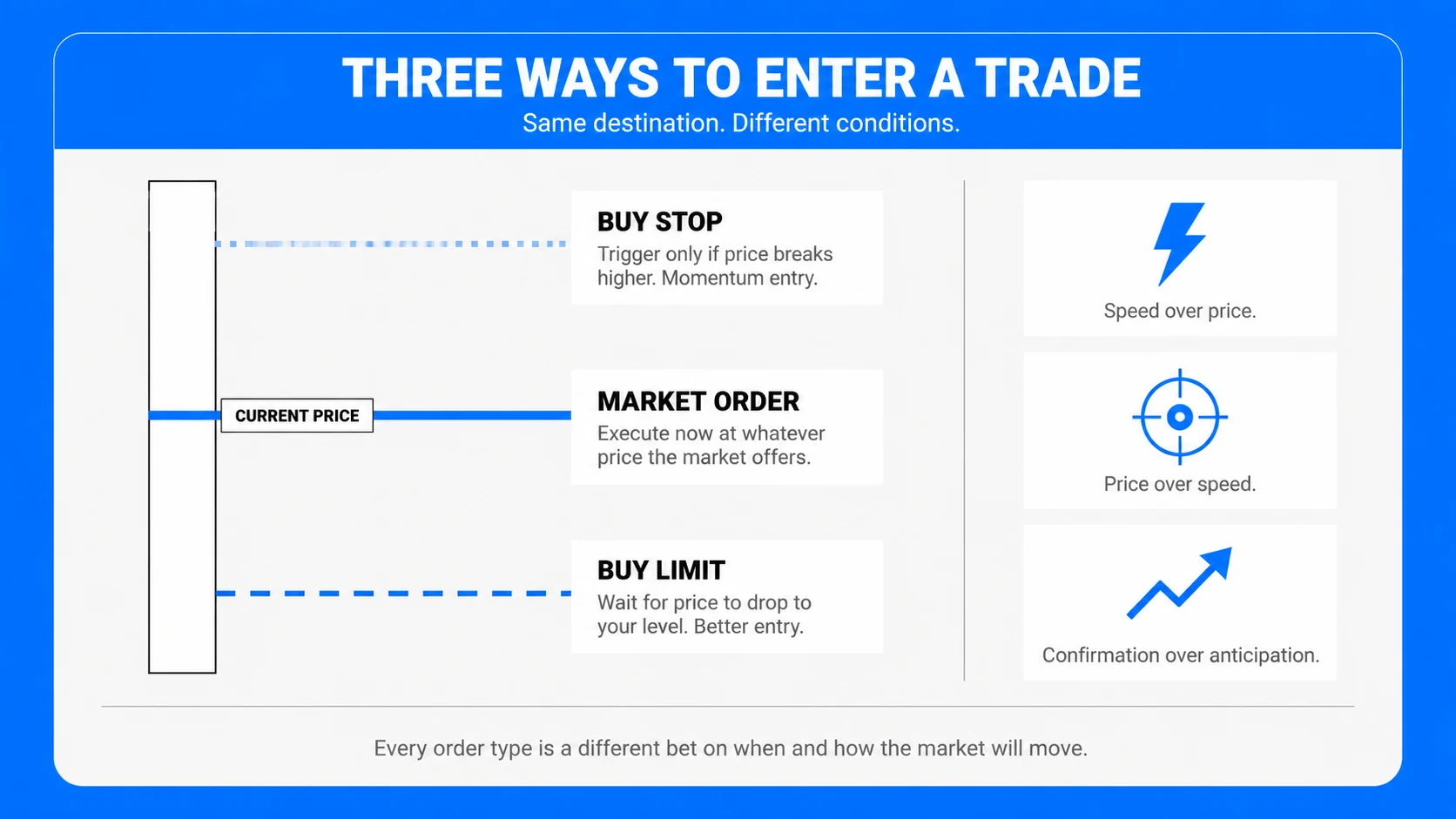
Regulators and educational bodies often highlight three foundational order types: market, limit, and stop (or stop-loss) orders.
- Market order: An order to buy or sell immediately at the best available current price. It prioritizes execution speed but does not guarantee the exact price you see, especially in fast-moving markets.
- Limit order: An order to buy or sell at a specific price or better. A buy limit order can only be executed at the limit price or lower; a sell limit order can only execute at the limit price or higher. This gives price control but may not be filled if the market never reaches your limit.
- Stop or stop-loss order: An order that becomes active once the price reaches a specified “stop” level; for example, a sell stop order below the current price can help limit losses if the market moves against you.
Traders may also use more advanced combinations (like stop-limit orders) and conditional orders to better control entry and exit, but most platforms build on these basic concepts.
Bid, Ask, and Spread
Every tradable asset typically shows two main prices: the bid (what buyers are willing to pay) and the ask (what sellers are willing to accept). The gap between these prices is called the bid–ask spread, and it represents a basic trading cost, since a trader effectively buys at the higher ask and sells at the lower bid.
In liquid markets, spreads tend to be small; in less liquid or more volatile markets, spreads can widen significantly, increasing transaction costs and the importance of order type selection.
How do Brokers Operate in Financial Markets?
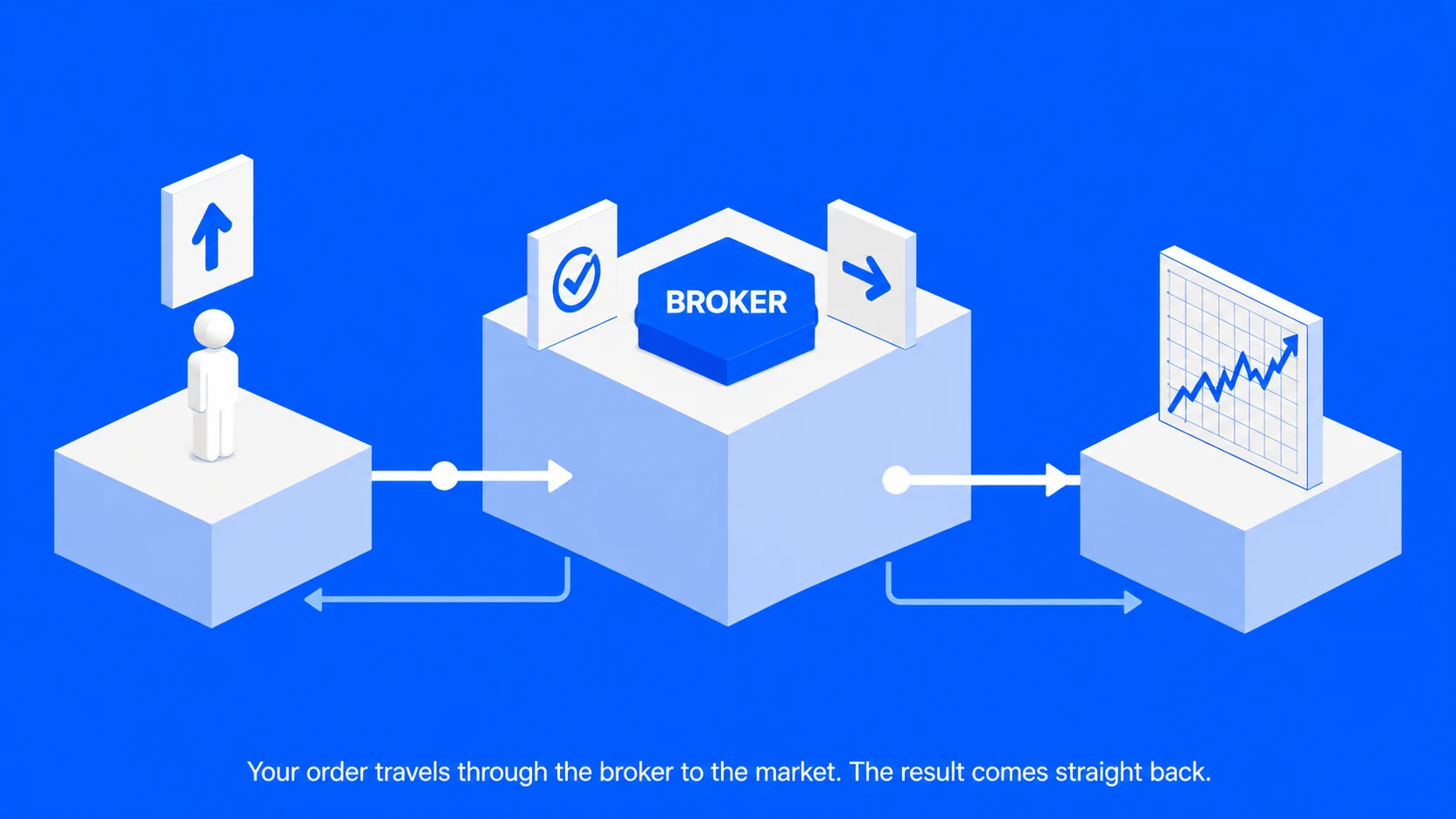
Brokers (or brokerage firms) are licensed intermediaries that provide access to financial markets, for instance (UEXO) routing your orders to exchanges or other liquidity providers and holding your assets in custody.
Historically, full-service stockbrokers offered personalized advice and trade execution for a relatively high commission, while today many traders use online or discount brokers that focus on low-cost order execution and digital platforms.
Brokers generate revenue in several ways, including commissions per trade, spreads on certain products, margin interest, and various platform or data fees, though many retail stock trades now have zero explicit commissions in some markets. They are typically regulated by national authorities and exchanges, which impose rules on capital requirements, client asset segregation, and fair dealing to protect investors and maintain market integrity.
Broker Roles in the Trade Lifecycle
When a trader sends an order through a brokerage platform, for instance UEXO, the broker’s systems validate the order, check for sufficient funds or margin, and then route it to an exchange, market maker, or internal matching engine. Once the order is filled, the broker updates the client’s account, reflecting the new position and any realized profit or loss, and later oversees settlement (the actual transfer of cash and securities between parties).
Some brokers also act as market makers in certain instruments, continuously quoting bid and ask prices and standing ready to buy or sell, which can improve liquidity but also means the broker may be the counterparty to the client’s trade. This model is common in foreign exchange and contract-for-difference (CFD) trading, while traditional stockbrokers often route orders to external market makers or exchanges under best-execution rules.
What is the difference between a centralized exchange and the OTC (forex) market?
A centralized exchange like the NYSE has a transparent order book where all buyers and sellers interact through one system. The forex market, by contrast, is entirely OTC — meaning trades happen directly between banks, brokers, and dealers in a decentralized global network, operating 24 hours a day, 5 days a week.
What happens if my limit order never gets filled?
If the market price never reaches the level you set, your limit order simply remains open or expires, depending on how you placed it. Unlike a market order, a limit order prioritizes your price over execution speed — so there is always a chance it goes unfilled in fast-moving or illiquid markets.
Can a broker trade against me?
In OTC markets, particularly forex and CFD brokers acting as market makers the broker may be the direct counterparty to your trade. This is a conflict of interest that regulators monitor closely. Exchange-based brokers, however, route orders to external markets and do not take the other side of your trade.
Key Takeaways for New Traders
New traders should understand that trading is not guaranteed profit; it involves real risk of loss, amplified when leverage is used. A solid foundation includes learning how financial markets function, how basic order types work, and how brokers connect you to the market, along with risk management practices such as sizing positions conservatively and using stop-loss orders thoughtfully.
It is helpful to start with education, practice on demo accounts if available, and treat early trading as a learning process rather than a quick path to wealth.