

Whenever someone new to trading sits down with me, I get the same question. What’s the indicator the pros use?
It’s a fair thing to assume. We’re taught that with enough data, the right model, or a complicated enough chart, we’ll eventually crack it. After two decades in this business, from bank trading desks to building a brokerage, I think the real answer is less technical and a bit more uncomfortable than that.
I used to say that clever people make the worst traders. It’s a neat line. It’s also not really borne out by the evidence, so let me walk through what is.
What the evidence actually says
Mark Grinblatt, Matti Keloharju, and Juhani Linnainmaa did something a bit unusual. They took intelligence test scores from Finnish military conscription, matched them against the actual trading records of those same men, and published the results in the Journal of Financial Economics in 2012.
The higher scorers were less likely to sit on losers and dump winners. They timed entries better, picked better, and got better prices when they traded. On nearly every measure, being smart helped.
So, the old line doesn’t really hold up. There’s one exception, though, and it’s an expensive one.
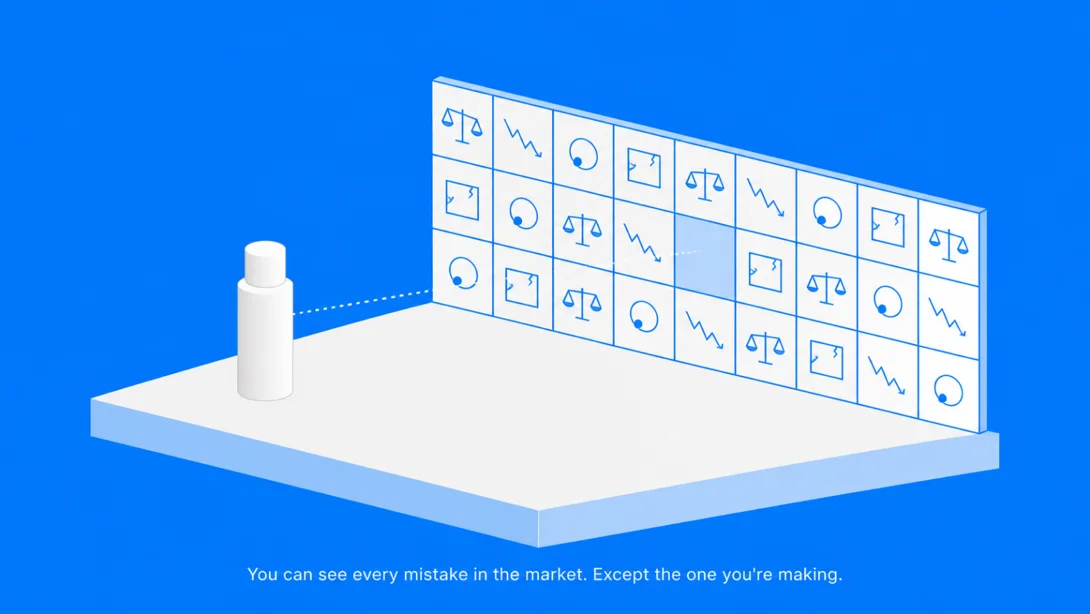
Richard West, Russell Meserve and Keith Stanovich looked at something called the bias blind spot. It’s the habit of spotting thinking errors easily in other people and not at all in yourself. Their 2012 paper in the Journal of Personality and Social Psychology found that cognitive ability did nothing to shrink these blind spots. If anything, the people who scored higher tended to have bigger ones.
That’s the finding I’d hang onto. Being smart seems to help with most trading mistakes. What it doesn’t help with is spotting the one you might be making right now.
Here’s how that shows up.
Being right is a work habit that doesn’t travel well
If you’ve built a career as an engineer, a lawyer or a founder, you’ve been rewarded for building a case and defending it. Gather the facts, make the argument, win.
Markets don’t concede arguments. When a position moves against a capable person, the first instinct is usually to defend the idea rather than the money, which is very human and very costly.
They add to the position. They wait for the market to come round.
There’s a name for this. Hersh Shefrin and Meir Statman called it the disposition effect back in 1985: we hang onto losing positions too long and close winning ones too early. Worth noting that the Finnish data found high-IQ investors were less prone to it. So, this is less about intellect and more about ego, which is a different thing entirely.
The best traders I’ve worked with weren’t right more often than anyone else. They were just quicker to admit when they weren’t.
Complexity can feel like rigor without actually being it
Capable people like intricate systems, partly because simple ones feel too easy to be worth much.
I’ve watched traders bury a chart under so many moving averages, oscillators and retracement lines that the price itself gets hard to find. The setup ends up so elaborate that it stops producing decisions.
And it costs real money. Brad Barber and Terrance Odean examined 66,465 households at a large discount broker between 1991 and 1996. The ones who traded most earned 11.4 percent a year while the market did 17.9 percent. The title of their paper says it: trading is hazardous to your wealth. They put the gap down to overconfidence, and the mechanism isn’t complicated, since more trading means more cost.
The consistently profitable traders I’ve known run setups that look almost dull. The effort goes into risk and execution, not into hunting for a better formula.
Leverage changes the math, not the analysis
Smart people tend to treat leverage as an intellectual tool. If the idea is good, size it up. But leverage doesn’t respond to how good your idea is. It only responds to how much room you’ve left yourself while the market takes its time agreeing with you.
Understanding a market gives you an advantage. Managing leverage is what keeps that advantage working over time.
Capable traders often use leverage to scale a strong idea, and in the right proportion it can be a useful tool. The key is remembering that even excellent analysis cannot remove short-term uncertainty. Liquidity gaps, unexpected headlines and sudden volatility can move price before the market has time to validate your reasoning.
Used carefully, leverage can improve capital efficiency and increase exposure to opportunities. But if position size becomes too large, even a relatively small move against you can create a disproportionate loss. The more leverage you use, the less room you leave for normal market volatility and unexpected events.
Real control in trading does not come from predicting every move correctly. It comes from sizing positions so that one wrong call remains manageable, your capital stays intact, and you are still in a position to benefit when your next good idea arrives.
More information isn’t more edge
Open any feed and you’ll find a few hundred confident opinions on the next central bank decision or where gold’s heading.
The instinct is to read all of it. The evidence suggests the attention itself is the trap.
Barber and Odean also found that individual investors are net buyers of whatever is grabbing attention: stocks in the news, ones with unusual volume, ones with big single-day moves. What feels like research is often just following whatever’s loudest.
Conviction doesn’t come from reading fifty opinions. It comes from a tested plan and the discipline to stick with it when the screen goes red.
Certainty is usually a warning sign
In most jobs, certainty gets rewarded. Clients want guarantees, and employers want confident answers.
In trading, it works against you. The moment you’re sure a position will work is the moment you stop managing it, stop looking for the thing that would prove you wrong, and stop asking whether your size still makes sense.
Which is roughly where the bias blind spot research lands. The traders most exposed often aren’t the careless ones. They’re the ones whose success elsewhere has taught them to trust their own judgement, which is a sensible lesson nearly everywhere except here.
Humility isn’t modesty. It’s a risk control.
What that meant for how we built UEXO
When we built UEXO for a global audience, this is the part we kept coming back to.
What we could control was friction: execution quality, costs you can see, and account structures that don’t hide what trading really costs. Trading is hard enough on your head. The infrastructure shouldn’t make it harder.
You don’t need an unusual IQ to trade well. The Finnish data suggests intelligence helps a bit at the margins. What it won’t give you is the willingness to be wrong quickly, and that turns out to be the part that counts.
It’s also why our account structures are built the way they are: to make being wrong survivable rather than terminal. The judgement stays yours. We just try not to get in the way of it.
Trading foreign exchange and leveraged derivatives (CFDs) involves significant risk and is not suitable for all investors. Leverage increases both gains and losses. You do not own the underlying assets and may lose all invested capital. This article is general information rather than personalized financial advice and does not take account of your individual objectives or circumstances. Past performance does not guarantee future results.




